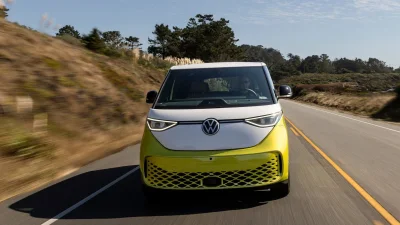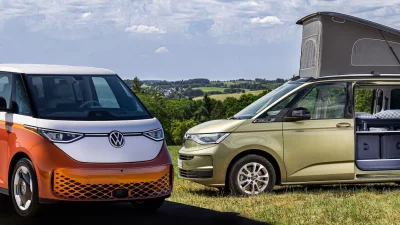
Volkswagen once considered a range-extender version of the ID. Buzz, but tight overhangs and the EV-dedicated platform made it impossible.
The fully electric ID.
Buzz hasn't found the audience VW hoped for in North America, prompting the company to weigh drastic options.
Stefan Mecha, CEO of VW Commercial Vehicles, told Go Auto that a combustion-engined variant had been on the table.
“I would not be telling the truth if I said we have not looked at this. Is this a feasible exercise?
Probably not… I think from this end, the ID. Buzz is an electric vehicle and it will stay an electric vehicle,” he said.
The van's short overhangs and EV-only MEB architecture left nowhere to place a range extender. Shoehorning in a combustion engine would have required an expensive redesign.
VW sold 60,700 ID. Buzz vans in 2025, double its 2024 tally.
North America accounted for just 6,140 units, leading VW to skip the 2026 model year to clear leftover stock.
The EV returns to the US for 2027 with minor updates and a camping-friendly trim.
One Platform to Rule Them All
In the same interview, Mecha outlined a structural overhaul to address what he called “costly platform fragmentation” across the LCV portfolio.
VW currently relies on four separate platforms: MQB for the Caddy and Multivan T7, MEB for the ID.
Buzz, Ford-based underpinnings for the Transporter T7, and a bespoke chassis for the Crafter.
To streamline manufacturing and R&D, Volkswagen will retool its Hanover plant and develop a new common architecture called the Space platform.
It will underpin the next-generation Caddy, Multivan, and Transporter, and supply components for the next Crafter.
Mecha said commercial buyers are moving to fully electric vans more slowly than expected, leaving VWCV on the hook for carbon emissions penalties.
The Space platform was conceived as an EV architecture but is being adapted to take hybrid powertrains.
Before the new platform arrives, VW is expanding its electric LCV lineup.
A successor to the e-Crafter, sold between 2018 and 2022, is in the works, likely offering longer range to rival the Ford e-Transit and Renault Master E-Tech.
The automaker is also considering a zero-emission variant of the Caddy. The current generation debuted in 2020 and received a facelift in mid-2026, offering diesel and PHEV options.
It remains unclear whether the e-Caddy will use an electrified MQB architecture or jump to MEB.