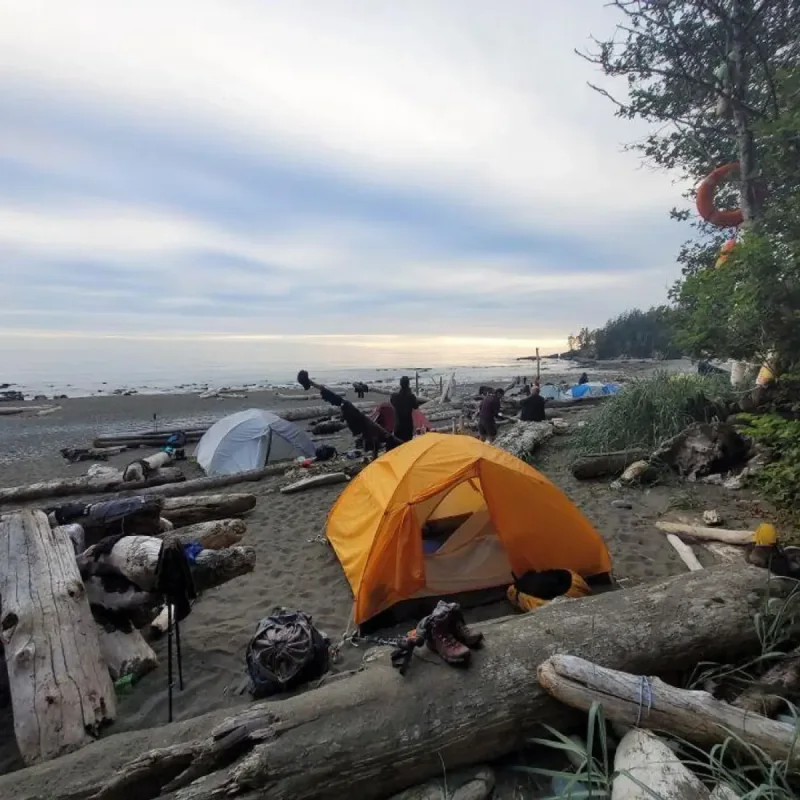
More than 70 hikers were evacuated from Vancouver Island's West Coast Trail after torrential rains flooded waterways and made sections impassable between Saturday and Tuesday.
Parks Canada reported that persistent heavy rainfall caused creeks and rivers to swell significantly along the 75-kilometer trail.
Officials responded to a high volume of evacuation requests and advised hikers against attempting foot crossings over flooded waterways.
With additional rainfall forecasted through Wednesday, July 29, Parks Canada recommended that hikers with reservations between July 27 and August 1 delay their start dates until at least Thursday, July 30, or request a full refund.
Hikers Describe Treacherous Conditions
Hiker Patrick Laprise, who traveled from Montreal with his 15-year-old son, described the conditions between Bamfield and Nitinaht Narrows as catastrophic after enduring nearly 44 hours of continuous rain.
"It was hard to keep the essential stuff dry," said Laprise.
Laprise noted that his group faced swollen creeks, deep mud, and damaged infrastructure before choosing to evacuate when a charter boat arrived at Nitinaht Narrows.
"It's frightening kind of in those conditions, because we had to move fast, we were super cold, like there's nothing, nobody that can help us," said Laprise.
He added that multiple hikers gathered at the trail's midpoint seeking transport out of the area due to injuries and mechanical failures on the route.
"A teenager that was on the trail broke his wrist, my son turned his ankle, an adult at the Crabshack had ruined his knee.
And then all those people that were soaked and stuck had to evacuate, mostly because of a broken cable car," said Laprise.
According to Laprise, cable car operations across Carmanah Creek became difficult to manage, while rising tides interacted unpredictably with swollen waterways.
"But then also there were all the creeks that are flooded, and they interact with the tide and evolve so you don't know when it will be passable," said Laprise.
Ferry Operators and Local Guardians Assist Evacuations
Ferry operators Carl and Shelley Edgar, owners of Nitinat Wilderness Charters and the floating Crab Shack restaurant, handled the transport of stranded hikers from the trail.
Carl Edgar noted that a July storm of this severity was unprecedented in his 51 years running the charter service.
"Everyone came in and they were soaking wet from top to bottom, not a dry spot on any of them, and they're just piling up at our Crab Shack dock right now," said Carl Edgar.
As ferry boats continued picking up stranded groups, additional water taxis were dispatched to meet the influx at the dock.
"And there's still more coming, my son is coming up with a boat as we speak," said Carl Edgar.
Shelley Edgar stated that their business usually assists four to eight evacuees per week, but the recent weather surge required coordination with shuttle bus operators to reroute dozens of stranded travelers.
"It's been pretty mind boggling," said Shelley Edgar.
Kim Dayman, a visitor from Regina, opted to abandon her planned hike to Gordon Bay on Sunday after trail conditions deteriorated rapidly near Darling River.
"It was raining when we were setting up camp and everybody just basically stayed in their tents and went to sleep, at four o'clock in the afternoon," said Dayman.
Dayman and her group attempted an early departure the following morning to navigate the trail before water levels crested further.
"When we were hiking the trail on the Sunday, it was like water up to your mid-shin through the entire trail," said Dayman.
She expressed disappointment over cutting the trip short after traveling from Saskatchewan, while acknowledging that high tide made continuing unsafe.
Local Indigenous guardians and bus companies also adjusted operations to support the influx of evacuees.
Edward Johnson of the Huu-ay-aht First Nation executive council noted that guardians monitored Darling Creek to instruct hikers against crossing.
"A lot of times the trail can turn into a creek itself, a little bit more mud," said Johnson.
Johnson emphasized the unpredictable nature of extreme weather along the coastal terrain.
Other visitors chose to turn back early after witnessing coastal erosion and hazardous path conditions firsthand.
Heather Millar, a 61-year-old hiker from Victoria, decided to return to the Crab Shack on her second day on the trail.
Despite the abrupt end to her trek, Millar indicated plans to attempt the 75-kilometer trail again under improved weather conditions.
"I'm looking forward to hitting the West Coast Trail and doing the whole thing next year in good, sunny weather," said Millar.
Parks Canada stated that travelers remaining on the trail must be self-sufficient and prepared to wait out high water levels for several days or self-evacuate through their starting point or Nitinaht Lake.