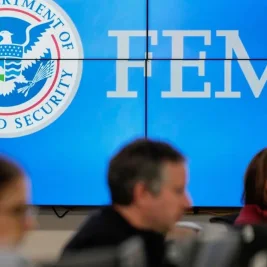
The Trump administration is attempting to rebuild the federal election security infrastructure at the Cybersecurity and Infrastructure Security Agency (CISA) less than 100 days before the 2026 midterm elections.
Internal federal documents obtained in July 2026 indicate a push following major staff reductions and organizational overhauls at the Department of Homeland Security agency.
State and local officials have been scrambling to fund private security vendors and manage cyber defenses independently.
New Operational Plan
Under the new operational plan outlined to Capitol Hill staff, remaining CISA employees are being reassigned to act as liaisons to state and local officials.
They will utilize security protocols similar to those deployed during the World Cup.
However, state election administrators and bipartisan lawmakers caution that the late-stage federal reorganization may arrive too late to effectively support local voting infrastructure before mail-in balloting begins.
Sarah Copeland Hanzas, Vermont Secretary of State, said, "This was all supported by federal agencies.
Now we’ve got to figure out how we can share that — with some duct tape and, you know, maybe a bungee cord or two."
In response to concerns, agency leadership maintains that voluntary technical assistance and threat-monitoring resources will remain accessible to election jurisdictions nationwide.
Nick Andersen, CISA acting Director, said, "Will further offer to states the cyber resources they need, including information about available no-cost voluntary services such as the sharing of threat information, technical expertise, vulnerability scanning, and other risk mitigation support."
Despite the new measures, election security experts note that a multi-month intelligence gap exists due to the earlier dismantling of CISA's specialized regional adviser network.
Geoff Hale, former CISA election security official and visiting fellow at the Center for Democracy and Technology, said, "We are well until the election cycle.
It is not simply about Election Day. Election Day is not when the Russians started in 2016.
It is not when the Iranians started in 2020. People should be realizing we have a gap of information of 14 to 18 months."
Bipartisan Support Surges
Bipartisan support on Capitol Hill has recently surged to restore funding and staffing to CISA, driven by emerging concerns regarding artificial intelligence-powered hacking capabilities against national infrastructure.
Key House leaders on oversight panels have publicly urged Congress to abandon delays and re-invest in the agency's primary operational capacity.
Representative Don Bacon, Chair of the House Armed Services Subcommittee on Cyber, Innovative Technologies and Information Systems, said, "PowerPoint is not capability."
Lawmakers emphasizing the urgency of defense capabilities argue that workforce cuts directly compromise protection across energy, public utility, and election networks.
Bacon added, "I’m a big proponent of CISA.
If you don’t like what it’s doing, get new leadership; don’t fire a third of its people … because they’re the ones who defend our private sector, our energy grid and our elections."
Members of the House Homeland Security cyber subcommittee who previously supported budget limitations have shifted their stance due to foreign technological competition.
Representative Andrew Garbarino said, "Unfortunately, I have colleagues that focus on the mis- and disinformation part of CISA, and that has turned them off to the entire agency."
Congressional leaders maintain that maintaining national security against foreign adversaries requires sustained federal technology investments.
Representative Nick LaLota said, "The future battlefield will be shaped by artificial intelligence, autonomous systems and cyber capabilities.
Congress must ensure America stays ahead of our adversaries by investing in the technologies, infrastructure, and workforce needed to defend our nation."
Concurrently, external activist groups led by former local officials have submitted alternative proposals directly to federal agencies, requesting hand-counted paper ballots and the elimination of machine tabulators ahead of November.
Tina Peters, former Mesa County Clerk, said, "CISA is not a forceful body that they can make people do things, but they can actually make recommendations."
Peters further noted that recent executive meetings covered broader systemic changes to federal election advisory bodies.
"If we don’t fix these machines, if we don’t get rid of these machines, we’re going to lose the next election," she said.
State election administrators continue to rely on self-funded local partnerships and inter-state coordination platforms while awaiting CISA's public resource roadmap scheduled for release in August 2026.