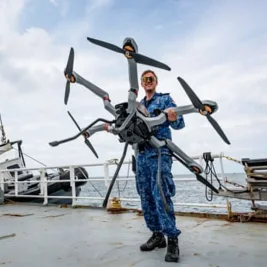
Naval forces from Britain, the United States, and Australia have wrapped up Exercise Lanternfish 2026, a six-week joint trial of autonomous underwater technology.
The exercise took place across Virginia, Washington state, and Western Australia, focusing on protecting critical seabed infrastructure.
Conducted under Pillar 2 of the AUKUS security pact, the drills tested detection, monitoring, and response to subsea threats using networked autonomous systems.
Military units and private defense firms evaluated uncrewed vehicles and sonar arrays in realistic operational environments.
During the exercise, Anduril's Seabed Sentry nodes worked with Ultra Maritime's Sea Spear deployable sonar array to track uncrewed submersibles moving through a channel.
The system classified the targets and sent tracking data to an operator screen in the Navy's Unmanned Operations Center within seconds, without human intervention.
The Royal Navy deployed personnel from its Diving and Threat Exploitation Group to operate the VideoRay Defender-Viper remotely operated vehicle for mine detection.
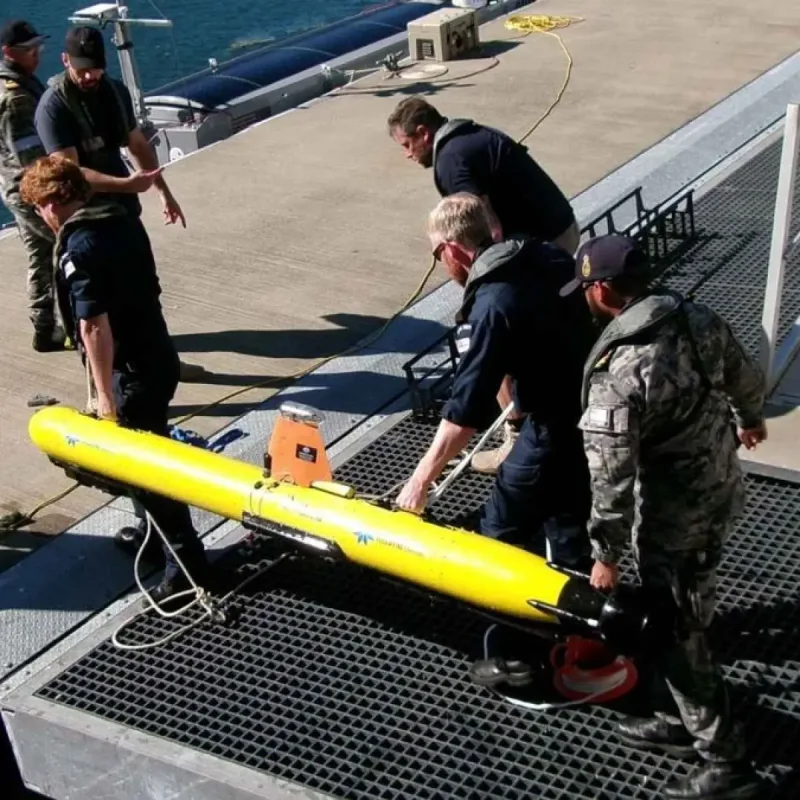
Hydrographic specialists from the Devonport-based Hydrographic eXploitation Group also launched the modular Teledyne Gavia autonomous underwater vehicle for seabed surveillance and acoustic calibration.
Lt Cdr Mark Wilton, from the Hydrographic eXploitation Group, highlighted the integration achieved between participating nations.
"Our Seabed Warfare team worked extremely closely with our AUKUS partners, demonstrating true integration through the seamless use of Royal Australian Navy equipment when required," Wilton said.
He noted that his unit executed several complex operations in the field using the autonomous submersibles.
"We completed a number of Gavia missions on the exercise – acoustic calibration, night-time and independent, unaided.
The team really delivered and their qualified and experienced personnel have grown exponentially," Wilton added.
The exercise follows heightened security concerns over subsea communications cables and energy pipelines, amid recent foreign naval activity near European waters, including Russian submarine deployments monitored by allied forces in the High North and the English Channel.
Commodore Marcus Rose, Deputy Director Defence Underwater, emphasized the role of joint exercises in refining allied maritime capabilities.
"These events provide a fantastic opportunity to test our interoperability in a real world setting and allow us to iterate our capabilities at pace," Rose said.
The trial marks a key step toward deploying shared autonomous payloads across the three navies, with the first common undersea capabilities scheduled to enter operational service beginning in 2027.