U. S.
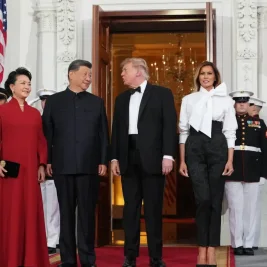
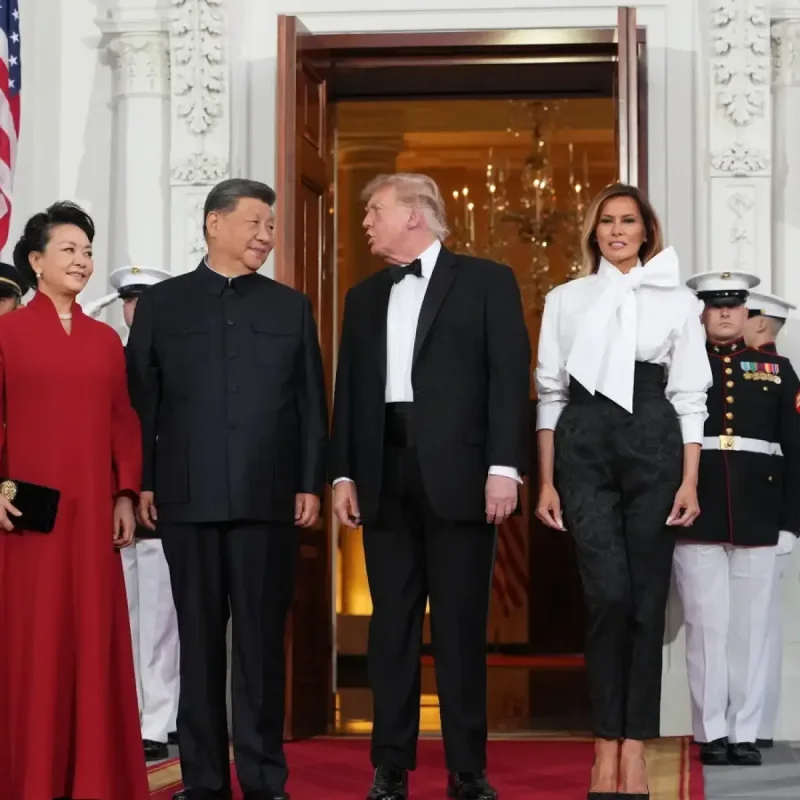
President Donald Trump hosted Chinese President Xi Jinping for a state visit in Washington, D. C.
, on Thursday to extend a bilateral trade truce and discuss strategic relations.
The multi-day summit featured a high-profile state dinner attended by corporate executives and technology leaders.
The temporary trade agreement extends access to Chinese rare earth elements for the United States and allows China continued access to certain advanced American semiconductor chips for two additional months.
However, official delegations omitted key implementation details regarding pending aircraft and agricultural purchases, as well as proposed trade boards.
During a White House tour, Trump highlighted personal diplomatic ties while showing Xi the South Lawn and the new Marine One helicopter.
In formal talks, Xi referenced historical geopolitical concepts and urged both countries to establish guardrails to prevent the misuse of artificial intelligence technology.
"Neither side is really in a position from a domestic standpoint to work out the really complicated issues at the heart of the conflict between the two," said Samm Sacks, a senior fellow at the think tank New America.
The policy discussions proceeded alongside a White House state dinner in the State Dining Room, where prominent business figures including Elon Musk, Jensen Huang, Tim Cook, Jeff Bezos, Mark Zuckerberg, and Sam Altman gathered.
"Look at the greatness that we had together fighting in World War II," said Trump.
Addressing the assembled guests, Trump veered off his prepared remarks to invite attendees to view the ongoing construction site of a new White House ballroom behind the curtain.
"If I could go off-script, just for a second," said Trump.
He praised the progress of the project and offered the attendees an advance look before the evening's entertainment concluded.
"I just want to say … I'd like to invite everyone in the room to visit through that beautiful curtain in the back — The door, it's all lit up, and looks beautiful.
It's one year away from completion, the new ballroom that you've heard about," said Trump.
He emphasized the exclusive nature of the preview to the executive audience.
"You'll be the first people to step foot on that, and we'll do that maybe after we're finished with the entertainment tonight," said Trump.
Former officials noted that the elaborate ceremonies signaled an effort to project civility despite ongoing friction regarding economic issues, artificial intelligence regulations, and Taiwan.
"This is our most difficult relationship in the world," said Nicholas Burns, former U. S.
ambassador to China.
He emphasized the public expectation for diplomatic civility despite the extravagant nature of the reception.
"American people want their president to be polite and civil to a foreign leader, but the over-the-top flattery by President Trump of President Xi, the red carpets, the pomp and circumstance, the marching bands, President Xi is," said Burns.
Political analysts observed that Beijing framed the meeting through traditional diplomatic themes while keeping open channels for national security alerts related to artificial intelligence.
"[Xi] wielded many of the usual feel-good tropes of Chinese diplomacy," said Lucy Hornby, author of The Last Man.
She noted the stark contrast in how Chinese leadership approaches bilateral talks with different global powers.
"Whenever he meets an American president, [Xi] frames the two countries as equals who can jointly sort out global problems; whereas in meetings with leaders of other countries, especially Russia or developing countries, he talks about solidarity against the "hegemonic" U.
S. ," said Hornby.
Experts highlighted that bilateral engagements continue to offer critical opportunities for managing economic and security tensions before upcoming administration shifts.
"Because they know there are China hardliners who want decoupling waiting in the wings.
The next president, Democrat or Republican, is very likely not to be as amenable to working with Xi Jinping the way we've seen," said Sacks.
She noted that establishing functional communication mechanisms remains the primary practical outcome of the summit.
"The bar is low, but they've set up a mechanism to keep talking," said Sacks.
Following the Washington meetings, Trump announced plans to attend the Asia-Pacific Economic Cooperation summit in China in November, while Xi is scheduled to attend the G20 Leaders' Summit in Miami in December.