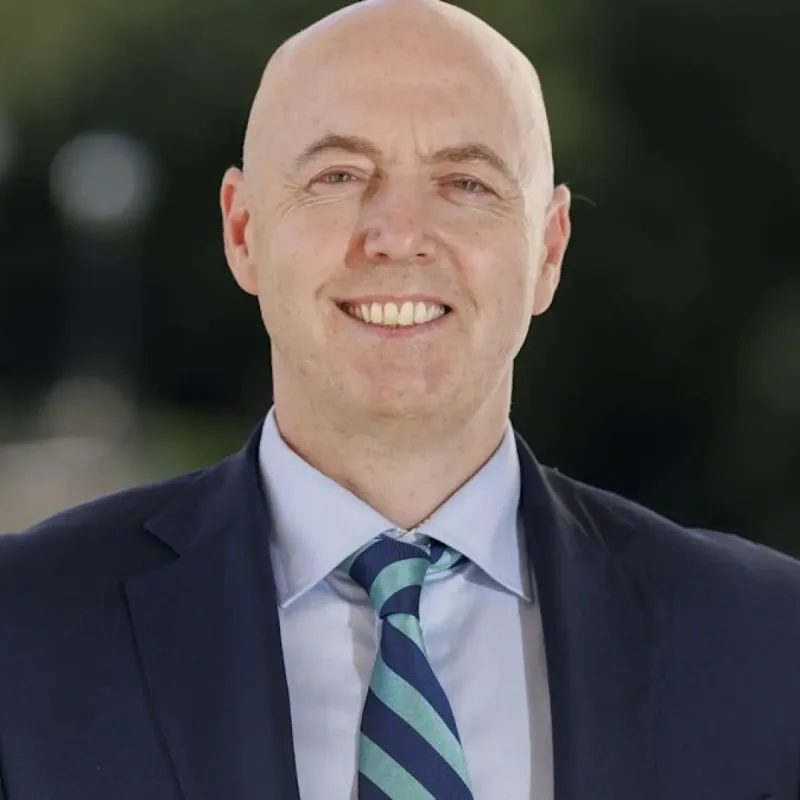
Ulster Unionist Party leader Jon Burrows used his first party conference address to warn that pulling down the Stormont Assembly would be one of the most destructive moves unionism could make.
Speaking in Belfast on September 26, 2026, under the banner 'Stronger Together,' the former senior police officer argued that any future governance breakdown would hand political advantage to Sinn Féin.
"Stormont is not perfect and it needs fixed, but collapsing it would be one of the most destructive things unionists could do," Burrows told delegates at the Crowne Plaza Hotel in south Belfast.
He said abandoning local government would let republican opponents brand Northern Ireland a failed statelet while shifting power away from local representation.
"I've heard talk of gift wrapping seats to Sinn Féin, collapsing Stormont could gift wrap the union potentially to Sinn Féin," he said.
According to Burrows, such a move would allow Sinn Féin to call unionism a failed project, hand all power to London, and almost certainly give Dublin a greater consultative role.
He asked what kind of strategy that would be for unionism.
Burrows Challenges O'Neill to Public Debate
The UUP leader extended his challenge to Sinn Féin Vice President Michelle O'Neill, urging her to face him in a public head-to-head debate on the constitutional future of Northern Ireland.
The push follows international interest triggered by US President Donald Trump during his visit to the Irish Republic, where Trump expressed enthusiasm for a united Ireland.
Burrows also pointed to O'Neill's recent trip to Cardiff alongside SNP and Plaid Cymru leadership advocating for constitutional change preparations.
He dismissed Sinn Féin's push for a border poll, noting that the 1998 Belfast/Good Friday Agreement secured Northern Ireland's position within the United Kingdom through the principle of consent.
"Sinn Féin hasn't delivered the project that they promised their people, that the Good Friday Agreement would lead to a united Ireland," Burrows said.
He noted that even opponents of the 1998 accord rely on its terms to affirm the consent principle following high-profile international commentary.
"In fact what it has done is copper fasten Northern Ireland's place in the United Kingdom," he said.
Burrows added that when Trump, as the most powerful man in the world, says he wants a united Ireland, the strongest critics of the Good Friday Agreement on the unionist side cite the Belfast Agreement and the copper-fastened principle of consent.
He maintained that Sinn Féin has failed to meet basic governance standards while making unfulfilled constitutional promises to its electorate.
"Sinn Féin have run out of road on their never ending border poll promise, and I say this to Michelle O'Neill and Sinn Féin, you want to create a whole new state?
You can't even fix a pothole, focus on doing your job," he said.
Turning to economic and security arguments, Burrows stated that Northern Ireland benefits significantly from being integrated into the broader United Kingdom military, economic, and law enforcement infrastructure.
"I think the case for the United Kingdom is compelling, it is compelling for our national security in this uncertain world," he said.
He described the UK as a country with NATO membership, a strong military, and access to every police service in the United Kingdom at short notice.
Burrows highlighted defence and trade advantages that he said place Northern Ireland in a stronger position than the Republic of Ireland.
"The Irish Republic is defenceless – who protects the cables between Ireland and Britain, the Royal Navy and the UK Armed Forces.
We're stronger and safer in the UK," he said.
He also claimed cheaper grocery prices because Northern Ireland is part of a 70 million domestic market instead of one less than a tenth of that size.
Burrows cited economic resilience from UK membership, pointing to the £3.25 billion lent to the Irish Republic in 2010 after the credit crunch.
He framed his challenge to O'Neill as a necessity for establishing hard facts rather than entertaining constitutional alternatives.
"This is not about entering the discussion on a 'New Ireland', it is about fact-checking myths with cold, hard facts," he said.
Tribute to Donaldson Victims and Alliance Pitch
Beyond constitutional issues, Burrows paid tribute to the victims whose testimony led to the sexual offence convictions of former DUP leader Jeffrey Donaldson, who was sentenced for 18 offences committed between 1985 and 2008.
"Jeffrey Donaldson was a vile paedophile, and he was a political fraud," Burrows said.
He commended the resilience required by survivors to navigate the legal system and secure justice.
"I hope he spends a very long time behind bars.
I want to pay tribute to the victims who had the courage and the resilience to give the evidence that convicted him," he said.
Burrows said he knows from his old professional life how difficult, invasive, and traumatic it is to enter an adversarial legal system and put the most difficult times of your life into sworn evidence.
He emphasized that the bravery of these witnesses established accountability regardless of political standing.
"Those who did did not just get justice for themselves, I think they have sent a message right across our country, that no matter how powerful you are, no matter what title you hold, you are accountable to the rule of law," he said.
He confirmed that the party stands firmly behind all survivors who come forward following development updates in the case.
"So I want to say on behalf of the Ulster Unionist Party we will always stand by victims and we want to give our gratitude, our support and our respect to the victims of Jeffrey Donaldson," he said.
Outlining electoral strategy, Burrows directed a pitch toward voters who previously backed the Alliance Party, asserting that Alliance has aligned increasingly with nationalist voting blocs in Stormont.
"They vote with Sinn Féin more often than any other party in Stormont – even the SDLP," he said.
Burrows criticized Alliance ministers Naomi Long and Andrew Muir, arguing that their legislative performance and departmental decisions have underperformed across justice and agriculture portfolios.
"They have failed the basic test of competence, and they hide it behind permanent outrage," he said.
He singled out specific legislative initiatives from Alliance members, criticizing Eóin Tennyson's proposal regarding conversion practices and Paula Bradshaw's flags and emblems bill.
"The leadership of our justice system by Naomi Long has catastrophic, sentencing is too soft, bail is granted too easily, the slow pace puts off victims of sexual and domestic violence," he said.
He noted systemic issues affecting law enforcement and correctional staff safety within Northern Ireland's justice framework.
"The entire balance of rights is out of kilter.
Police officers, we're told, are too frightened to protect themselves for fear of being disciplined; prison officers breathe in inmates' second-hand smoke because we are the only part of the UK where smoking in prisons has not been banned – the rights of the inmate seem to trump the rights of the prison officer," he said.
Burrows concluded his appeal to former Alliance voters by positioning the Ulster Unionist Party as a pragmatic alternative focused on overall governance.
"I say to those who voted Alliance, if you want to support a party that believes in the whole of Northern Ireland, but that has competence and common sense, come home to the Ulster Unionist Party," he said.