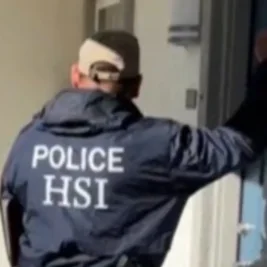
A federal judge in California on Wednesday limited the Department of Homeland Security's ability to investigate suspected noncitizen voting in nine states.
Judge Araceli Martínez-Olguín ruled that unreliable government data could expose eligible US citizens to scrutiny and discourage participation ahead of the November midterm elections.
The order covers California, Connecticut, Georgia, Missouri, Nevada, New York, Pennsylvania, Washington and Wisconsin, according to CNN and The New York Times.
The restrictions are scheduled to take effect Friday afternoon and will remain in place until after the midterm elections.
The Trump administration has an opportunity to appeal before they begin.
The judge did not suspend all federal field investigations.
Instead, she prohibited agents from conducting interviews involving people they know, suspect or reasonably should suspect are US citizens.
That leaves uncertainty about how substantially the order will affect the department's operations.
Flawed Data at the Center of the Ruling
Martínez-Olguín identified the government's reliance on incomplete citizenship records as a central problem in compiling lists of suspected noncitizen voters.
Her ruling addressed concerns that those lists could mistakenly identify naturalized citizens and discourage eligible voters from participating in elections.
"At issue here is the reliance on admittedly flawed and incomplete data to create a list of individuals for HSI to interview in the months leading up to an election."
The judge also emphasized the potential consequences for public participation in elections.
She wrote that the government's interest in investigating unlawful voting did not outweigh the public interest in protecting elections from interference and intimidation.
"The public’s interest in safe elections, free from interference or intimidation, far exceed Defendants’ purported interest in combating unlawful voting by non-U.
S. citizens."
The case was brought by voting rights organizations and advocacy groups that argued the federal investigations had already created anxiety among eligible voters.
Beau Tremitiere, an attorney with Protect Democracy, which represents the plaintiffs, said the ruling offered protection against investigations targeting citizens.
"This order is a serious protection: the current policy targets known naturalized citizens," Tremitiere said.
Tremitiere said the restrictions also require the department to reconsider cases in which evidence suggests a person may be a citizen, rather than treating those individuals as viable investigative targets.
"Those operations are prohibited.
And this order should otherwise force DHS to stop presuming many others are viable targets when there are indicia of citizenship."
California List Raises Reliability Concerns
The ruling follows a separate dispute in California over a federal list of approximately 20,000 people whom the Department of Homeland Security identified as likely noncitizens registered to vote.
According to National Public Radio, the Department of Justice asked California to verify the citizenship of people on the list and segregate ballots associated with them, prompting objections from state and local officials.
Los Angeles County officials reviewed a sample of 200 records and raised concerns about the list's reliability.
Assistant Registrar-Recorder Monica Flores reported that 38.9% of records with meaningful birthplace information indicated that the individuals had been born in the United States, which generally confers citizenship, subject to narrow exceptions.
"The review is preliminary and quality control is continuing, but it indicates that the October List is unreliable," Flores wrote in a court declaration.
County officials also reported that 112 of the 200 sampled records were associated with registrations that had been canceled or were inactive, while approximately 70% of the people sampled had no voting history.
The county registrar's separate court filing said only 7,035 of the approximately 20,000 names had addresses in Los Angeles County, and some entries were duplicates.
California officials argued that verifying the entire list so close to the election would be impractical and could violate federal and state election laws.
"At best, this litigation is a reckless political stunt," California officials wrote in a court filing, warning that the federal government's request could threaten eligible voters' participation.
"At worst, it threatens to disenfranchise thousands of Californians this election."
The Justice Department defended its demand for state cooperation, arguing that officials must independently verify citizenship rather than ignore potential violations of federal law.
Deputy press secretary Kiersten Pels said California could not facilitate unlawful voting, while acting Deputy Attorney General Trent McCotter acknowledged that the federal list could contain errors.
"There may be some names on there who it turns out ultimately are citizens, we're not perfect," McCotter said at a Monday news conference, adding that federal officials had asked California to cooperate with their investigation.
The Justice Department also announced criminal charges against 28 people on Monday in connection with names on the list.
NPR reported that all 28 were legal permanent residents, commonly known as green card holders, and that some cases appeared to involve people who may not have understood the restrictions on voting by noncitizens.
One person facing charges described the emotional strain of the case in an interview with KCRA 3 while seeking legal assistance.
"I'm feeling very depressed, very full of anxiety. I'm disabled.
I've got so much problems in my heart, my condition, so it's going to give me more stress," the individual, identified by NPR as Shah, said.
Shah said the situation had caused significant distress and that legal representation was being sought to challenge the charges.
"I'm very upset. I'm trying to get an attorney, hopefully I can have the charges dismissed."
The Trump administration has expanded efforts to investigate suspected noncitizen voting while promoting claims of widespread unlawful voting that have faced scrutiny over the accuracy of supporting data.
The federal judge's order restricts some investigative methods in nine states, while the separate California lawsuit continues to challenge the government's demand for additional verification of voters' citizenship.