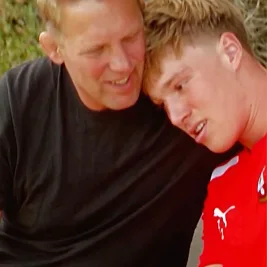
Former England football captain Terry Butcher has shared intimate details about his career and the tragic loss of his veteran son in an upcoming ITV documentary.
The film, titled "Butcher: Invisible Wounds," addresses the mental health struggles of military families and is set to air in June after a cinema premiere in Ipswich.
Butcher's eldest son, Christopher, died at age 35 at the family home in east Suffolk following tours in Iraq and Afghanistan.
A coroner ruled his death resulted from an abnormal heart enlargement combined with drug effects against a background of severe PTSD.
"I've never given anybody a story like this," Butcher said. "But if you're going to do something, do it well.
This is a story much bigger than me."
Living with Grief
Butcher described his nightly routine, still acknowledging his son.
"When I go up to bed in the evening, Chris's room is on the left and our room is on the right.
I always stop at the top of the stairs and say good night to him."
The family visits Christopher's military grave, which features an artillery crest. "We sort of hug the stone and always say, 'See you at home, son.'
It's really tough, but it's just part of our life now."
Butcher admitted he previously suppressed emotions due to his reputation as a sports hard man. "I was feted as this so-called hard man.
You just didn't cry. But I think you have to.
It's compulsory. It's part of the process."
He recalled unexpected emotional breakdowns during train journeys and noted that discussing his son has become easier, though conversations with strangers remain awkward.
"When someone says, 'How many children did you have?' I normally say three sons.
And then if they ask what they're all doing now, then you have to come clean and say one passed away.
And then that conversation stops."
Christopher's Battle with PTSD
Christopher experienced severe flashbacks, auditory hallucinations, and reliance on alcohol and drugs several years after returning from Iraq.
His behavior changes eventually required him to move back in with his parents.
"It was probably about two or three years afterwards that it manifested itself," Butcher said. "He was drinking and he kept getting a lot more flashbacks.
He had these voices in his head."
The family often adapted their daily schedules, such as returning early from dog walks when Christopher experienced sudden anxiety.
Butcher stated they felt helpless during multiple suicide attempts and faced a lack of specialized military PTSD training within the NHS.
"I don't put any blame on them. What you want is a military unit where you can put PTSD sufferers in," he said.
"At the start there was a lot of anger because he was let down. But I don't harbour any grudges now towards the MOD."
Butcher shared lighter memories, including bottle-feeding Christopher as a baby in the stadium stands during the 1982 World Cup in Spain.
He also recalled his sons searching for coins at Ibrox Stadium during his time playing for Rangers.
The documentary features interviews with football figures including Gary Lineker, Ally McCoist, Kieron Dyer, and Alan Brazil. Butcher joked about their flattering commentary.
Director Stuart Burley described Butcher as a humble individual who subverts the typical alpha male stereotype.
"He's not your typical England captain, there's a lot more to him than that.
With the World Cup coming up, it's a really important time for men to open up."
Butcher noted that discussing his grief with the director served a therapeutic purpose.
"Eventually we got around and I found it cathartic in many respects because it made me talk more about him, understand him more and then my family did as well."