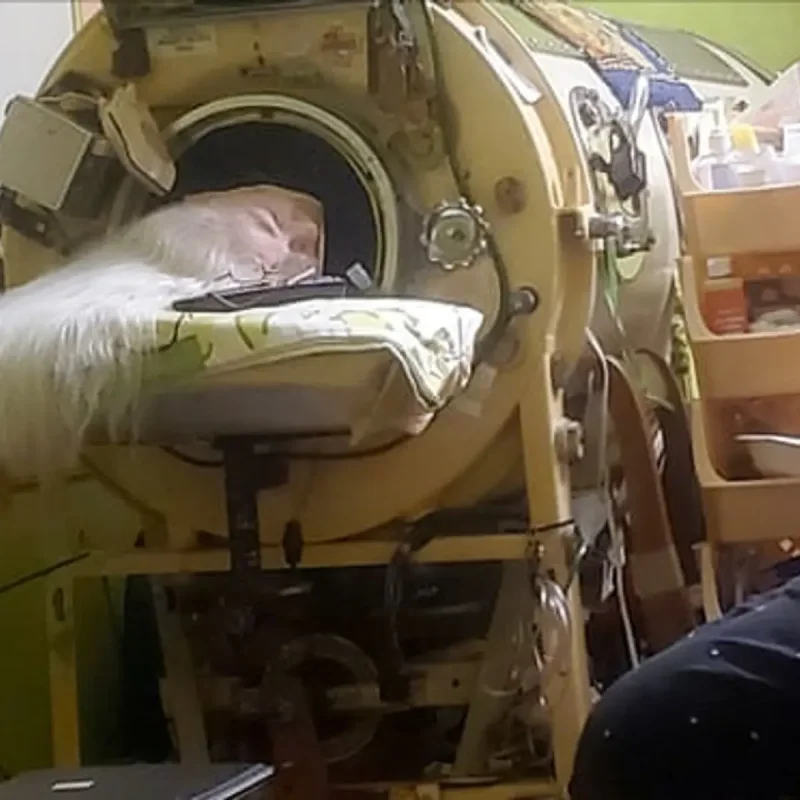
Martha Lillard, the last known person in the United States living with polio while relying on an iron lung, has died at age 78.
She passed away on June 26 in Oklahoma, according to an online obituary.
Lillard contracted polio at age five and required the mechanical cylinder to breathe for most of her life.
Her sister, Cindy McVey, confirmed that Lillard faced severe health complications before her death.
The official causes of death included chronic pulmonary failure, post-polio syndrome, and long-term effects of Covid-19.
McVey recalled that doctors had told Lillard she was not expected to live past 20.
Despite the prognosis, Lillard lived for decades with the help of the iron lung.
Her family customized a trailer so she could travel, and her father contacted hotels to ensure door widths could accommodate the heavy breathing apparatus.
“She had the enthusiasm and the drive to continue living and make the best of her life,” McVey said.
Life with the Iron Lung
In a 2013 interview with NBC News, Lillard described her relationship with the machine that enclosed her body to manipulate air pressure and force oxygen into her lungs.
“It feels wonderful, actually, if you're not breathing well,” she said.
She elaborated on the physical sensation, stating, “It makes all the difference when you're not breathing.”
Her death follows that of Paul Alexander, a Texas man who also spent his life in an iron lung after contracting polio at age six.
Alexander died at age 78.
Before widespread vaccination campaigns in the late 1950s, annual polio outbreaks left thousands of American children paralyzed. Iron lungs were commonly used before being replaced by modern ventilators.
Immunization reduced annual domestic cases to fewer than 100 in the 1960s.
The Centers for Disease Control and Prevention declared polio eliminated from routine spread in the US by 1979.