The Michigan Left is an unconventional intersection design that eliminates direct left turns on divided highways.
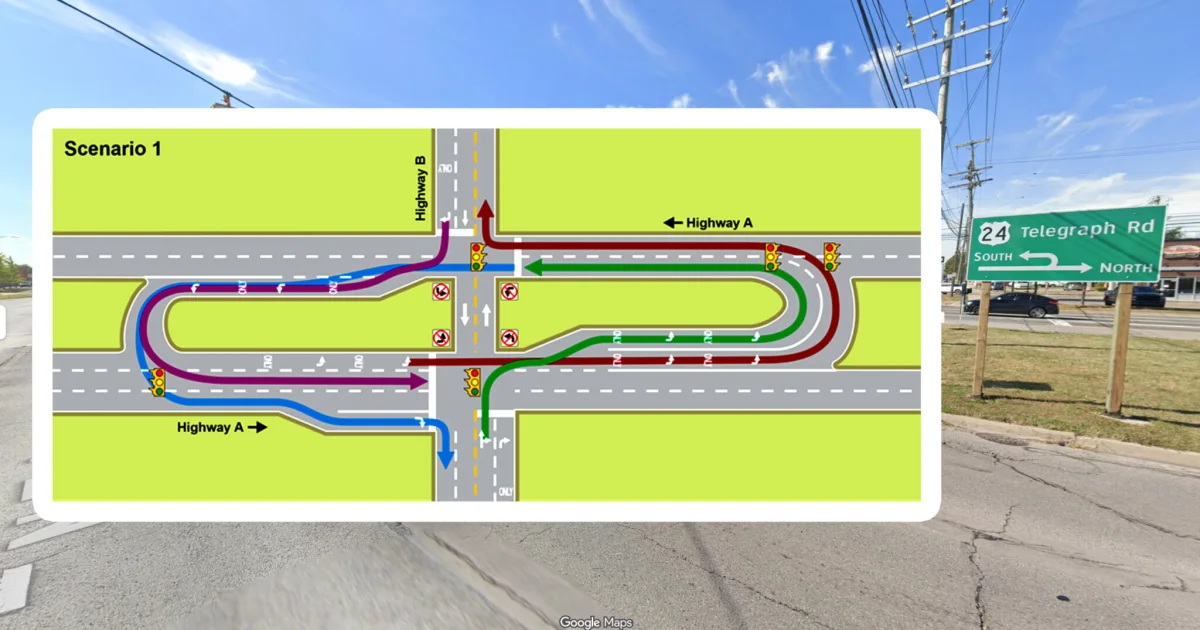
Instead of turning left across oncoming traffic, drivers continue straight, make a U-turn in a median crossover, and then turn right.
According to the Michigan Department of Transportation (MDOT), this design can reduce crashes and fatalities by 30 to 60 percent while increasing intersection capacity by 20 to 50 percent compared to traditional left-turn intersections.
How It Works
On a divided highway, drivers approaching an intersection must go straight, then about 660 feet (200 m) beyond it, they enter a dedicated median crossover to perform a U-turn.
After the U-turn, they return to the intersection and turn right onto the cross street.
Drivers from the side road follow the opposite sequence: they turn right onto the highway, continue to the median crossover, make a U-turn, and proceed in their desired direction.
Every movement at the main intersection becomes either straight ahead or a right turn.
Why It Improves Safety
MDOT reports that around 30 percent of all crashes in Michigan occur at intersections, and nearly 58 percent of those involve head-on left-turn or angle collisions.
These are often high-speed and severe.
By removing direct left turns, engineers eliminate the potential for such collisions. The design assumes human error, as road users inevitably make mistakes.
Rather than slowing traffic, the Michigan Left actually improves traffic flow by allowing simpler traffic light cycles and reducing congestion.
History and Adoption
The first modern Michigan Left was developed in 1960 along Telegraph Road (US-24) in Wayne County by engineers Joseph Hobrla and Joseph Marlow.
Today, Michigan has more than 425 miles (684 km) of highway median featuring these crossovers.
Other states have adopted similar designs. North Carolina uses them in "Superstreet" intersections, and Arizona has "Arizona Boulevard" layouts.
The design costs less than constructing a conventional interchange and, despite requiring a detour of a few hundred feet, leads to fewer severe crashes and shorter waits at traffic lights.