Montreal kicked off the Canadian Grand Prix weekend on Friday, May 22, 2026, under sunny skies and mild temperatures at Circuit Gilles Villeneuve.
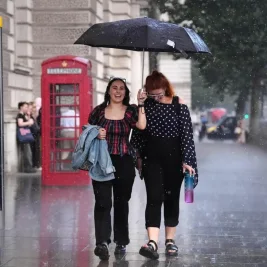
Conditions are expected to shift, with rain and cooler temperatures forecast for Sunday's race.
Environment Canada predicts a high of 20 degrees Celsius on Friday, with mostly sunny weather continuing into Saturday.
Sunday's race day is expected to bring rain and a high of only 13 degrees Celsius.
Organizers have made Parc Jean-Drapeau completely car-free for the event, which is projected to attract between 355,000 and 360,000 total spectators.
The Société de transport de multimédia is increasing Yellow line Metro service to accommodate an estimated 130,000 daily visitors.
This weekend marks the first F1 Sprint event in Montreal.
The circuit features long straights, tight chicanes, and three Straight Mode zones designed to reduce drag under new aerodynamic configurations.
Former Renault F1 driver Jolyon Palmer shared his perspective on the 14-turn circuit.
"Canada is a really nice track to drive, and you get a sense of atmosphere going around it," Palmer said.
"Overhanging trees give it the feel of a park, and it feels like a street circuit – in essence, it is."
Palmer emphasized the need for precision through numerous chicanes.
"There are a lot of slow-speed corners, the walls are very close in a lot of places, but it's a great racetrack.
You need a good front-end to get your car turned into the chicanes, which are pretty much everywhere."
The track's unique layout alters braking approaches, complicating vehicle handling under varying temperatures. "Then there's the hairpin, which launches you into an overtaking area at the final chicane.
If not there, maybe you’ll have a little sniff of something into Turn 1.
Turns 1 and 2 are pretty tricky because you’re approaching Turn 1 very, very fast, arcing to the right as you’re braking, and then hurling speed to the left," Palmer explained.
Colder temperatures on race day could further impact traction during early laps.
"If you have any sort of moment coming to Turn 1, you’re really off-line or cutting the corner down towards Turn 2, while tyre warm-up sometimes isn’t ideal here, particularly on chillier days in Montreal," Palmer added.
Team Updates and Technical Adjustments
In the paddock, teams are managing mechanical and strategic adjustments. Williams announced new staff recruits to address production line weaknesses.
Williams driver Carlos Sainz expressed confidence in the team's swift response after difficulties earlier this year.
"After the struggles we had in the winter, I think it was quite clear we're still not at the level that we should be in multiple areas and I think the team took very quick action into addressing it and hiring some key people," Sainz said.
The newly hired chief operating officer brings experience from previous technical turnarounds.
"Piers is someone that I know pretty well from my time in McLaren which I think will be a massive help on the production line and operation side," Sainz noted.
Sainz remains optimistic about structural changes.
"So, happy to see that we were able to react, realise quickly that we were not at the level that we thought or we could potentially think we were, and that there's a plan to revert that situation and make ourselves stronger."
Cadillac driver Sergio Perez expressed concerns about how the MAC-26 vehicle handles track surface bumps and kerbs.
"We were struggling quite a bit in Miami with the ride, so that’s something we put a lot of emphasis [on] in this small break to try to come up with better solutions and make sure that we are on top of it," Perez said.
The Montreal circuit is expected to thoroughly evaluate these mechanical changes. "And it’s probably the biggest test in terms of [kerb] riding, this circuit," Perez remarked.
Honda has indicated progress in performance development, focusing on resolving internal combustion and friction issues on the dyno.
Trackside general manager Shintaro Orihara confirmed technical development has progressed. "We found something where we can improve what we need to improve," Orihara said.
The development focus centers on enhancing engine efficiency and reducing energy loss. "Combustion side we need to improve.
And also we need to focus to reduce friction," Orihara explained. While exact performance metrics remain confidential, initial laboratory evaluations show encouraging outcomes.
"We see some positive things on dyno. So it's difficult to say the number.
But we know what we are doing there," Orihara stated.
Ferrari's Charles Leclerc discussed the performance standings regarding the FIA's Additional Development and Upgrade Opportunities system. "I think it’s going to be very difficult.
They have a very big advantage, and I obviously don’t know yet if we are included.
I would be surprised if we’re not, because sometimes on the straights I can see that we are lacking a little bit compared to Mercedes or even the Ford power unit.
But still, I think it will definitely help us try to get closer. Whether it will be enough to fully close the gap, I don’t know.
It also depends on what level we get to and whether we get it at all.
But surely, if we do get it, it will help us get closer," Leclerc said.
Discussions regarding proposed power unit modifications for the 2027 season are ongoing among manufacturers and governing bodies during the race weekend.