The long, grueling Premier League campaign has finally reached its conclusion.
Over nine months of relentless action, spectacular goals, and baffling VAR controversies, the English top flight once again delivered a theatrical spectacle.
Rather than filtering these moments through a rigid chronological lens, a panel of Guardian football writers looked back at the campaign.
They offered a kaleidoscope of contrasting perspectives on the individuals and incidents that truly defined the season.
Player of the Season: A Goalkeeper's Triumph
In a sport where goalscorers routinely monopolize the headlines, the debate for the season's finest player took an unorthodox turn.
Arsenal's defensive solidity emerged as a dominant theme, casting a bright spotlight on their last line of defense.
The tactical evolution under Mikel Arteta placed immense responsibility on his goalkeeper. That gamble ultimately yielded historic dividends.
"Goalkeepers never usually get a mention for this award but David Raya played an integral role in Arsenal finally getting over the line," stated Ed Aarons, Football Writer.
Raya won the Premier League's Golden Glove award for a third year in a row thanks to 19 clean sheets.
While Raya commanded the penalty box, other pundits found themselves captivated by individual brilliance elsewhere on the pitch.
The vote was heavily split between the engineering precision of Arsenal's engine room and the sheer resilience of individuals carrying flawed teams on their backs.
"Admitting on social media that I'd voted for Fernandes in the football writers' award caused all manner of weirdness," noted John Brewin, Football Writer.
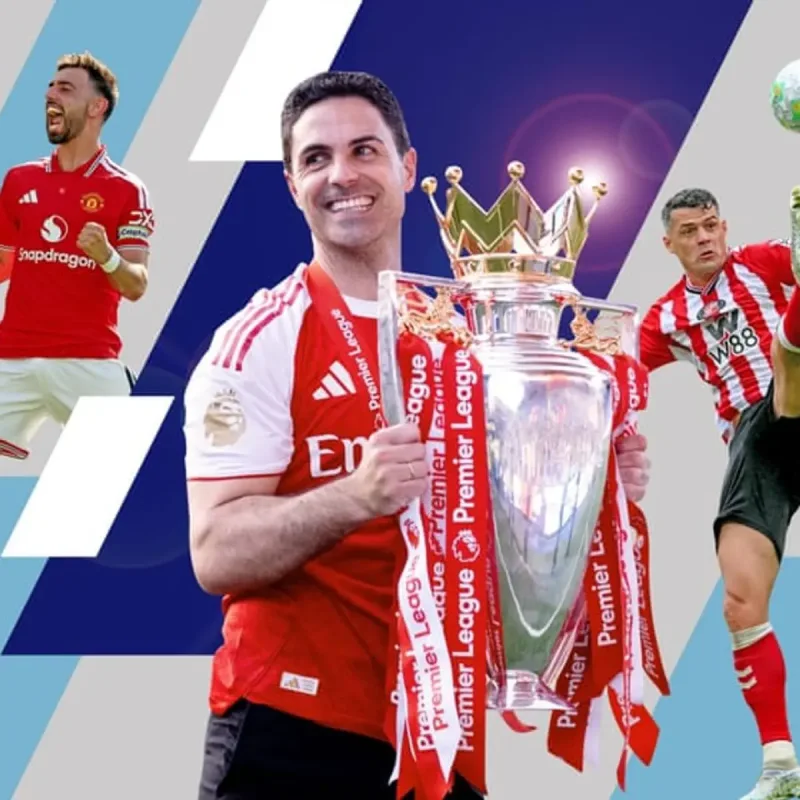
The polarization of the panel highlights the unique narrative of the season: a contrast between Arsenal's collective machine and Manchester United's individual brilliance.
For some, the choice came down to the pure momentum that carried the North London side through their early structural tests.
"With Arsenal finally getting over the line, Rice edges it," observed Yara El-Shaboury, Football Writer.
The discussion extended far beyond the traditional heavyweights.
Across the league, individual quality flourished in unexpected environments, providing a reminder that the top flight's depth stretches well beyond the top three positions.
Breakthrough stars and clinical finishers from mid-table sides forced their way into the conversation. "Antoine Semenyo," wrote Ben Fisher, Football Writer.
"Phenomenal for Bournemouth and superb for Manchester City."
Yet, the romantic allure of a talismanic figure dragging an otherwise dysfunctional team forward remained incredibly potent for many writers.
That kept Manchester United's creative hub at the center of the debate.
"Fernandes," asserted Taha Hashim, Football Writer. "Manchester United's best player for six and a half years, bringing colour to their gloomiest days."
For the tactical purists, however, the individual accolades could not be separated from the collective system that secured the ultimate prize.
The focus inevitably shifted back to the core components of the champion's blueprint.
"Rice," argued Andy Hunter, Football Writer.
"Given the importance of set pieces and defensive organisation to the destination of the title, it has to be the player who was key to both for the champions."
Ultimately, the beauty of the season lay in the eye of the beholder.
Some prioritized the sheer anticipation that built whenever a master technician assumed control of the ball.
"I have most enjoyed watching Fernandes," admitted David Hytner, Football Writer.
In contrast, the terrifying efficiency of isolated wide players offered a completely different kind of thrill.
Relentless wide threats capable of shattering defensive low blocks provided some of the season's most electric sequences.
"Jérémy Doku," highlighted Jamie Jackson, Football Writer. "The jet-heeled winger elevated his output to a relentless threat, eradicating the former inconsistency."
The fundamental philosophical question remained: is it more impressive to shine in a flawless system, or to spark life into an otherwise chaotic environment?
"Look, anyone can excel in a brilliant team," pointed out Jonathan Liew, Columnist. "Jack Rodwell has a Premier League medal, for heaven's sake."
The grit and stamina required to anchor a title-winning midfield over thirty-eight games remained a powerful counter-argument.
It emphasized the mental fortitude needed to sustain a pursuit at the top.
"Rice," reiterated Paul MacInnes, Football Writer. "He was right, it wasn't done."
The emphasis on fine margins kept returning the conversation to the specific moments where a match, and potentially a title, swung on a single defensive intervention.
"Raya," added Billy Munday, Football Writer.
"You could argue Arsenal's ability to defend set pieces has been just as important as their attacking output."
Beyond the goalkeeper, the emotional heartbeat of Arsenal's backline earned recognition for delivering decisive moments at both ends of the pitch.
"Gabriel Magalhães," suggested Sachin Nakrani, Football Writer.
The consensus among a large contingent of the panel, however, remained firmly fixed on the modern profile of the goalkeeper who acted as both an extra playmaker and an elite shot-stopper.
"Raya," wrote Barney Ronay, Chief Sports Writer. "Overwhelmingly key to Arsenal's season as playmaker, spectacular save-maker and groovy and stylish spirit animal."
Even when looking at specific, season-defining moments, the contribution of the Spanish international seemed to overshadow the impressive statistics compiled by the league's top creators.
"With apologies to Fernandes after all his assists, Raya has been the most decisive player in Arsenal's title win," remarked Jacob Steinberg, Football Writer.
Away from the title race entirely, the sheer aesthetic pleasure of watching a technically gifted playmaker lift a lower-profile side provided a different kind of joy.
"Enzo Le Fée," noted Louise Taylor, Football Writer.
Ultimately, the discussion of individual brilliance underscored how tiny the margins between success and failure have become at the highest level of English football.
"Raya," concluded Will Unwin, Football Writer.
"Goalkeepers often do not get the credit they deserve in title wins but the Arsenal No1 has ensured his side have always been on the right side of tiny margins."
The Architects of Success
Behind every great on-field performance sits a manager navigating intense pressure, evolving tactical trends, and demanding fanbases.
This season witnessed several remarkable managerial journeys, from unexpected European qualifications to redemption stories at the top of the table.
Mikel Arteta's transformation of Arsenal from perpetual challengers into structured champions earned widespread praise. That was especially given the psychological hurdle of overtaking Pep Guardiola.
Simultaneously, Andoni Iraola's work at Bournemouth drew significant admiration for its aesthetic appeal and tactical sophistication. He navigated significant squad changes to secure a historic European finish.
In the lower half of the table, Daniel Farke orchestrated a dramatic turnaround at Leeds.
He used a mid-season tactical shift at Manchester City to salvage his job and guide the club to an FA Cup semi-final and top-flight safety.
The rise of Régis Le Bris at Sunderland provided another captivating narrative.
The versatile coach transformed a newly promoted squad, seamlessly integrating fourteen summer signings to claim a stunning European qualification spot.
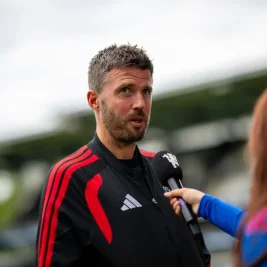
Similarly, Michael Carrick stepped into a fractured environment at Manchester United.
He ditched a rigid defensive system in favor of a fluid approach that resurrected their season and secured a return to elite continental competition.
Spectacular Strikes and Chaotic Evenings
The season was defined by goals that defied physics and matches that descended into glorious tactical anarchy.
From Dominik Szoboszlai's astonishing 35-yard free-kick against Arsenal to Kaoru Mitoma's perfectly-cushioned volley against Tottenham, the technical quality on display was extraordinary.
Unlikely heroes emerged in dramatic fashion.
Harrison Reed's thunderous 97th-minute equalizer for Fulham against Liverpool, a strike that rattled off the crossbar to ignite Craven Cottage, was one such moment.
When it came to the matches themselves, structural discipline occasionally evaporated entirely, giving way to pure entertainment.
A chaotic 4-4 draw between Manchester United and Bournemouth at Old Trafford stood out as an eight-goal fever dream where momentum swung violently every few minutes.
Elsewhere, Fulham and Manchester City engaged in a breathless 4-5 thriller.
Newcastle and Leeds produced an extraordinary night of attacking football that culminated in a 102nd-minute winner from Harvey Barnes, leaving managers admitting that all tactical control had been utterly lost.
The Best Bargains and the Hardest Falls
Recruitment strategies dictated the fates of multiple clubs. Several modest investments vastly outperformed nine-figure superstars.
Granit Xhaka's return to England with Sunderland proved to be a masterstroke.
The veteran midfielder operated as an on-pitch coach, anchoring the dressing room and guiding the newly promoted side into Europe for a modest fee.
In contrast, Leeds reaped massive rewards from picking up Dominic Calvert-Lewin on a free transfer. The striker netted 14 crucial goals to spearhead their survival drive.
Conversely, the season was less kind to several high-profile figures and clubs.
Newcastle's massive investment in Alexander Isak and Chelsea's acquisition of Liam Delap yielded frustrating returns, plagued by injuries and underperformance.
The collective struggles of Chelsea, Tottenham, and West Ham drew sharp criticism from the panel. Managerial tenures fractured under the weight of immense expectation.
Liverpool's season also hit a collective wall, failing to sustain their initial momentum despite heavy summer spending. That left incoming manager Arne Slot facing a steep learning curve.
The Growing Discontent
Despite the high-scoring thrillers and tactical intrigue, the writers expressed deep-seated frustrations regarding the modern trajectory of the sport.
The relentless, expanding calendar took a visible toll on elite talents, leaving key players looking exhausted ahead of international tournaments.
Structural decisions by wealthy ownership groups, ticket price hikes during a cost-of-living crisis, and divisive rhetoric from billionaire executives cast a dark shadow over the community values traditionally embedded in English football.
The loudest complaints, however, were reserved for the officiating infrastructure.
The implementation of the handball law and the constant interruptions brought about by VAR drew universal ire, with writers arguing that the technology continues to strip the game of its natural spontaneity.
From mic'd-up announcements to endless reviews for minor physical contact at corner kicks, the consensus called for a return to accepting human imperfection over a sterilized, mechanical version of the sport.