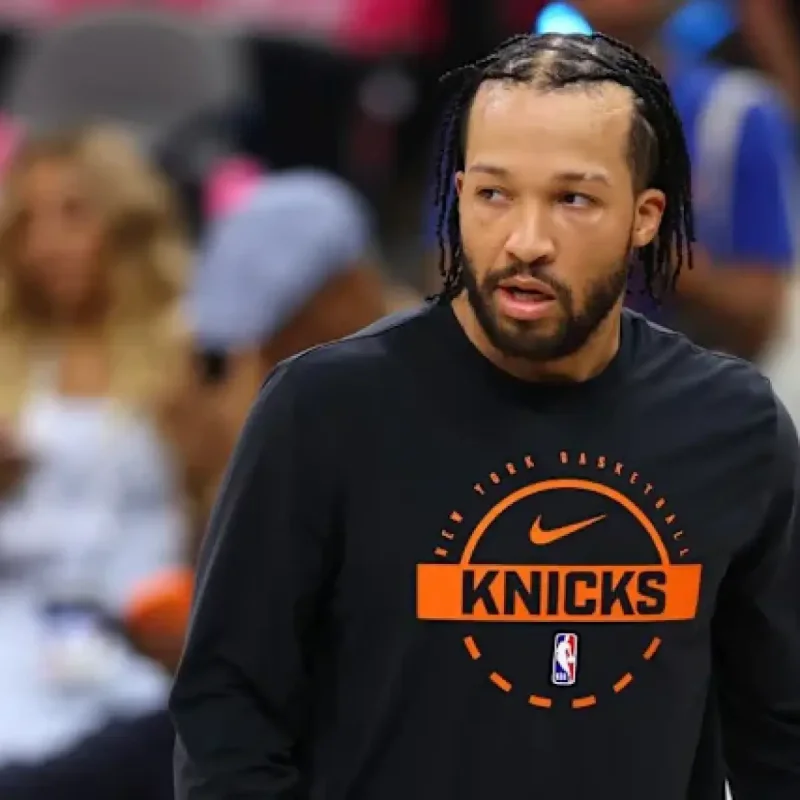
By any objective measure, Jalen Brunson should be on a max contract right now.
The New York Knicks' star point guard has been named to the All-NBA second team each of the past three years.
He finished 12th in MVP voting in 2022-23, fifth in 2023-24 and 10th in 2024-25. He also won the league's Clutch Player of the Year award in 2024-25.
If he isn't currently one of the NBA's top 10 players, he's not far off.
Typically, a player of Brunson's caliber would earn between 25-35% of the salary cap depending on tenure.
Brunson, finishing his eighth season, would be eligible for as much as 30% of the cap. Instead, he's earning less than 23% of this year's cap.
He is only going into the second season of the four-year, $156.5 million extension he signed in July 2024.
Perhaps Brunson won't be as magnanimous on his next contract.
But his financial sacrifice set the stage for the Knicks to get within three wins of their first championship in 50-plus years.
It also might be a blueprint for other stars and teams navigating the NBA's second-apron era.
How Brunson Helped Build the Knicks
Teams that go over the first apron—which the Knicks have soared above in each of the past two seasons—face restrictions.
They can't take back more salary than they send out via trade, can't acquire players via sign-and-trade, and can't sign someone on the buyout market who was previously earning more than the non-taxpayer mid-level exception.
Teams that go above the second apron have their hands tied even more.
Beyond all first-apron restrictions, second-apron teams also can't aggregate two or more smaller contracts to acquire a bigger salary.
They also lose access to the taxpayer MLE in free agency and can't trade their first-round pick seven years in the future.
Since the Knicks stayed under the second apron in 2024-25, they were allowed to aggregate contracts to acquire both Mikal Bridges and Karl-Anthony Towns via trade.
Since they stayed under it this season as well, they had access to the taxpayer MLE.
They used it to sign Guerschon Yabusele to a two-year, $12 million contract in free agency.
Yabusele didn't work out as hoped for the Knicks, but he wasn't a total loss.
They wound up flipping him for Dalen Terry, whom they quickly dealt for Game 1 hero Jose Alvarado ahead of the February trade deadline.
Had Brunson been on a market-value contract, the Knicks would have been over the second apron each of the past two years, barring other moves.
They wouldn't have been able to aggregate contracts for Bridges or Towns, nor would they have had the taxpayer MLE this past offseason.
Unlike other teams, the Knicks are willing to spend deep into the luxury tax under the right circumstances.
But the latest CBA imposes draconian roster-building restrictions for teams that cross either apron.
Brunson's current contract is the Knicks' way around that.
ESPN's Brian Windhorst wrote during last year's Eastern Conference Finals between the Knicks and Indiana Pacers: "Their ability to keep the team together, and add to it, is less a question of dollars and more about flexibility under the NBA's newish apron rules."
Windhorst added: "And this is why there is a belief across the league that New York is just opening its own pathway, perhaps right alongside Indiana.
At the heart of why is star Jalen Brunson's four-year, $156 million contract extension."
Will Other Stars Follow Suit?
We're now three full seasons into this CBA.
Players, front office executives, and owners alike have seen how difficult it is to build teams around three max contracts unless you're the Oklahoma City Thunder.
Even the Thunder have tough financial decisions to make this offseason now that Chet Holmgren and Jalen Williams are no longer on rookie-scale deals.
This CBA effectively gives star players a binary choice: maximize earning potential or championship equity.
Paul George chose the former when he signed a four-year, $211.6 million deal with the Philadelphia 76ers in free agency two years ago.
He has exactly four playoff wins to show for it.
Brunson and the Knicks are three wins away from winning four playoff series this year alone.
Some older stars, such as Kyrie Irving and James Harden, have begun to take below-max deals in recent years, largely due to age and other circumstances.
In-their-prime stars—and even a few past-their-prime stars like George—are still routinely getting full max deals.
Now that Brunson's sacrifice has paid off in a Finals run, will other stars look to emulate that strategy?
Based on the current $165 million projection for the 2026-27 salary cap, a five-year, 25% max deal would be worth $239.25 million, a 30% max deal would be $287.1 million, and a 35% max deal would be $334.95 million.
Agents and income taxes (in most states) would wipe out a not-insignificant chunk, but it's generational wealth either way.
If someone eligible for a 35% max took closer to a 25% max, he'd be freeing up more than $16 million in financial flexibility for his team this coming season.
For context, the non-taxpayer mid-level exception is projected to be just over $15 million.
If multiple stars agreed to take similar discounts, that could give one lucky team the flexibility to build around a Big Three without running into major apron issues.
It'd be what Brunson's contract did to the Knicks but on steroids. The NBA's financial system is effectively designed to prevent superteams.
It's now harder to build around multiple players on max contracts, and under the recently passed draft-lottery reform, teams can no longer have three straight picks land in the top five of the draft.
They're automatically moved to No. 6 or lower in their third year.
Brunson and the Knicks are proving how beneficial one discount contract can be in overcoming second-apron restrictions.
If two or more stars agreed to team up on well-below-max deals, they could quickly become the team to beat in the NBA thanks to the flexibility their front office would have to build around them.