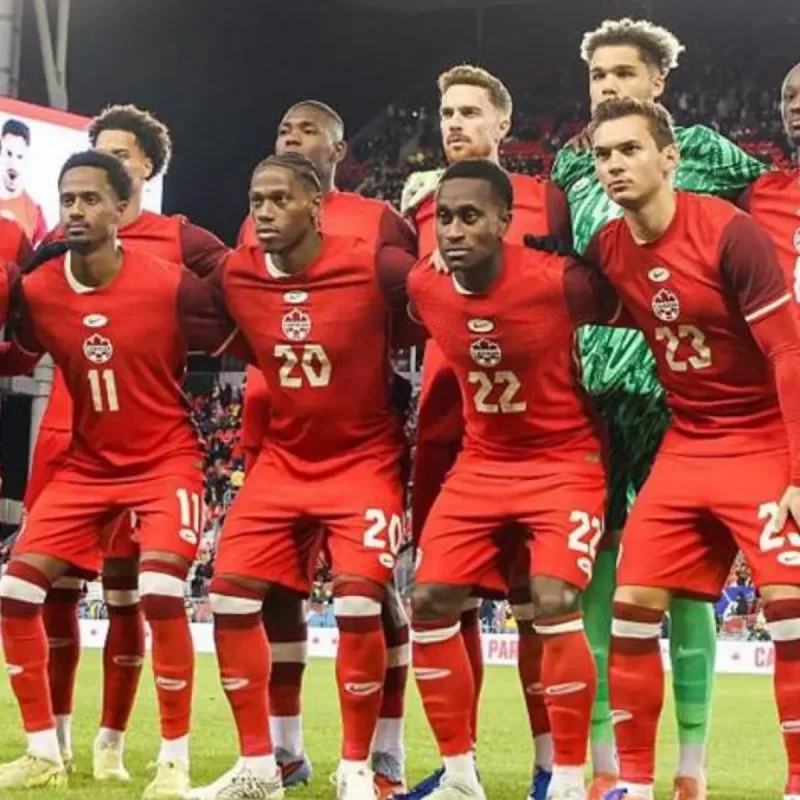
The Canadian men's national football team will play its first match of the 2026 World Cup against Bosnia-Herzegovina in Toronto on Friday at 20:00 BST.
The tournament begins amid local enthusiasm, though steep travel and hotel costs are affecting fans across Vancouver and Toronto.
Canada enters its third World Cup appearance with a historical record of six losses, two goals scored, and 12 goals conceded across the 1986 and 2022 tournaments.
Despite past struggles and recent mixed friendly results, local expectations remain elevated for the current squad.
Strongest Squad in History
Canadian soccer journalist Har Johal told BBC Sport that the team possesses an unprecedented level of talent playing in European leagues.
"Canada is often overlooked, we will be fine about that," Johal said.
"We will smile, be polite, and allow the countries down south take the headlines," he added.
The national team sits in a group alongside Switzerland, Qatar, and Bosnia-Herzegovina, who qualified after defeating Italy on penalties.
"The timing is fantastic, but it has been building for Canada - we have seen more players in Europe, the talent is there," Johal stated.
Local fans have expressed excitement, rallying behind the national squad as the opening fixture approaches.
"At Qatar, the expectations were high and they are high again this year," Johal observed.
"People are getting excited, it is slowly building. People are really behind Team Canada, it is ramping up every day," he reported.
The current roster is widely considered by local analysts to be the strongest lineup the nation has fielded.
"This is a great generation, the best Canadian team we have ever had," Johal explained.
Commentators suggest that the tournament provides an immediate opportunity for the squad to progress further than in previous campaigns.
"People are saying there is no reason Canada cannot top this group, especially after Italy choked," Johal claimed.
The upcoming match against Switzerland is anticipated to be a decisive fixture for group positioning.
"Now maybe the Swiss are our biggest rivals," Johal remarked.
Team leadership remains vital for Canada's tournament strategy, particularly concerning key players returning from injury.
"We saw Davies come back and score for Bayern, he is an integral part," Johal said.
Captain Alphonso Davies remains central to the squad's public identity despite missing the opener with a hamstring injury.
"Davies is 100% the face of the team, it's just we have not seen that face so often with the injuries," Johal noted.
Advancing past the group stage remains the minimum benchmark for evaluating the team's success.
"Success has to be getting out of the group, or even topping the group," Johal insisted.
Johal stressed that failing to advance would result in immediate accountability for the coaching staff.
"There is no reason why they can't, they are strong all over the field.
Yes, we have never won a game, but as hosts it is a good time to do that now.
If they don't get out the group, heads will roll," Johal warned.
Growing Football Culture
The cultural significance of football has grown across Canada, influencing the development of younger athletes.
"The exposure to other leagues around the world being shown on TV here was also a factor," Canada midfielder Jonathan Osorio told BBC World Service.
Osorio emphasized how the domestic growth of Major League Soccer franchises created a pathway for local talent.
"I think Canadian club teams in MLS being successful helped, and all those things helped that next generation really believe and dream big, and believe that it's possible to one day help Canada reach a high level," Osorio added.
Enhanced grassroots infrastructure directly enabled the country to break its qualification drought.
"Our grassroots began to improve.
Everything began to improve as far as the sport in our country and that's what led us to finally getting over that hump and qualifying for a World Cup," Osorio explained.
The midfielder believes the diverse backgrounds of the squad mirror the demographics of the Canadian public.
"I think this team represents Canada more than any other national team in any sport. We really show how diverse Canada is," Osorio observed.
Canadian soccer administrators have also highlighted this societal diversity during official event proceedings.
"Here, the world doesn't just visit," Canada Soccer President Peter Augruso declared at the Fifa World Congress.
Augruso emphasized that the nation serves as a collaborative environment for global communities.
"The world lives, works, learns, and thrives together," he added.
Local business owners from the Balkan diaspora in Toronto are preparing community events for the opening match.
"perfect storm," said Adis Mrakovic, co-owner of Mrakovic Fine Foods.
"And we're right in the middle of it," added Amir Mrakovic, co-owner of Mrakovic Fine Foods.
The unexpected qualification of Bosnia-Herzegovina over traditional powerhouses surprised the owners.
"It was a shock for everybody," Amir Mrakovic stated.
The brothers felt motivated to arrange a public viewing event to celebrate both aspects of their heritage.
"We felt an obligation to bring people together," Adis Mrakovic explained.
Organizers noted emotional reactions from multi-ethnic fans during pre-tournament jersey exchange campaigns.
"It's very rare to be in a country like ours where you're allowed to have multiple homes in your hearts," Canada Soccer spokesperson Paulo Senra told the Canadian Press.
West Coast host cities are witnessing similar community interactions between diverse supporter groups.
"This is Canadian identity," remarked Ilyas Kayran, member of Istanbul the Band, to the BBC.
Political topics have also emerged during the tournament buildup, with Canada's coach addressing statements from the United States administration.
"If I have one message to our president, it's lay off the ridiculous rhetoric about Canada being the 51st state," Canada manager Jesse Marsch stated last year.