International rescue operations faced severe transportation bottlenecks on Saturday after back-to-back high magnitude earthquakes devastated northern Venezuela, killing at least 1,430 people and leaving nearly 68,900 others missing.
The 7.2 and 7.5 magnitude quakes heavily damaged Simon Bolivar International Airport, halting civilian flights and leaving a specialist British crisis-response team stranded at Madrid Airport for over 24 hours.
Airport Damage Halts Flights
National Assembly President Jorge Rodriguez confirmed severe destruction in the coastal state of La Guaira and parts of nearby Caracas, where hospitals remain at a breaking point due to decades of underfunding.
The United Nations Development Programme and local agencies reported that the disasters injured 3,200 individuals and left 3,100 people homeless across the affected regions.
Serve On international operations lead Vernon Young stated that his 11-member technical rescue team remains desperate to reach Caracas with specialized seismic and acoustic tracking equipment.
"These things are always time critical. We're a light team and can move quickly.
The sooner you get there, the more chance you have of saving lives," Young said.
The British Government Fire Service Team is currently en route with a heavy rescue deployment of 68 personnel to support the ongoing local efforts.
"Every situation is different, in Turkey they were pulling live victims out 14 days after the earthquake.
We hope we can get out there and make a difference," Young added.
The organization is collaborating with French and Spanish teams encountering identical transit obstacles while attempting to secure alternative military transport flights.
"We're a technical rescue team and can potentially find deeply entombed victims just by their movement.
We still believe we will make a decent contribution if we get there in the next day or two," Young said.
Young noted that the team maintains communication with the British government, which is actively assisting their deployment logistics.
"The British Government Fire Service Team are en route now, they're a heavy team with 68 people and we've got links with them.
But we don't hear much (from Venezuela), we don't know how they're doing," Young said.
Volunteers continue to monitor their remaining operational funding while coordinating with other international deployment units stranded in Europe.
"We've been reaching out to any other type of flights, military flights and lots of different ways," Young said.
The UK charity has an additional 22 personnel working from Britain to establish an entry corridor into the disaster zone.
"We have 11 out in deployment but twice that back in the UK working really hard to try to help us get there.
We're not alone – there's a French team and two Spanish teams facing the same problems," Young said.
The rescue workers remain focused on the life-saving potential of their technical detection equipment despite the logistical gridlock.
"We've been in contact with the Government and we know they're doing all they can, we have evidence of that.
They're out to help us," Young said.
The motivation for the deployment relies heavily on past successful operations in international disaster zones like Syria and Turkey.
"It's the saving lives aspect that motivates me.
Serve On as an organisation has proved we can affect people's lives deeply by saving people," Young said.
The team continues to seek immediate transport alternatives to ensure their specialized equipment reaches trapped victims before the survival window closes entirely.
"We all understand that things are difficult, we're frustrated and we want to be out there now," Young said.
Serve On volunteer Matt Hasdell explained that the team is balancing strict financial limits with the evolving logistical challenges of the mission.
"It's escalated quite quickly," Hasdell said.
The operational priorities focus entirely on reaching the high-risk zones where victims remain buried under collapsed concrete structures.
"There's been a lot of logistics and making contact with other international teams and finding out different ways into the country," Hasdell said.
The deployment team is managing its limited capital while UK-based support staff explore alternative routes into South America.
"We don't have infinite money, so it's trying to manage our finances.
Our priority is to go into the dangerous zone and save as many lives as possible," Hasdell said.
The logistical team continues to work continuously to establish a secure landing zone within the affected region.
"Our team has been working as hard as possible to get us on the ground," Hasdell said.
In Caracas, former police officer Jan Carlos Roa Garcia expressed uncertainty regarding recovery assistance in the Chacao neighborhood.
"If I was 30 and not 50, then maybe. But I don't know where to begin.
And so far, no-one in authority has contacted us," Garcia said.
Local musician Zaira Castro criticized the official state response, noting that municipal rescue efforts rely heavily on community solidarity.
"We're all pretty frustrated because the government is not showing what it should – a serious display of help," Castro said.
Castro emphasized that citizens are independently managing localized rescue and supply distribution operations across the capital.
"It's actually us, the Venezuelans, who are helping each other. We live in a society that has grown into helping each other.
We don't depend on the government – that doesn't exist for us anymore," Castro said.
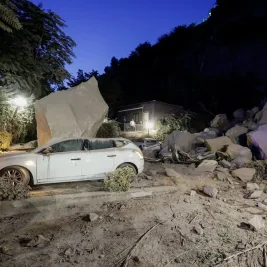
In the coastal town of La Guaira, where over 100 structures collapsed, residents pleaded for heavy excavation machinery to clear rubble.
"There are still people in there, we need machinery," said resident Eileen Lada.
Emergency medical personnel continue operating under extreme shortages as international rescue teams attempt to bypass airport closures.
"Help us, please," Lada said.
From a regional hospital bed, survivor Maria Vargas detailed the scale of destruction to the AFP news agency.
"It was awful – so many people died, so many family members went missing," Vargas said.
Local authorities continue checking destroyed residential complexes for remaining survivors as the critical 48-hour rescue window closes.
"I lost my house completely, but we're all right, thank God," Vargas said.