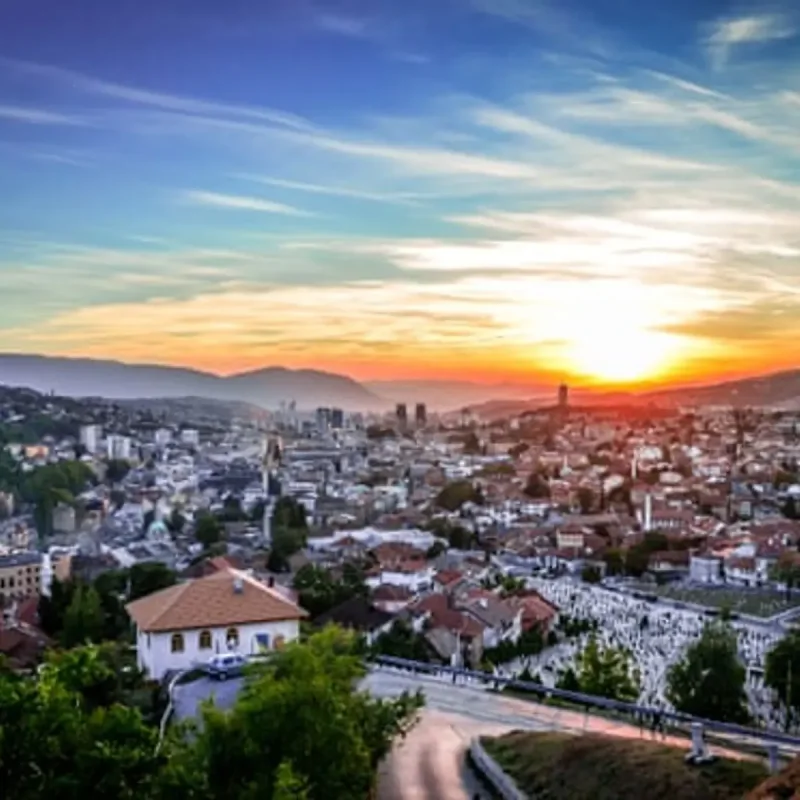
Diplomats from around the world are scheduled to gather in Sarajevo on Tuesday to resolve a severe disagreement between the US and Europe regarding a top envoy appointment.
This post holds significant powers that could deeply influence the future of Bosnia and Herzegovina.
The dispute centers on who will become the next high representative for the international community.
The Trump administration is assertively pushing a business-driven agenda that could potentially disrupt the delicate postwar political balance in Bosnia.
Ambassadors from the US, UK, France, Germany, Italy, and the EU, alongside envoys from Canada, Japan, and Turkey, will make a second attempt to agree on the position.
A previous meeting in early June broke up amid acrimony.
Before that meeting, the US administration rattled European capitals by demanding the removal of the current high representative, German politician Christian Schmidt.
Washington reportedly reneged on an agreement to let Schmidt stay until the October Bosnian elections for continuity and personal dignity.
In May, US officials demanded Schmidt's immediate departure and began aggressively campaigning for Antonio Zanardi Landi, a 76-year-old Italian diplomat.
This move bewildered most other members of the Peace Implementation Council (PIC) steering board, which convenes on Tuesday.
Landi has no significant previous experience or knowledge of Bosnia.
While he has previously expressed fondness for Serbia where he was once posted, he has not shown much interest in its neighbor.
Pipeline Deal at the Heart of Dispute
European officials in Sarajevo suspect Washington's abrupt maneuvering is tied to a new US priority to clear the way for a $1bn gas pipeline contract named the Southern Interconnection.
The deal was provisionally awarded to AAFS Infrastructure and Energy, a US-based company with minimal infrastructure experience but strong personal connections to Donald Trump.
Last month, the Trump administration unveiled a new Balkans policy stating that US actions would be guided by "direct return" for American companies instead of "open-ended institution building."
Jim O’Brien, a former US diplomat, wrote on the European Council on Foreign Relations website regarding the situation.
He said the policy "reflected what is already happening in the region under the second Trump administration" as "politically connected Americans seek to earn money by weakening … international institutions."
O'Brien added his view on the impact of these actions. "This behaviour undermines the peace that has held for 30 years," O’Brien said.
The pipeline contract was awarded without a tender, prompting a warning from the EU that it could jeopardize Bosnia’s long-term European integration.
This confrontation culminated in the row over Landi and the high representative position.
Landi currently serves as the ambassador to the Vatican of the Sovereign Military Order of Malta.
Contacted by the Guardian, he shared his perspective on the ongoing discussions, saying it was "unwise for me to step into the heated debate."
However, Landi argued that his focus manifesto circulated among PIC members was "perfectly in line with the European positions."
The Landi manifesto promises not to overturn decrees of previous high representatives, to consult the PIC before taking substantial actions, and not to unilaterally close the office.
London, France, and Berlin remain unconvinced by the Landi campaign.
As of Monday, they were aligned behind a French candidate, René Troccaz, who serves as France’s Balkans envoy.
Bosnia's Fragile Peace at Stake
This tussle underlines how much Bosnia’s current realities are still defined by the 1992-95 war, which killed 100,000 people.
Most victims were Muslim Bosniaks slaughtered by better-armed Serb forces, and to a lesser extent, Croats.
The US-brokered Dayton peace deal stopped the bloodshed in late 1995 but enshrined ethnic politics.
It divided the country into a Bosniak-Croat Federation and a Serb-run entity called the Republika Srpska.
The office of the high representative was established to oversee the Dayton agreement and guide Bosnia toward integration.
That mission has largely failed, leaving the country deeply divided, with Republika Srpska under the sway of Serb separatist Milorad Dodik.
Successive European high representatives have been reluctant to invoke their powers, but Schmidt stepped in last year to annul Dodik’s separatist actions.
This intervention led to the Serb leader’s ousting last September.
The hardliner's 28-year grip on power momentarily seemed broken, but the Trump administration later came to Dodik’s rescue.
The US abruptly lifted sanctions imposed by the Biden administration on Dodik and his associates for corruption and divisive rhetoric.
During the following months, the US president’s son, Donald Trump Jr., visited the main city of Republika Srpska, Banja Luka.
Subsequently, Dodik gave his approval to the Southern Interconnection pipeline.
Remaining obstacles to the project include EU objections and the fact that a third of the pipeline would be built on state property.
Ownership of Bosnia’s lands and forests remains a thorny postwar issue, as Dodik insists everything on Serb-controlled property belongs to Republika Srpska rather than the Bosnian state.
An official in Sarajevo outlined a possible scenario where Landi, upon taking office, would issue a special law dividing state property between the entities.
This would bring the pipeline closer to reality, and an AAFS official reportedly briefed parliamentarians that the issue would be resolved if Landi took over.
The US has threatened to reconsider its role in the international presence if Landi is not given the job.
It remained unclear on Monday evening if European capitals would give in or coalesce around Troccaz or a third compromise candidate.
The steering board pledged a decision by the end of June, but a participant noted it could be postponed if necessary.
The US State Department declined to comment on Monday because negotiations were still under way.
For the Bosniak majority, the collapse of western cohesion causes worry.
Most view the high representative's office as an essential safety net keeping Bosnia from a return to conflict, despite past inaction.
Ćamil Duraković, a Bosniak survivor of the Srebrenica genocide and current vice-president of Republika Srpska, expressed deep unsettling feelings regarding a potential US abandonment.
"They’re just giving up on everything, including democratic values, for the sake of business," Duraković said.
Duraković shared his concerns about the institutional impact.
"If the United States doesn’t empower democratic institutions in this country or an independent judicial system, then we are really in trouble."