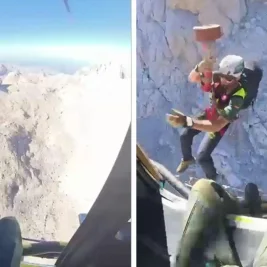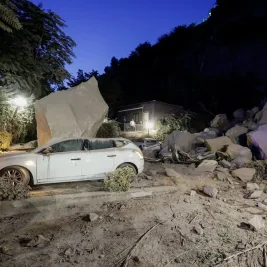
International rescue workers pulled a 43-year-old security guard alive from the rubble of a collapsed seven-story building on Thursday, eight days after twin earthquakes devastated Catia La Mar, Venezuela.
Hernan Gil survived after being trapped under 140 tonnes of rubble in a small concrete basement parking lot booth that shielded him during the June 24 disasters.
Emergency teams from seven nations, including Venezuela, Chile, the United States, Portugal, Costa Rica, El Salvador, and Mexico, collaborated for over 100 hours to extract him through a three-meter tunnel.
The rescue occurred as the official death toll reached 2,295, with 11,000 injured and approximately 50,000 people still missing across the country.
Authorities estimate that 60,000 buildings were damaged or destroyed, leaving 13,000 people homeless.
Complex Rescue Operation
A Chilean firefighter involved in the operation highlighted the extreme difficulties faced by the international emergency teams during the grueling extraction process.
"Without doubt the most complex and technically difficult which I've had to tackle," said the unnamed Chilean firefighter.
Costa Rican Red Cross paramedic Allan Madrigal, who first detected the survivor on Sunday, described the emotional weight of hearing signs of life beneath the debris.
"It was an emotional moment," Madrigal recalled. He added that the experience profoundly affected him during his deployment.
"The lad who came here a week ago is not the same one that will return to Costa Rica, believe me," Madrigal said.
An anonymous fellow Costa Rican Red Cross worker shared an optimistic update regarding Gil's physical condition just moments before the final extraction.
"He has told us that he does not even have a crushed nail," said the unnamed worker.
Mexican Red Cross member Marco Antonio Franco noted that the trapped security guard maintained an upbeat attitude and communicated preferences to his rescuers.
"A cheerful man," Franco described.
He informed the Mexican news site Milenio that Gil requested specific items to maintain his stamina during the multi-day rescue operation.
"He even asked for hydration drinks of specific flavours he likes," Franco said.
The rescue worker emphasized that the survivor actively motivated the teams throughout the complex extraction process.
"He himself drives us on, telling us to carry on.
He recognises our team members, saying 'how nice that you came back and that you're with me again'," Franco said.
The family of the survivor expressed profound relief following the successful extraction from the collapsed structure.
"This is truly a miracle," said Gusbimar Gonzalez, Gil's wife.
Chilean rescue team leader Cristian Vera explained the technical measures utilized to keep the trapped security guard stable before teams could physically reach him.
"It wasn't easy to reach the exact spot where the victim was located," Vera said.
Shift from Rescue to Relief
Al Jazeera correspondent Zein Basravi reported that search experts view the massive scale of destruction as an obstacle to finding more survivors.
"One search-and-rescue expert we spoke to on the ground said the footprint of this disaster is so big, there are 58,000 buildings that have been destroyed or damaged, there's so much area to search, and so many days into the aftermath of this earthquake, it is less and less likely that anyone can be found alive," Basravi said.
Basravi added that the focus of operations in the affected region is undergoing a significant transition.
"Move away from rescue and recovery into a very different phase of this disaster, which will see more relief work, more humanitarian work needed on the ground," Basravi said.
Journalist Noris Soto reported from Caracas that the severe economic context complicates the ongoing disaster response.
"Venezuela has been struggling with economic hardships for the past two decades.
So, if you add this disaster to that economic crisis that Venezuelans were already suffering, they will need help for years to come," Soto said.
Amid the devastation, the United States Department of State pledged $300 million in relief funding, while the World Food Programme appealed for $50 million to assist 500,000 affected residents over the next three months.