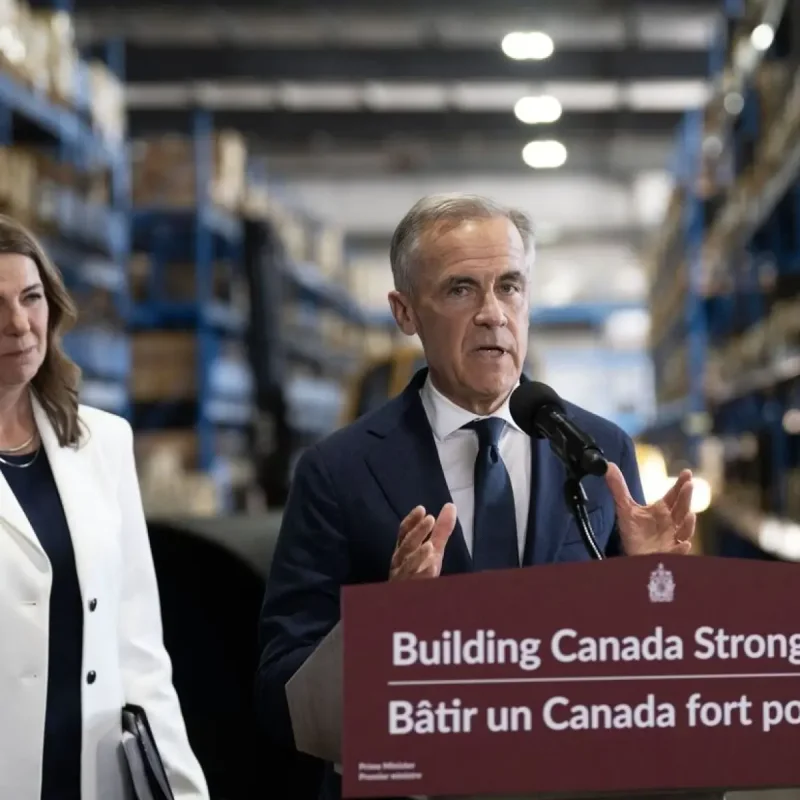
Prime Minister Mark Carney and Alberta Premier Danielle Smith announced a proposed 1,200-kilometer crude oil pipeline from Alberta to the British Columbia coast during an event in Calgary on Thursday, July 2, 2026.
The project aims to catalyze energy investments through heavy public sector funding.
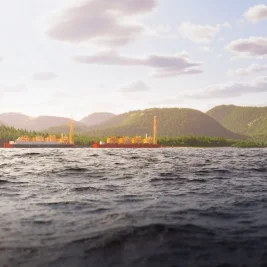
The pipeline will follow the existing Trans Mountain right-of-way to southern British Columbia, terminating at the Roberts Bank Terminal in Delta.
The federal government, via Trans Mountain Corporation, and the Alberta government, through the Alberta Petroleum Marketing Commission, will initially control 90 percent of the $35 billion project.
Just 10 percent will go to the private sector via Pembina Pipeline Corporation.
The proposal has been submitted to Ottawa's Major Projects Office for fast-tracked regulatory approvals.
Alongside the pipeline, the federal government committed $10 billion to upgrade infrastructure at the Delta port terminal, which faces criticism from environmental advocates regarding its impact on endangered orcas.
Economic and Political Support
University of Calgary economist Kent Fellows noted that while pipelines face regulatory profit limits, they generate widespread economic benefits through employment and government royalties.
"Pipelines do make money, but the amount of money that they make is limited by regulation and legislation," said Fellows, an associate professor at the university's School of Public Policy.
Fellows stated that infrastructure funding helps establish well-functioning markets, though he expressed a preference for market-driven solutions.
"As a fundamentalist free market economist, I am a little bit disappointed that we can't let the market take care of this one," Fellows added.
Local communities like Bruderheim, Alberta, where the pipeline would begin, anticipate positive economic spin-offs from the influx of workers.
"As a town that had very little growth in the last 20 years, any, you know, positive growth would be a great thing," said Bruderheim Mayor Ron Ewasiuk.
Local business owners also expect commercial growth from the increased population.
"We're going to have more people come to our store and then our business will grow too," said Bruderheim store owner Kim Chin Young.
Jackie Forrest of the ARC Energy Research Institute explained that alternative pipeline routes give Canadian producers better leverage against U.
S. customers.
"As soon as Trans Mountain started up, the Americans had to pay us a better price for our crude because we had options," Forrest said.
Forrest added that private companies have previously abandoned major Canadian infrastructure projects due to high regulatory risks and rejections.
"We have proven over the last decade that private companies can come here, spend hundreds of millions, if not a billion dollars, advancing a project only to get rejected," Forrest noted.
Martha Hall Findlay, director of the University of Calgary’s School of Public Policy, highlighted that major Canadian nation-building infrastructure historically requires public backing.
"If you look at Canadian history, nothing we've done that has been really big has been purely private," Hall Findlay said.
Heather Exner-Pirot of the Macdonald-Laurier Institute observed that past governmental interference has discouraged private capital from assuming such immense balance-sheet risks.
"This is an enormously expensive nation-building project, very difficult for any private proponent to accept it all on their balance sheet," Exner-Pirot said.
Former Alberta deputy minister of energy Grant Sprague stated that federal frameworks currently fail to attract sufficient private capital.
"It seems like that's the way we're," Sprague said on CBC Radio's Calgary Eyeopener.
Premier Danielle Smith defended the public funding model by citing the costly historical failures of the Northern Gateway, Energy East, and Keystone XL projects.
"That’s the environment we’re finding ourselves in, and so it does take some work, I think, to make sure that the private-sector proponents understand that this is a real process," Smith said.
Smith emphasized the joint political willpower dedicated to finalizing the pipeline infrastructure.
"This is a real commitment on the part of all three parties – myself, as well as the Premier of British Columbia, as well as the Prime Minister – to get this project to the finish line," Smith added.
Provincial and Environmental Reactions
British Columbia Premier David Eby stated that a signed memorandum secures federal infrastructure investments and ensures the preservation of the northern tanker ban.
"This agreement doesn’t require us to support any pipeline proposal from Alberta; however, as I’ve said before, we recognize our constitutional position, and we do not have the authority to stop a new pipeline.
That’s why this agreement matters," Eby said.
Eby maintained that the deal guarantees British Columbia will receive fair compensation for environmental liabilities.
"It ensures that the tanker ban stays in place, and it ensures that if a pipeline goes ahead, that British Columbians are fairly compensated for the environmental risks we would take on any new pipeline project," Eby stated.
Chief Marilyn Sleet of the Heiltsuk Nation expressed relief over the preservation of the Great Bear Sea tanker restrictions to protect tribal sustenance economies.
"We have been supporting this type of measure for at least five decades, and we had members there in the late 70s talking about what the impacts would be, talking about if an oil spill happened in our territory that it would finish us," Sleet said.
Sleet emphasized the community's dependence on the coastal waters for food and cultural longevity.
"We rely upon a healthy ocean for our way of life, our sustenance, for a sustainable economy.
Some of our members harvest up to 60 per cent of their food from the ocean," Sleet added.
Chief Sleet reiterated support for the joint government stance against shipping lanes in the region.
"We are happy that both governments have once again recognized what we have always known: that the Great Bear Sea is no place for oil tankers," Sleet said.
Alexa Young, spokesperson for the Port of Vancouver, noted that the Roberts Bank Terminal 2 project will massively scale up regional container trade capacity.
"As we look to double exports, that’s going to require a lot more capacity, and thankfully we have game-changing projects on the horizon like Roberts Bank Terminal 2 that’s going to increase container trade capacity by $100 billion annually," Young told CityNews.
Lucero Gonzales of the Wilderness Committee strongly opposed the port expansion due to severe ecological impacts on southern resident killer whales.
"All of that together is happening in the Fraser River; I can tell you that my reaction is it is an ecological nightmare," Gonzales said.
Gonzales warned that increased maritime transit threatens the local whale population with extinction.
"Any more added traffic into the habitat of these orcas will increase underwater noise, will make food scarcer, and will make it harder for these orcas to communicate, to hunt, and to rest.
This environment is already a very noisy environment, even without the construction of RBT 2 or a new pipeline.
You cannot add any more noise to this environment without driving these species to extinction," Gonzales concluded.
Delta Mayor George Harvie welcomed the federal funding for the George Massey Tunnel replacement but called for clearer project schedules.
"We need to have some clarity and some answers with regards to the overall project, how much it’s going to cost, approximately, what are the timelines, and what are they doing to remove the risk that has come up with regards to building a new tunnel next to the existing tunnel," Harvie said.