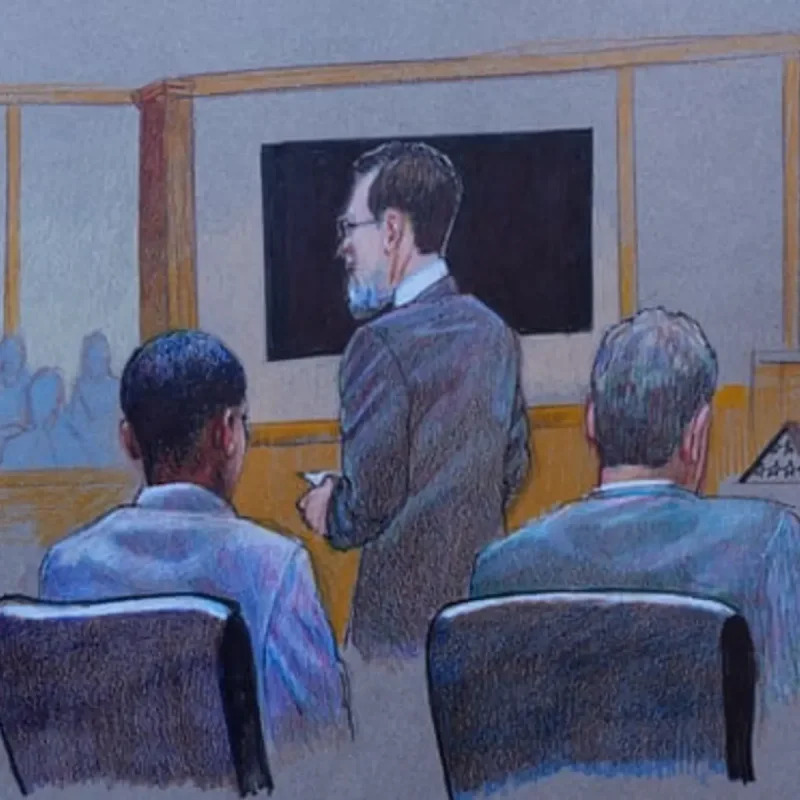
Some of the United Kingdom's top judges are currently reviewing arguments regarding the legal authority of a Trinidad and Tobago court to reinstate a colonial-era homophobic law.
The legal challenge addresses whether the local court had the right to overturn a 2018 decision that removed laws criminalizing anal sex between consenting men.
The legislation, known as the "buggery" or "sodomy" law, originated in 1925 and was integrated into the Sexual Offences Act of Trinidad and Tobago in 1986.
Activist Jason Jones launched a legal challenge in 2017, leading to a high court ruling in 2018 that the statute violated his constitutional rights to equality and privacy.
However, an intervention by the attorney general led an appeals court to quash that initial ruling last year.
The case has now escalated to the London-based Judicial Committee of the Privy Council (JCPC), the highest court of appeal for several independent Commonwealth nations and UK overseas territories, using the same judges as the UK Supreme Court.
The legal proceedings are drawing close attention from activists across the Caribbean, with a final ruling anticipated within three to six months.
Regional Context and Government Position
While nations like the Bahamas decriminalized homosexuality in 1991, and the UK repealed similar laws in its territories such as Anguilla and the Cayman Islands in 2001, enforcement remains active in some regional countries.
Recent judicial rulings have dismantled such laws in Barbados, Dominica, St Lucia, and Antigua and Barbuda, but consensual same-sex intimacy remains criminalized in Guyana, Grenada, Jamaica, St Vincent and the Grenadines, and Trinidad and Tobago.
The government of Trinidad and Tobago is actively opposing the appeal.
Prime Minister Kamla Persad-Bissessar noted that the outcome could influence other historical "savings clauses" enacted during colonial rule to preserve British laws post-independence.
"This ruling is going to be a very profound decision, not just impacting on sodomy laws but that whole issue of the saving clause," Persad-Bissessar told the Guardian.
"We have a lot of colonial laws that were saved, so this will give us guidance as to which ones we keep, which ones we don't keep."
Darrell Allahar, a minister in the office of the prime minister and a member of the legal team, described the Privy Council hearing as a beneficial exercise for obtaining clarity on the constitutional mechanism.
"We want to get the court's view because the issue is more than the sodomy laws, the issue has to do with what is called the savings clause, which is a feature of all of our constitutions in the English-speaking Caribbean," he said.
Allahar added that the clauses were created "to save existing laws at independence so we don't have a wholesale gutting of those laws in light of the human rights provisions."
Activist and International Perspectives
The 61-year-old activist Jason Jones expressed frustration that the legal dispute had to reach a British appellate court instead of being resolved locally.
"At any time over the last decade of my legal challenge, the state and indeed parliament could have put a stop to this and just removed these heinous laws themselves," he said.
"They have wasted millions of taxpayers' money fighting me."
Under the contested statute, individuals can face up to five years in prison for consensual same-sex actions, a penalty that Jones argues creates severe systemic harm.
"It dehumanises LGBTQ+ people. It makes us both a criminal and a victim at the same time," he said.
Jones remains optimistic about the final judgment.
"The privy council will never uphold a 500-year-old homophobic piece of British law that goes against the rights of the individual.
Not in 2026," he said. "I know I'm on the right side of history."
Leo Varadkar, the former Irish taoiseach and current global LGBTQI and human rights fellow at Harvard University, pointed out that the only five countries in the Americas continuing to outlaw homosexuality share a history of British administration.
He highlighted the contradiction of former colonies maintaining legal structures that the UK discarded long ago.
In a research paper published for Harvard, Varadkar wrote: "From Canada in the north to Chile in the south, homosexuality has been long since been decriminalised in the 35 countries that make up the Americas" apart from Jamaica, Guyana, St Vincent and the Grenadines, Trinidad and Tobago, and Grenada.
"All are anglophone and formerly part of the British empire. This is not a coincidence."
Varadkar added that the presiding UK judges are fully aware that core human rights, including bodily autonomy and the right to privacy, are firmly protected under modern British law.