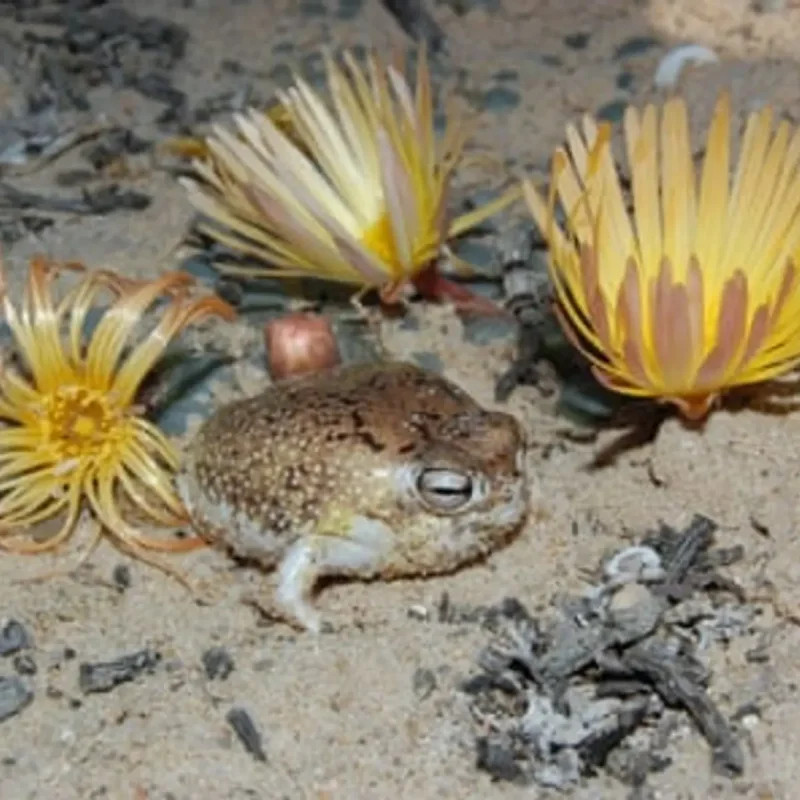
The International Union for Conservation of Nature (IUCN) has classified the round desert rain frog as vulnerable on its Red List, citing threats from mining and infrastructure projects.
The species, known scientifically as Breviceps macrops, lives exclusively along a narrow coastal strip in northwestern South Africa and southwestern Namibia.
According to conservationists, without immediate protection, the global population could drop by 20% over the next decade.
Industrial Expansion Threatens Habitat
Large-scale diamond mining and infrastructure developments, such as the Boegoebaai port and rail project, are expected to disrupt one-third of the frog's South African range and two-thirds of its Namibian range within 20 years.
Dr Jeanne Tarrant, executive director of Anura Africa and co-chair of the IUCN Amphibian Specialist Group, described the frog as a completely unique species adapted to a harsh desert environment.
“It [exhibits] the least typical frog kind of behaviour that you can get,” she said, noting that most frogs prefer moist, tropical conditions.
Unique Adaptations and Behavior
The nocturnal amphibian spends daylight hours buried in coastal sand dunes, emerging at night to hunt termites and insects.
It burrows backward about 30 centimeters to find moist sand layers.
Louis du Preez, professor of zoology at North-West University in South Africa, explained that the frog can survive underground for months by absorbing oxygen from the soil.
Upon emerging, it absorbs moisture through a specialized pink patch on its belly that collects water from fog.
Its round, compact body minimizes surface area to prevent dehydration.
Termites are its primary food source.
“If it’s absolutely at full capacity and there’s another termite walking past, it will go for it,” du Preez said, adding that the frog may take more termites than it can swallow.
Reproduction involves unusual adaptations.
The male secretes a glue from his chest and forearms to attach to the female during mating, as her round shape prevents a typical grip.
The female lays eggs in a subterranean chamber, placing unfertilized eggs over fertilized ones.
The unfertilized eggs liquefy, creating a fluid that tadpoles stir into an oxygen-rich foam layer.
“Among all the frogs in the world, this one has got really unique breeding, biology, physical features, morphology,” du Preez said, emphasizing that conserving sand dunes is the best way to protect the species.
Social Media and Illegal Trade Concerns
Viral videos showing the frog's high-pitched squeak, which resembles a toy, have raised fears of illegal wildlife trading.
Tarrant noted that the sound is actually an expression of terror, often caused by poking or trauma.
Despite millions of views and online inquiries about purchasing the frog, conservationists strongly discourage captivity, as its specialized environmental needs are difficult to replicate.
The IUCN Red List listing highlights the urgent need for habitat protection to ensure the survival of this unique amphibian.