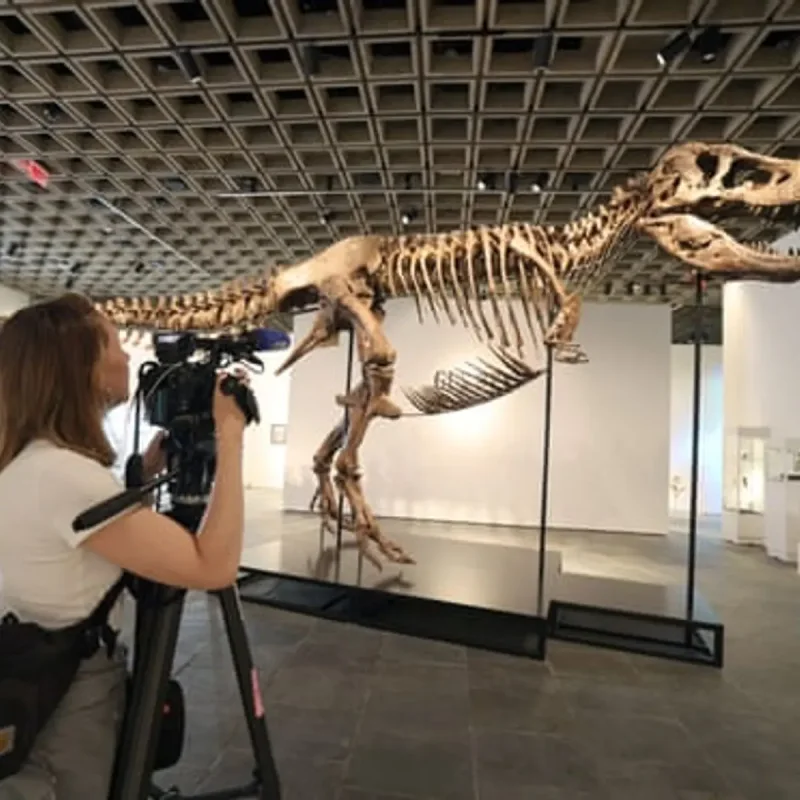
A massive and highly complete Tyrannosaurus rex skeleton is set to go under the hammer at Sotheby's in New York on Tuesday.
The prehistoric specimen, nicknamed "Gus," is expected to fetch between $20 million and $30 million.
This auction follows a recent trend where dinosaur fossils command astronomical prices, similar to rare masterpieces in the art market.
In 2024, a Stegosaurus named Apex set a record by selling for $44.6 million at a Sotheby's event, which was 11 times its original listing price.
Gus stands approximately 3.8 meters tall in a predatory stance and is estimated to be around 67 million years old.
Discovery and Excavation
The commercial firm Theropoda Expeditions excavated the adult dinosaur over three years starting in 2021 on a ranch in Harding County, South Dakota.
Landowner Gary "Gus" Licking granted permission for the dig but passed away before researchers completed the excavation process.
Field prospector Cole Jacobs discovered the remains on his first day on the site after spotting a metatarsal bone protruding from the earth.
While the discovery marks a significant find, the commercial sale of such specimens worries global scientific communities.
University of Birmingham vertebrate paleontologist Prof Richard Butler expressed deep concern over marketing fossils as status symbols or commodities.
"A fossil not in a recognized museum collection cannot be studied and is therefore lost to research.
Fossils have been bought and sold for hundreds of years, but prices are increasingly out of the reach of museums, much to the detriment of science," he said.
Prof Stephen Brusatte from the University of Edinburgh noted that while the American sale is legal under local property laws, it remains worrisome.
"If a dinosaur like this fetches tens of millions of dollars at auction, then there's little that scientists or museums or universities can do.
Those prices can only be paid by the super-rich," he said.
The trend contrasts with the 1997 auction of "Sue," a T. rex purchased for $8 million by Chicago's Field Museum via public and corporate backing.
Today, high-profile celebrities and wealthy individuals increasingly view fossil collection as a private hobby.
University of Bristol professor Michael Benton suggested some buyers generate public good by loaning acquisitions to museums.
Billionaire Ken Griffin previously followed this model by loaning the Apex specimen to the American Natural History Museum for four years.
However, Carthage College associate professor Dr. Thomas Carr emphasized that short-term museum loans do not secure scientific advancement.
"A private collection has no guarantee that a fossil will stay in a collection for all time, whereas a public trust's mission is to maintain, conserve and curate its collection indefinitely," he said.
"Fossils need to be available to test previous observations and to make new insights; the fossils are the data so they must always be available for study."
Carr also pointed out that private owners retain the right to recall fossils at any moment, breaking the scientific principle of replicability.
Many scientific journals now require research papers to rely solely on fossils kept in permanent public repositories.
"When we publish research, we need to make sure that research is repeatable, meaning that other scientists can check our data and results and verify our conclusions, or not," said Brusatte.
"The only way for our research to be repeatable is if the dinosaur fossils we study are in a museum, where other scientists are guaranteed access to them."
Carr argued for legal protection against commercial exploitation on private lands, advocating for systems similar to Mongolia where fossils belong to the state.
"A fossil in a public trust is a win for science and society all around," he said, "rather than being hoarded in some McBillionaire's living room."
Sotheby's experts defended the commercial framework, stating that private outfits ensure rare fossils are successfully retrieved from the ground.