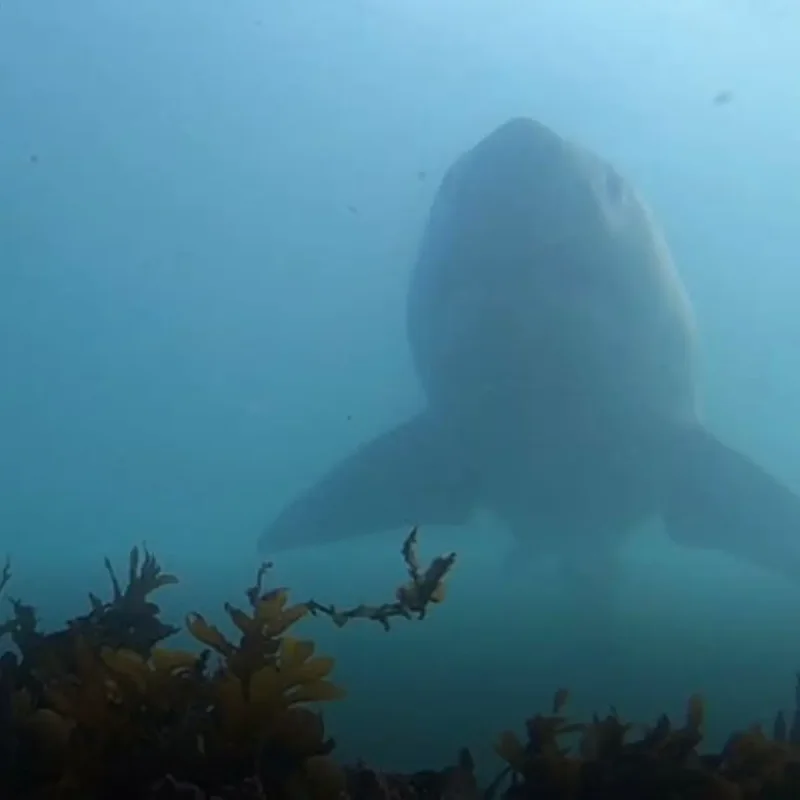
California is set to experience one of its sharkiest summers in a decade, as large numbers of juvenile great whites migrate from warm Mexican waters to cooler areas along the western United States.
The marine predator has become more common along the west coast in recent years.
Surfers report seeing underwater behemoths closer to shore, and scientists say swimmers and ocean-lovers are likely already sharing their favorite beaches with great whites, whether they know it or not.
"We're already seeing a high number of white sharks," said Dr. Chris Lowe, director of the Shark Lab at California State University Long Beach.
"We started seeing baby white sharks in February, which we've never seen before. Usually that happens in April."
El Niño Drives Shark Migration
One major reason for the influx is El Niño.
Forecasters at the National Oceanic and Atmospheric Administration (NOAA) confirmed the formation of the climate phenomenon in the Pacific in early June.
El Niño can cause worldwide impacts, including heatwaves, drought, heavy rainfall, and extreme weather. Science agencies have said this year's could be incredibly strong.
For fish and ocean life, including sharks, warmer oceans can cause mass migrations. Cold-water species move from their usual ranges further north or into deeper waters.
"Every El Niño is not the same; each one is unique with its own imprint on our weather," said Ken Graham, director of NOAA's National Weather Service.
Lowe noted that the last time conditions matched those forming in the Pacific, it was a sharky time for California.
His team at the CSULB Shark Lab has been tagging and tracking juvenile great whites for 20 years.
In 2015 – an El Niño year that coincided with a marine heatwave known as the "Blob" – the lab saw "twice as many white sharks" along the California coast.
A few years later, on a trip to Baja California, a known white shark nursery, Lowe heard that fishers had seen almost no sharks in Mexico's waters that summer.
"When we have these El Niño conditions, it gets too warm, and the white sharks don't like it," Lowe said.
"And it pushes them into California."
Adult white sharks are massive, ranging from 10 to 20 feet in length. But most of those off California's coastline are juveniles.
White sharks are born as live young at about 5 feet in length.
A juvenile is classified as any shark between 6 and 9 feet from snout to tail.
The younger sharks spend much of their time closer to shore, migrating between areas with shallower waters where ample food is available.
Stingrays, fish, and squid are all on the menu.
Lowe says California waters will probably host a few more visitors than just white sharks while the water's warm.
In 2015, a big influx of smooth hammerhead sharks came up from Baja California, following schools of mahi mahi.
Whole suites of subtropical species – the food source for great whites – replaced the usual populations of squid, anchovies, and sardines, providing an El Niño buffet just off the coast of southern California.
"I expect any day we're going to start seeing hammerheads," Lowe said.
Conservation and Risk Management
Local officials have already taken measures to protect both sharks and beachgoers.
The California Department of Fish and Wildlife said it was "anticipating a larger presence of white sharks."
The body passed emergency regulations last month to prohibit the use of certain fishing gear at beaches and on piers to limit any accidental hooking of white sharks.
The species are fully protected in California, and it's illegal to catch them.
But John Ugoretz, a pelagic fisheries and ecosystems program manager at the state's fish and wildlife department, said that hasn't stopped people from trying.
Modern fishing equipment presents a major danger to swimmers and surfers.
A powerful shark snared on a metallic line could "become like a cheese cutter" that could decapitate a person, Lowe says.
"What we've seen already this year is a pretty significant increase in people interacting with those white sharks in southern California in particular," Ugoretz said.
"That includes people fishing for white sharks."
He added that California has seen "aggregations" of white sharks regularly, but in El Niño years those aggregations are bigger, move further north towards Santa Cruz and Monterey Bay, and stay later into the year.
"Conservation measures for sharks in California have already been successful, and we're already seeing increases [in populations]," Ugoretz said.
"We're just very concerned with the potential, not only for additional sharks being caught and killed, but also the potential for a hooked shark to wrap the line around a swimmer, or even in a worse case, biting someone while it's fighting on that line."
Both Lowe and Ugoretz stressed that shark bites remain a rarity in California, and fatal ones even more so.
There have been fewer than 250 shark incidents in the state since 1950 across all shark species, and just 17 of those were fatal.
More than 85% of those 250 incidents, however, involved white sharks. At the same time, white shark populations have increased due to widespread conservation measures.
"We always assumed that the more sharks and the more people you put together, the higher the likelihood of bites," Lowe said.
"But what we're seeing in California is actually the opposite."
"These sharks are around so many people, and they recognize that we're not prey."
Ugoretz said beachgoers should take comfort knowing that a sighting of a white shark remains a rare experience, like seeing a mountain lion or a bear on a hike.
Caution is needed, but you're in their territory.
"The one thing I always tell people about the ocean is: when you go into the wildness you might encounter a wild animal, just like when you go into a forest and maybe see a bear," Ugoretz said.
"If you do, you're probably lucky because you're seeing them at all. It's part of the diversity of the marine environment."
Lowe said if you asked him if the beaches were safe from shark incidents 10 or 15 years ago, he wouldn't have given you the same answer he does now.
"When I first started this work, lifeguards would ask me this exact same question: is it safe to be in the water with them?"
he said. "And to be honest, we did not know."
Now, he said, the Shark Lab's research shows white sharks are intelligent, apex predators for a reason, and they largely know humans are not dinner.
"Flash forward 20 years later, based on all our drone data, I swim with these white sharks every day, and I have no qualms doing it," Lowe said.
"How do we explain the fact that people are around white sharks every day, some 9-, 10-, 12-, 14-feet long, and are not being bitten?
They've learned that we're not food."
Obviously incidents do happen, and Lowe said it was unclear why sharks occasionally bite people.
The most common go-to explanation is mistaken identity, possibly with sharks that haven't been around many people.
But they are extremely uncommon when you consider the number of sharks in the water and the amount of people on a hot summer's day.
"As I'm speaking to you, a white shark is swimming by a surfer or swimmer who doesn't know the shark is there," Lowe said.