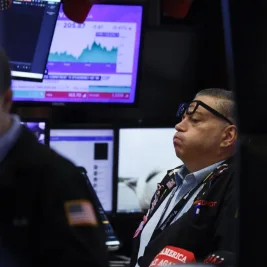
Wall Street remained quiet ahead of the highly anticipated monthly jobs report, following a shortened trading week due to the July 4th holiday.
S&P and Nasdaq futures showed little change, while Dow futures edged slightly lower as investors looked for signs of a gentle cooling-off in the labor market.
The upcoming government tally is expected to trigger a more significant response from traders than Wednesday's ADP private payroll data, which fell to 150,000.
Economists Expect Slower Job Gains in June
Economists largely expect that net job gains in June cooled off to an estimated 190,000, representing a pullback from the net gain of 272,000 recorded in May.
In May, the US unemployment rate increased to 4%, a level not seen since January 2022, even though job growth remained strong during that month.
First-time claims for unemployment benefits have drifted higher in recent weeks, landing in line with pre-pandemic averages, according to labor economists.
Marisa DiNatale, head labor economist for Moody’s Analytics, noted that initial jobless claims are rising between the May and June payroll survey reference months.
"They’re still low, historically speaking, but they are up between the May and June payroll survey reference months, so we do think we could see some slowdown in job growth over the month," DiNatale said.
While June's job gains should remain steady, a growing chorus of economic data indicates that consumer spending is letting up and workers are feeling less secure.
ADP’s chief economist, Nela Richardson, emphasized that a gradual cooling is acceptable, but a steep decline would serve as a warning sign for the economy.
"I think as long as the job gains continue to show a gradual cooling, this economy is in good shape," Richardson said.
ADP estimated that private employers added 150,000 jobs last month, down from 157,000 in May.
"If we see the cooldown go from gradual to steep, I think that’s a warning," she said.
Stability and Federal Reserve Considerations
Nick Bunker, Indeed Hiring Lab’s head of economic research, wrote that the current level of job openings is consistent with a healthy and balanced market.
"The words ‘little changed’ were repeated no fewer than a half dozen times in the May JOLTS release, and virtually every key indicator tracked showed limited notable movement, either up or down," Bunker wrote.
"This short-run stability is a good thing.
But the question remains if this period of calm can continue or if more unsteady times are on the horizon," he wrote.
"This current level of job openings is consistent with a healthy, sustainable and balanced market, but any continued declines below these current levels will quickly become more worrisome."
Bunker added that it may take an interest rate cut to ensure employers' demand for workers does not tumble too far in the coming months.
Federal Reserve officials still believe the job market remains on solid footing, comfortably keeping interest rates at a 23-year high as they await more inflation evidence.
Chicago Fed President Austan Goolsbee noted that while the unemployment rate remains low, policymakers must balance labor market softening with progress on inflation.
"If employment starts falling apart or if the economy begins to weaken, of which you’ve seen some warning signs, you’ve got to balance that off with the progress you’re making on the price front," Goolsbee said.
"The unemployment rate is still quite low, but it has been rising," he said.
Workers' wage gains have also been slowing, with economists expecting June month-on-month average hourly earnings to land around 0.3% down from 0.4% in May.
Federal Reserve Chair Jerome Powell recently noted that the labor market is cooling off appropriately and moving toward a more sustainable level.
"Wage increases are still a bit above where they would wind up in equilibrium; but nonetheless, you can see the labor market is cooling off appropriately," Powell said.
"We’re watching it very carefully, but it doesn’t look like it’s heating up or presenting a big problem for inflation."
The overall labor force participation rate dipped in May to 62.5% from 62.7%, while employers appear to be shifting toward hiring more part-time workers.
Rachel Sederberg, senior economist at Lightcast, noted that while involuntary part-time workers have increased, their total numbers remain very low.
"They’d like full-time hours but can’t get them, which is potentially an indicator of a softening labor market," Sederberg said.
"That said, the number of people who are involuntarily part time are still very, very low."
Department of Labor data showed that first-time claims for unemployment benefits rose by 4,000 to an estimated 238,000 last week, lifting the four-week average.
Furthermore, Americans are staying unemployed longer, as continuing claims rose to their highest level since November 2021.
Luke Tilley, Wilmington Trust’s chief economist, stated that the three-month average of permanent job losers is up about 200,000 people from last year.
"On a three-month average basis, it’s up about 200,000 people from last year," Tilley said.
"And that metric of permanent job losers, year-over-year, is almost never positive in an expansion.
It was never positive between 2010 and 2019; it was not positive in between the tech crash recession of 2001 and then 2008," he said.
"So when you sort of peel back the onion from what looks like very strong job growth in a raw number count and look at it a little closer … that paints a labor market that has normalized and is at risk of slipping."
Despite these concerns, data from Challenger, Gray & Christmas showed that US-based employers announced 48,786 job cuts in June, down 24% from May.