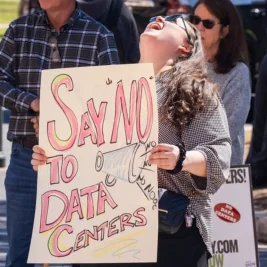
Last February, Molly Walker posted an Instagram photo of herself holding a protest sign in the desert. The text read: "...
if you want to organize, DM me."
Born and raised in Big Bend, Texas, Walker had no idea that post would spark a bipartisan grassroots campaign.
"The five people who responded to that photo," says Walker, founder of No Big Bend Wall (NBBW), "with their various skill sets, I thought, 'Wait … we can actually do something.'"
Walker and others have since paused their careers to fight the proposed border wall, which they say threatens their home, livelihoods, and the Rio Grande corridor.
"I've walked away from all of my sources of income," Walker says.
The sacrifice has reshaped their daily lives as they confront the federal apparatus driving the project.
"We've tried to put our energy back into our other work, but it doesn't feel right," she adds.
The emotional weight took a toll. "At first, I wasn't even eating or sleeping.
I didn't expect my Instagram post to become the foundational block. I felt responsible," Walker says.
An Unlikely Bipartisan Alliance
Media attention has focused on the unlikely bipartisanship.
Border agents, sheriffs, progressive activists, and politicians from both sides have coalesced, drawing up lawsuits and mobilizing landowners.
"I've never worked with so many conservatives," says activist Clara Bensen.
However, the picture is more nuanced. Some locals have cooperated with contractors.
A pecan farmer sold water to a construction camp. A landowner leased space to wall contractors.
Outdoor company Yeti's co-founder Ryan Seiders, part-owner of Moody Bennett Ranch, allowed Barnard Construction to use the land for equipment and materials.
"Yeti Holdings does not have any involvement or ownership in Moody Bennett Ranch," a Yeti spokesperson said.
This cooperation complicates the grassroots efforts.
"The only reason there's any work getting done is those people, and they stand to make a lot of money," says Yolanda Alvarado, landowner coordinator for NBBW.
Alvarado explains landowners' rights and legal options.
If more capitulate, she has much to lose: the wall would cut her family's ranch in two, leaving their well and ancestral cemetery inaccessible.
"We're fighting like hell," says David Keller, NBBW board member.
Despite federal resources, the opposition remains firm.
"A lot of people say, 'This is the federal government and they'll do what they want,' and I'm like, 'That's not how this works.'
We have a brilliant team. There's not going to be a wall," Alvarado says.
Rooted to the Border Wilderness
Deep ancestral ties motivate local residents. "I have family from Presidio that goes way back.
As a little girl we'd travel here and I dreamed of living here," says resident Anna Claire Beasley.
"I'm not going to roll over."
The feeling of isolation reinforces their drive. "We know that we only have each other.
There's no one we can call," Beasley says.
Most Americans don't care much about far-west Texas, so locals lead the fight. At the highest levels, the Texas GOP has used noncommittal language.
"No idea what the border actually is," Walker says.
"The American understanding is built off worst-case scenarios and manufactured fear rhetoric; it completely disregards that there are American lives and thriving communities rooted to the border."
The fight remains in residents' hands. Keller lost his job, both parents, and a serious relationship.
Big Bend is all he has left.
"I've pinned my entire life on this place," Keller says. "So what does it mean to lose it?
Some might say, 'Well, you're not losing it. They're just building a wall through it.'
But to me, it's a total loss. I don't know if I could stay."