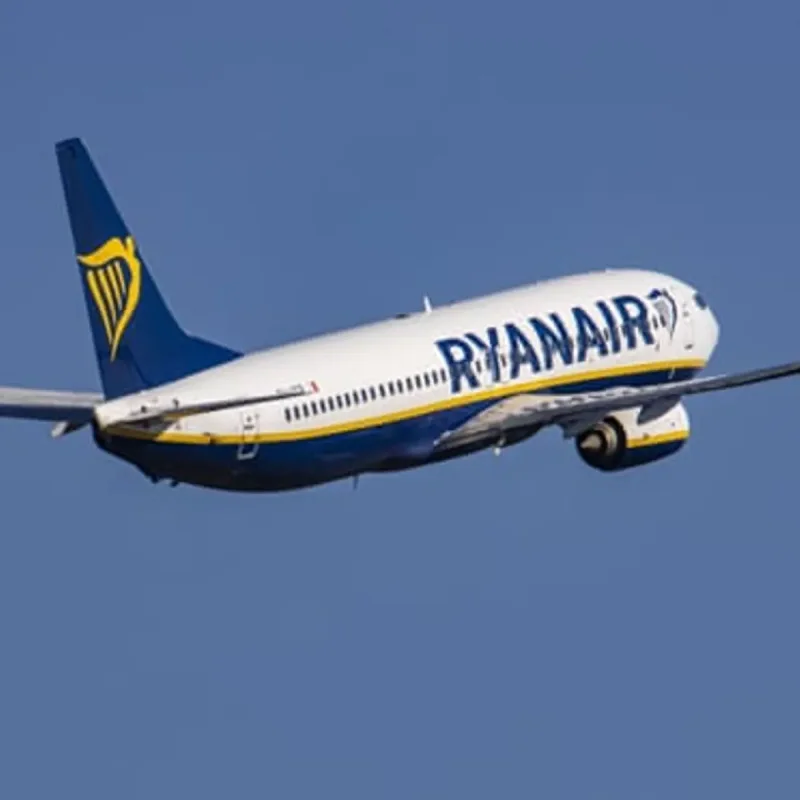
A passenger on a Ryanair-Air Malta flight was nearly sucked out of a broken window last week, an ordeal that experts say is extremely rare but survivable.
Ljubisa Karović was on flight FR3141 from Thessaloniki, Greece, when the window next to him blew out of the Boeing 737-800.
His head and shoulders were pulled outside the aircraft.
His wife and fellow passengers helped keep him inside. The plane returned to Thessaloniki shortly after takeoff, according to Ryanair.
What Caused the Window to Blow Out?
Investigators have not confirmed details, but passenger reports suggest the window broke after being struck by debris from a failed right engine at about 16,000 feet.
Footage posted online appears to show a missing fan blade.
The incident occurred over North Macedonia, where authorities said the plane turned around due to a right engine issue and cabin decompression.
Karović had his seatbelt on, which helped. Airliner windows are small, and an adult body can physically block the hole.
The most severe suction is short-lived.
“The airflow is sudden and will stop once the pressure inside the cabin is same as the pressure outside,” said Dr Jason Knight, senior lecturer in fluid mechanics at the University of Portsmouth.
Previous Incidents and Survival
In 2018, a passenger on a Southwest Airlines flight was partially sucked out of a broken window and died despite being pulled back in.
That incident also involved a Boeing 737 with a broken fan blade.
In 2024, an entire door panel blew out of a Boeing 737 Max on an Alaska Air flight, but the adjacent seats were unoccupied.
Most recent cases have been survived. A Sichuan Airlines co-pilot suffered only a broken wrist after going partly through a window in 2018.
In 1990, a British Airways pilot was held in by his legs for 20 minutes after a windshield blew out.
He survived with severe injuries.
“Hypoxia is one risk, the other is physical trauma, and the other is psychological trauma,” said Dr Simon Bennett, a pilot and director of the civil safety and security unit at University of Leicester.
“But one can survive.”
Who Is Most at Risk?
People close to the window and not wearing a seatbelt are most at risk, especially if they are small enough to pass through.
Those in rows in front and behind are protected by seats.
“The maximum speed of airflow is through the window itself, so anybody close to the window that could fit through the window is at risk,” said Knight.
Doors are much larger, so anyone near a door would also be at risk, but such incidents are very rare.
Planes are designed to withstand a window blowing out, but sudden pressure loss can cause problems on older or poorly maintained aircraft.
“If it had been an ancient airframe, one that was 25, 30 years old, that could have triggered other latent failures,” said Bennett.
Maintenance Concerns
Bennett is worried about the rise in airlines contracting out manufacturing and maintenance. “What history teaches us is that the weak point here is maintenance,” he said.
Subcontracting makes quality control more difficult, especially in a dispersed system.
The only obvious precaution is wearing a seatbelt and avoiding window seats near engines.
The exact window that shattered on the Ryanair flight is not confirmed but appears to have been around seats 12F, 14F or 15F.
Once decompression occurs, the risk to others assisting is low. Experts advise following crew instructions.
“Don’t get blase,” said Bennett.
“When a cabin crew member stands in front of you before takeoff and shows you how to put a lifejacket on, bloody well listen.”