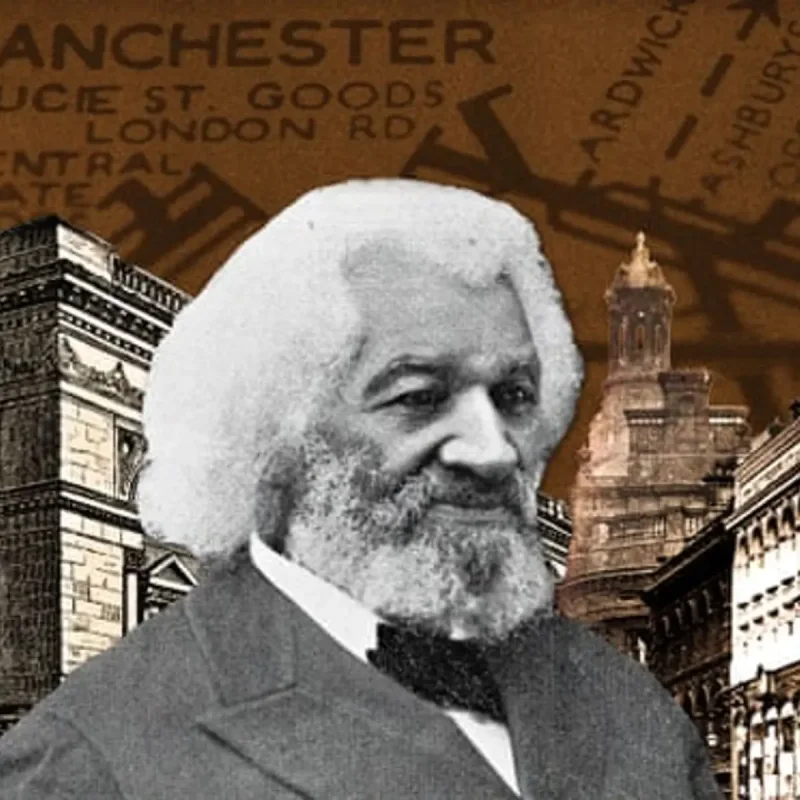
The Manchester Literary and Philosophical Society (Lit and Phil) has established an annual lecture series celebrating the legacy of Frederick Douglass, the renowned author, orator, and American statesman.
The initiative marks the 180th anniversary of Douglass delivering historic lectures across Manchester and surrounding regions.
Inaugural Lecture and Collaboration
The first lecture, titled Frederick Douglass: A Global Life, took place in June 2026.
It was organized in collaboration with the peacebuilding organization Carisma and the University of Manchester research platform Creative Manchester.
Historian David Olusoga delivered the inaugural lecture, highlighting how Douglass's time in a non-segregated society allowed him intellectual growth.
"The impact of Frederick Douglass on Britain and Britain’s impact on him, was profound," Olusoga said. "He became a sensation.
He revitalised the anti-slavery cause here in Britain in a way that no other speaker could."
Douglass's Journey to Freedom
Born into slavery in Maryland in 1818, Douglass escaped to the northern United States as a teenager with financial help from his future wife, Anna Murray.
He published his first autobiography in 1845.
That same year, Douglass began a 19-month tour of Britain and Ireland, using Manchester as his primary base.
He spoke at venues like the Free Trade Hall and the Mechanics Institute while Manchester was at the center of the global cotton trade, processing materials grown and packed by enslaved individuals.
During his stay, Douglass gathered funds to launch his abolitionist newspaper, the North Star, and officially secured his legal freedom.
Quaker abolitionists Anna and Ellen Richardson raised £150 to purchase his freedom from his American owner, Thomas Auld, with support from local reformers like John Bright.
The transaction faced criticism from some uncompromising white American abolitionists, including Henry C Wright, who argued Douglass had always been naturally free.
Douglass responded in a letter from Manchester dated December 22, 1846, clarifying his legal status and the necessity of the purchase.
"I am legally the property of Thomas Auld, and if I go to the United States, Thomas Auld, aided by the American government can seize, bind and fetter, and drag me from my family," Douglass wrote.
"It was not to compensate the slave-holder, but to release me from his power; not to establish my natural right to freedom, but to release me from all legal liabilities to slavery."
Return to Britain and Lasting Impact
Douglass returned to Britain in 1859 amid a pro-slavery backlash in the United States following John Brown's raid on Harpers Ferry.
By his second visit, racial attitudes in Britain had hardened, forcing him to counter scientific racism and pro-slavery advocacy.
Despite shifting sentiments, the abolitionist spirit endured, culminating in Lancashire cotton workers boycotting slave-produced cotton during the American Civil War.
In March 1847, before returning home, Douglass delivered a farewell address in London reflecting on his transformative journey.
"I go back to the United States not as I landed here – I came a slave; I go back a free man.
I came here a thing – I go back a human being," he said.