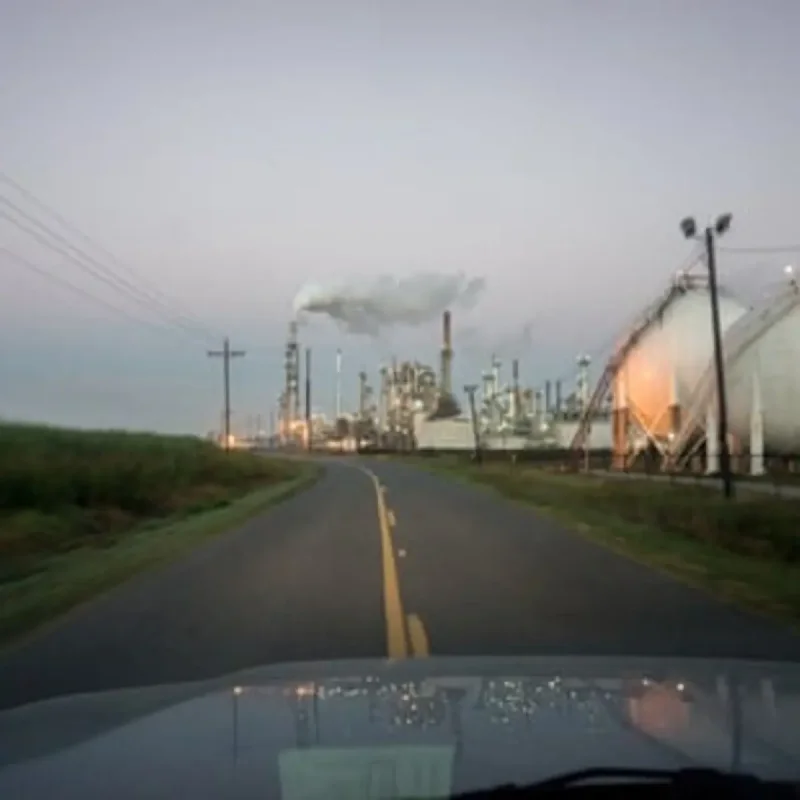
Kimbrelle Kyereh lives just a few hundred feet from massive chemical storage tanks in St Rose, Louisiana.
Oily fumes sometimes drift into her home, causing headaches, nausea, and insomnia. One night, she grabbed her son at 3am and fled to an all-night Ihop.
In 2023, Kyereh began collecting air samples in her yard for a local environmental justice group.
But soon after, Louisiana passed an industry-backed law that sharply restricted how such data could be used. She stopped.
“I shut my mouth like they wanted me to,” said Kyereh.
Along the 85-mile corridor between Baton Rouge and New Orleans, cancer rates from toxic air pollution are among the nation’s highest.
Many residents live in the shadows of heavy industry with no idea what they’re breathing.
Gaps in Monitoring
A Floodlight/Guardian analysis found that Louisiana’s public air monitors are often miles from major industrial polluters and fail to test for some of the most dangerous chemicals.
The analysis identified the state’s top 25 industrial air polluters using self-reported emissions data to the EPA, then calculated each plant’s distance to the nearest public monitor and determined which pollutants are tested.
Ten of Louisiana’s heaviest air-polluting facilities operate without a single public air monitor within five miles.
Dow Chemical’s plastics factory in Plaquemine is about eight miles from the nearest station, which measures only ozone, even though the plant releases toxic pollutants including ethylene oxide, a known carcinogen.
No public monitors measure ammonia, despite CF Industries’ Donaldsonville plant emitting more than 7 million pounds of the hazardous chemical each year.
The three chemicals that account for the majority of cancer risk in the area – ethylene oxide, chloroprene, and formaldehyde – are not monitored by the state at all.
Industry groups have fought proposals for better monitoring and helped draft a 2024 law restricting community air monitoring use in enforcement.
Leak Exposes System Flaws
On August 24, 2023, a leak at Marathon’s southeast Louisiana refinery revealed the limits of the state’s system.
At 6:50pm, the coast guard reported naphtha leaking from an above-ground tank. More than six hours passed before the Louisiana Department of Environmental Quality (LDEQ) began monitoring.
At about 7am, the leak ignited a massive fire, sending a plume of black smoke. Two nearby schools opened anyway.
Residents within two miles were not ordered to evacuate until 10:15am – more than 15 hours after the leak began.
Naphtha exposure can cause dizziness, headaches, and nausea. At least 29 residents were later treated at area hospitals.
The nearest state monitor measures ozone but not toxic pollutants released in the fire. The plant’s own monitors track only benzene at its fenceline.
By contrast, Marathon’s Los Angeles refinery continuously monitors more than 15 pollutants, as California regulations require.
“It’s not adequate to protect the health of the community living in close proximity to these industrial facilities,” said Wilma Subra, an environmental chemist from Louisiana.
Community Advocates Push for Change
Community advocates and researchers have pressed for expanded monitoring, especially in predominantly Black communities near industrial facilities.
Louisiana State University associate professor Adrienne Katner concluded in 2022 that roughly 400 high-emission facilities in Louisiana had no public air monitoring.
Communities only learn about toxic releases when there’s a shelter-in-place order or evacuation.
“It’s a public health emergency waiting to occur,” said Katner.
In 2023, researchers from Johns Hopkins University drove a mobile laboratory through Louisiana’s industrial corridor.
In 14 of 15 locations, cancer risks from toxic emissions exceeded EPA figures, in some areas by more than 11 times.
“If large emissions from these facilities are happening far away from the air monitors, they’re often going to go unnoticed,” said Peter DeCarlo, an atmospheric scientist at Johns Hopkins.
“But that doesn’t mean they’re not gonna have an effect on the people who live there.”
The state has seen a retreat from monitoring.
New Orleans’s Irish Channel neighborhood, near a 48-acre storage terminal handling hot asphalt and other toxic chemicals, had a temporary state monitor that recorded elevated levels of harmful particulate matter.
In 2022, Louisiana regulators shut it down.
In 2023, the EPA urged state regulators to create a permanent monitoring station there, to no avail.
Louisiana’s 2022 monitoring plan included a section titled “environmental justice considerations”, describing monitors in communities such as St Rose and the Irish Channel.
A year later, the section was gone, as was the St Rose monitor.
The LDEQ operates 35 permanent air monitoring stations and says it meets all regulatory requirements. “We run our sites well.
We have good operators, and [the network] provides very high-quality data,” said Jason Meyers, overseer of the LDEQ air monitoring team.
The agency has two mobile monitoring vans that respond to incidents and fill in when storms knock out power.
The department also measures toxic air pollutants at 19 sites, but not continuously.
Most sample every sixth day on a fixed schedule, meaning plant operators know when testing occurs.
Financial and technical constraints limit full monitoring coverage, the LDEQ acknowledges. Since 2020, the state has lost four air monitoring stations.
Expenditures for the division overseeing air monitoring fell nearly 15% between 2020 and 2026. Adjusted for inflation, spending dropped by more than one-third.
Nationally, the number of operating air monitors fell by nearly half over the decade ending in 2021.
“Your dollars are just not going nearly as far,” said Chet Wayland, former leader of the EPA air quality assessment division.
“The bottom line is that more money is desperately needed for monitoring.”
The EPA monitors toxic air pollutants at 26 stations nationally, but none are in Louisiana or Texas, two states with the largest toxic emissions volumes.
Industry Influence on Legislation
Former state senator Cleo Fields, a Democrat from Baton Rouge, repeatedly proposed requiring major industrial polluters to monitor toxic air emissions at their property lines.
Each time, the bill died.
“I got so frustrated because every year this was opposed by industry for no good reason,” said Fields.
He said the petrochemical industry argued the bills would cost too much. “Well, what is it costing people?
It’s costing them their lives.”
State senator Royce Duplessis, a New Orleans Democrat, tried again in 2024 with a bill requiring perimeter monitors at facilities emitting toxic pollutants.
That measure also failed. The Louisiana Chemistry Association (LCA), representing 70 chemical industry companies, and other groups repeatedly fought these efforts.
The LCA helped draft the 2024 Community Air Monitoring Reliability Act (Camra), which prohibits using air pollution data for enforcement unless captured by EPA-approved monitors – equipment costing tens of thousands of dollars, beyond most community groups.
Critics say the law has stifled community air-quality reporting efforts.
Camra’s sponsor, Republican state senator Eddie Lambert, chairs the state senate environmental committee, which repeatedly killed air pollution monitoring bills.
Lambert has received more than $28,000 in political contributions from petrochemical, oil and gas, and other polluting industries since 2020 and has reported investing in major oil companies.
In 2024, the LCA covered his $450 hotel bill for a conference where he spoke.
Lambert told Floodlight neither his investments nor industry campaign contributions influenced his decisions. “I don’t take that into consideration at all,” he said.
He added that he was surprised oil and gas companies had donated to his campaigns because he consistently backed industry positions.