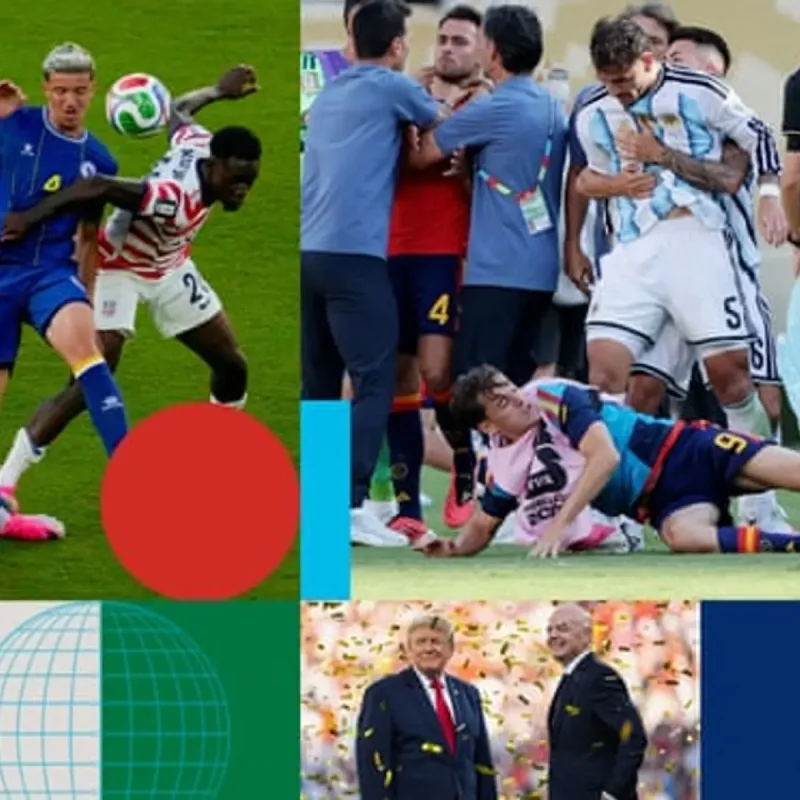
The World Cup that ended with Leandro Paredes grappling with Gavi will be remembered as good rather than great on the field.
Off it, the picture was far less edifying.
Perhaps it is too early for a proper assessment, with gold tape still fluttering in the New Jersey sky.
But some judgments can already be made.
Political Interference and FIFA's Priorities
The Balogun Affair could have major consequences.
Bending to political pressure and sweeping aside 64 years of precedent to ensure a particular player could take the stage marks a milestone.
Gianni Infantino had already done the same for Cristiano Ronaldo and gerrymandered Club World Cup qualification criteria to include Lionel Messi.
The prioritization of revenue generation over justice or the good of the game has been a feature of this tournament.
An immediate consequence could be the expansion of the World Cup to 64 teams as Infantino shores up his base.
US and Canadian immigration policy has damaged his claims to champion the global south.
The treatment of Iran was scandalous and sets a worrying precedent.
Ticket prices may be lower at the 2030 World Cup, but the idea that reasonable proportion should be available to regular fans is now gone.
The World Cup is no longer a mass movement but a luxury event. Host cities will feel the financial and social costs in retrospect.
In the US and Canada, street sweeps of the homeless deprived people of ID and medication.
In Mexico, outcry over water extraction and environmental damage linked to World Cup projects has been loud.
La Gazzetta dello Sport ran a double page calling the World Cup a “disaster,” citing ticket prices, Balogun, weather, increased games, and decreased rest.
The newspaper then found its ticket allocation for the final slashed from five to two.
The idea that a media outlet could be denied access for rejecting the official narrative that this was the greatest World Cup ever is dystopian.
FIFA's contemptuous attitude toward the media was evident throughout.
Basic organization and facilities were the worst for at least six World Cups.
Fans are treated as revenue units to be milked mercilessly; the media as an irritating imposition.
On-Field Action: Good but Not Great
The football was good but not great.
There were fine and dramatic games – Brazil v Japan, Morocco v Netherlands, England v Mexico, Argentina v Cape Verde, Norway v Côte d'Ivoire, Belgium v Senegal, Norway v Brazil, Argentina v Egypt – but almost all were in the last 32 or last 16.
The quarter-finals were not especially inspiring.
Argentina's win over England in the semi was thrilling and involved a collapse that will be discussed for years.
Spain's win over France was too easy, establishing superiority that was never challenged.
The final was dismal.
The right team won in their familiar bloodless way, but the grim spectacle was a direct consequence of the indulgence shown Argentina earlier in the tournament.
The ending colors what went before and drags this tournament behind 2022 and 2018, let alone the glorious World Cups of the 1980s or 1998.
Posterity can judge where exactly in the middle rank it sits.
It was not great but it was good. Beyond the FIFA bluster, that's fine.