Ferrari, McLaren, and Red Bull are introducing updated versions of their rotating rear wing designs ahead of the Hungarian Grand Prix on July 24, 2026.
The technical modifications aim to manage downforce and aerodynamic efficiency at the tight Hungaroring circuit.
Ferrari's High-Downforce Wing
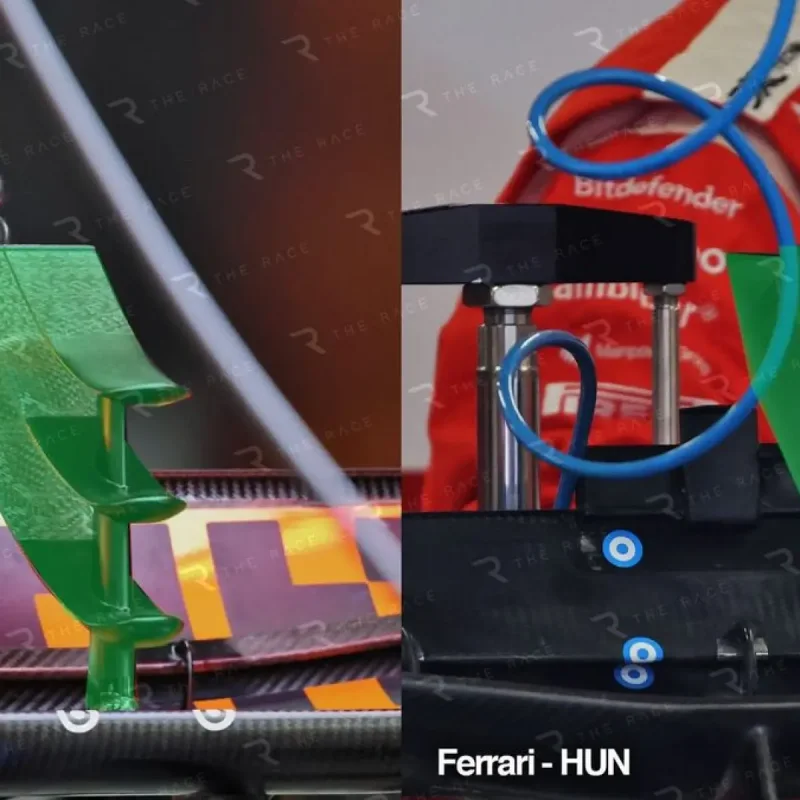
Ferrari unveiled a high-downforce specification featuring three stacked mini winglets in the central legality box ahead of opening practice.
The circuit-specific addition targets local downforce and airflow management during wing movement rather than modifying the underlying dynamic mechanism.
Ferrari previously missed using an extreme-downforce rear wing setup when active aerodynamics were restricted at Monaco earlier in the season.
“I think when we arrived on Thursday we saw other people, those guys with trick additions to their wing, we didn't have that, which was a little bit of a surprise,” said Lewis Hamilton, Ferrari driver.
The Italian team is also developing a second-generation version designed for low-drag, high-speed tracks, targeting a competitive debut at the Italian Grand Prix in Monza.
McLaren's Experimental Wing and Upgrade Package
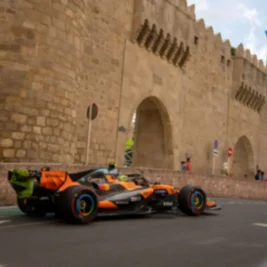
McLaren is running its own experimental upside-down rear wing in Friday practice following initial garage assembly issues during the Austrian Grand Prix.
The team aims to evaluate the component during practice sessions before returning to its standard setup for qualifying.
The experimental wing forms part of a larger upgrade package for McLaren, which includes a redesigned floor and refined aerodynamic bodywork.
“We have an upgrade package arriving this weekend, and in such a competitive season every development is important so it will be great to gather further understanding on how those parts perform throughout free practice,” said Randy Singh, McLaren's Senior Director of Racing.
The team is addressing a development delay stemming from its previous championship battle and a revised aerodynamic approach for 2026.
“Our aim is to maximise everything we have available, carry positive momentum into the shutdown and put ourselves in the strongest possible position for the second half of the championship,” Singh added.
McLaren leadership expects the overall upgrade package to improve cornering grip at Budapest and Zandvoort.
“It's difficult to lean on the range of performance that Ferrari and Mercedes are operating in at the moment, but hopefully as of Hungary we will start to see a bit of an acceleration in our competitiveness,” said Andrea Stella, McLaren Team Principal.
Stella noted that the current chassis generation requires aggressive handling styles that affect driver performance differently across the grid.
“In both Budapest and Zandvoort, Ferrari will probably be the fastest car again,” he said, emphasizing the physical demands placed on drivers negotiating the car's dynamic sliding tendencies.
“They have very strong cornering speed and we're still lacking a bit of grip there,” Stella added.
The team remains focused on refining car dynamics to aid driver adaptation ahead of the summer break. “The upgrades should help us in that regard.
We've also planned new parts for the races after that,” he said.
Team management expressed optimism about regaining competitive form as development continues into the late season.
“I hope we can fight for wins again in the second half of the season,” Stella said.
Addressing performance differences between drivers, Stella highlighted the ongoing adaptation process required by modern F1 machinery.
“The drivers keep saying that this generation of race cars requires a specific driving style,” he said.
He noted that smooth steering inputs do not always translate to optimal lap times with current aerodynamic setups.
“If you drive too cleanly, you won't get good laptimes in the end. You have to really attack and accept that the car will slide,” Stella explained.
The team principal expects driver performance to normalize as vehicle handling improves. “You have to be really active on the steering wheel,” he said.
Stella observed similar stylistic adaptation challenges occurring across several competing teams on the grid.
“But we see this phenomenon with other teammates as well, for example with Antonelli and Russell, or sometimes with Hamilton and Leclerc,” he noted.
McLaren expects both drivers to fully maximize the vehicle potential once mechanical setup solutions are finalized.
“I'm sure we'll find a solution and that Oscar's full talent will shine through again,” Stella said.
Red Bull's Return and Mercedes' Update
Red Bull is planning to reintroduce its rotating wing concept after removing it at the Belgian Grand Prix following high-speed incidents involving Max Verstappen in Austria and Great Britain.
Engineers traced the issue to a specific mechanical failure identified following the accident at Silverstone.
“It's a mechanical problem we detected after the Silverstone accident,” said Pierre Waché, Red Bull Racing Technical Director.
Red Bull has presented its corrective mechanical solutions to the FIA to ensure safe operational parameters. “We know what happened, we've fixed it,” Waché said.
The team confirmed that technical evaluations were completed prior to bringing the wing back to the circuit. “We have demonstrated what we have done to the FIA.
It is up to us to be more cautious now,” Waché said. Red Bull emphasized a cautious approach to testing to prevent further aerodynamic instability.
“We don't want to take any risks and we want to be 100 percent sure,” he added.
Mercedes is also fielding a modified rear wing specification in Hungary featuring supplementary winglets attached to the upper flap to maximize downforce.