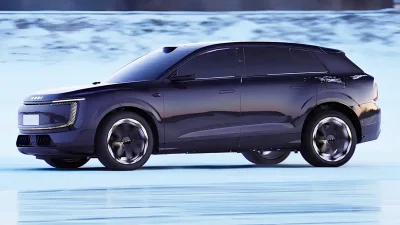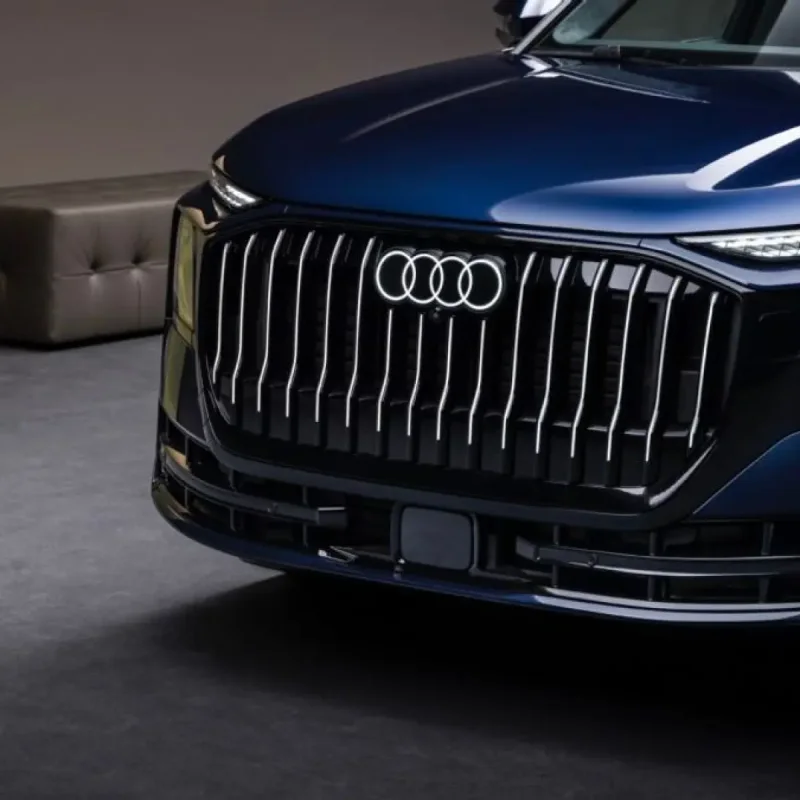
German luxury automaker Audi unveiled its first-ever three-row full-size Q9 SUV and performance SQ9 variant on July 29, 2026, in New York.
The launch targets the North American market following a 17 percent drop in U. S.
sales through June.
Built on the Volkswagen Group Premium Platform Combustion architecture, the new flagship measures 209 inches long, 86.8 inches wide, and features a 123.5-inch wheelbase.
Starting at $89,095 for the base Q9 and $119,395 for the SQ9, the vehicle expands Audi's top-end lineup alongside the recently refreshed Q3 and Q7 models.
Designed for American Consumers
Audi of America Senior Vice President of Product Management Filip Brabec said the model caters specifically to American consumers through larger proportions, enhanced cupholders, six and eight-cylinder powertrains, and high-end features.
"If you look at our recent introductions, whether it is the Q3, whether it is this car, it really plays right into the center of what's happening in America," said Brabec.
Brabec highlighted that utility vehicles represent over 80 percent of the premium automotive segment, positioning the Q9 to compete directly against rival full-size offerings like the BMW X7 and Mercedes-Benz GLS.
"It represents the most lavish luxury car that we have in this space," said Brabec.
Powertrain and Features
The base Q9 features a 2.9-liter V6 engine producing 429 horsepower, capable of accelerating from 0 to 60 mph in 4.9 seconds.
European markets will also receive a 3.0-liter V6 diesel variant delivering 220 kW.
The sportier SQ9 upgrades to a 4.0-liter twin-turbo V8 generating 591 horsepower and 590 pound-feet of torque, achieving a 3.8-second 0-60 mph sprint.
Both powertrains pair with an eight-speed tiptronic transmission and permanent quattro all-wheel drive.
Technological features include Matrix adaptive beam LED headlights approved for U. S.
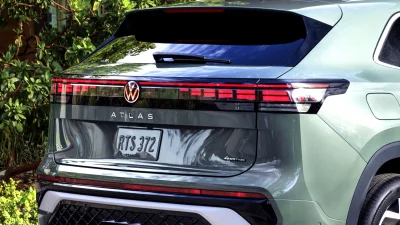
deployment, 3D curved digital OLED taillights, projected ground turn signals, a ChatGPT-powered voice assistant, and a 1.5-square-meter panoramic glass sunroof.
The interior offers seven-seat or six-seat captain's chair configurations with up to 87.7 cubic feet of cargo space and a 7,700-pound towing capacity.
Audi Chief Executive Officer Gernot Döllner emphasized that modern luxury depends heavily on the interior cabin environment.
"In the future, 'Vorsprung durch Technik' will increasingly be defined by the in-car experience – because cars are much more than just a means of transportation.
For many of our customers, they are becoming mobile living spaces," said Döllner.
Döllner added that the model showcases the brand's future direction through premium cabin materials, power-assisted doors, advanced driver assistance software, and interconnected user interface features.
"That is exactly what the Audi Q9 represents as the new flagship of our portfolio.
Premium materials, individual electric seats in the second row, and automatic doors underscore our commitment to quality in the interior.
When combined with the latest driver assist systems and a holistic user experience, it becomes clear where we are taking the Audi brand," said Döllner.
Industry analysts noted that Audi faced structural trade disadvantages compared to domestic German competitors, as the company imports 100 percent of its U.
S. product lineup and incurs substantial tariff costs.
"This one's going to have some real decadent features, I would almost say, like power opening doors and crazy interior materials, even by Audi standards," said Karl Brauer, Executive Analyst at iSeeCars.
Brauer observed that Audi sought higher profit margins and larger vehicle proportions to balance shifting consumer demand away from fully electric models back toward internal combustion vehicles.
"They are watching things like the [Mercedes-Benz] GLS and the and the [BMW] X7, and they're just saying to themselves, 'We need more.'
We need more space, but what we really need is more MSRP and more profit," said Brauer.
Financial analysts pointed out that Audi historically expanded its market position against the established luxury brands by combining technical performance with competitive pricing structures.
"Really it was kind of nipping at the heels of what used to be a duopoly of German [original equipment manufacturers]," said Tom Narayan, Global Autos Analyst at RBC Capital Markets.
Orders for the Q9 open in Europe at the end of July 2026, with initial retail deliveries scheduled for the fourth quarter of the year.