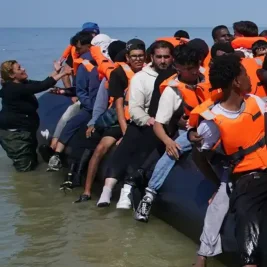
Spain has deployed military forces to secure its border in Ceuta following a recent influx of thousands of migrants crossing from Morocco.
This move highlights persistent diplomatic tensions over the North African territory.
The Spanish government continues to reject negotiations regarding Ceuta and Melilla, maintaining that both cities have been integral parts of Spanish territory for more than five centuries.
Historical records show Melilla became part of Spain in 1497 under the Crown of Castile, while Ceuta was incorporated into the Spanish Monarchy in 1580, centuries before the modern Kingdom of Morocco was established in 1956.
Strategic Importance
Control over the entrance to the Mediterranean Sea through the Strait of Gibraltar has historically served as a strategic priority for Spanish security and maritime trade.
"Ceuta and Melilla acquired a lot of value due to their proximity to the peninsula and the ability they provided to control the passage through the Strait of Gibraltar," said Manuel Torres Soriano, a historian at the Pablo de Olavide University of Seville in Spain.
The coastal locations provided administrative and military defense capabilities against piracy and regional security threats throughout five centuries of continuous administration.
"Melilla, on the other hand, served the need to have a port and a base from which to sustain the fight against piracy," added Torres.
"This was a huge problem for Spain's security."
The geopolitical significance of both enclaves continued into the 20th century, serving as central command posts during the Spanish colonial protectorate in northern Africa from 1912 to 1956.
"Both cities became the epicenter of Spain's colonial administration in present-day Morocco," said Torres. "They were the administrative and military base to control that protectorate."
The strategic deployment of military forces in the region eventually played a critical role in the outbreak of the Spanish Civil War in 1936.
"All this influenced the garrisons assigned here to show affinity for the uprising and take the initiative in the outbreak of the Civil War," said Torres.
With permanent populations established over hundreds of years, Spain maintains that both autonomous cities possess full territorial integration with the mainland.
"Now, with a stable population, Ceuta and Melilla are as Spanish as any other territory on the peninsula," said Torres.
Following its independence in 1956, Morocco has repeatedly asserted territorial claims over both cities, viewing them as unredressed colonial occupations under its broader national vision.
Moroccan political analysts note that early post-independence governments anticipated a diplomatic resolution to the territorial status of the enclaves.
International law and the United Nations classify Ceuta and Melilla as official Spanish provinces rather than non-self-governing territories or colonies.
With Spain's entry into the European Communities in 1986 and the ratification of Autonomy Statutes in 1995, both cities form part of the external legal borders of the European Union.