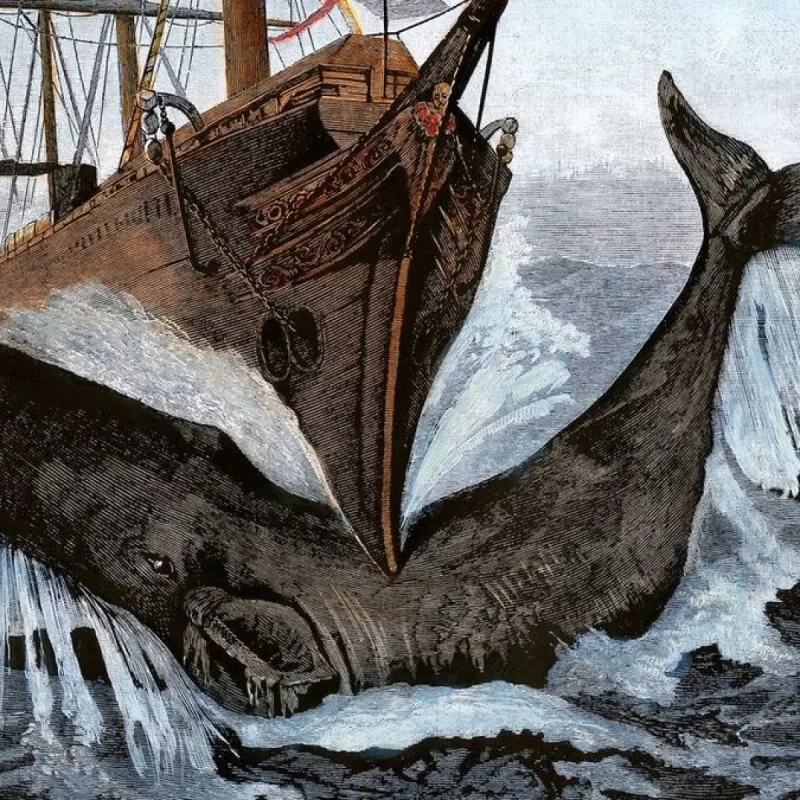
Scientific research published 175 years after Moby-Dick confirms that a sperm whale's spermaceti organ functions as a battering ram capable of destroying large wooden ships.
The finding validates theories recorded in historical logbooks following the sinking of the whaleship Essex in November 1820.
The huge fatty organ in the whale's head makes up roughly one-third of its total body length and houses the world's largest brain.
Analysis shows it possesses enough structural buffering to deliver massive blunt-force strikes without causing internal cranial injury.
Evolutionary biologists studied the mechanical properties of the spermaceti organ to understand how these apex marine mammals use force during intraspecific combat and naval interactions.
"This wasn't originally our hypothesis, it was Owen Chase's," said Dave Carrier, retired evolutionary biologist.
"An 18th-Century whaler argued that the forehead was a weapon, and we set out to test that."
Carrier noted that historical observations made by mariners had been overlooked by mainstream researchers for two centuries despite providing accurate biomechanical insights.
"Whales are mammals, closely related to animals like deer and rams, where males compete by ramming – so this behaviour may be inherited from their ancestors," said Carrier.
Recent drone footage filmed near the Balearic Islands and the Azores captured actual head-butting engagements between living sperm whales in the wild.
"A lucky coincidence," said Alec Burslem, an ecophysiologist at the University of Hawaii.
Field measurements recorded during these events demonstrated the immense force generated when young male sperm whales collide head-on.
Burslem documented a juvenile male striking another whale at a speed of 15 feet per second, generating an impact force of approximately 460 kilonewtons.
Fully grown adults hitting the same velocity are estimated to deliver 1,200 kilonewtons of force, equivalent to a bus travelling at 40 mph.
Historical records confirm that while open rowing boats were regularly targeted, full-sized whaling ships were destroyed by sperm whales in three distinct historical instances, including the Ann Alexander in 1851 and the Kathleen in 1902.
"In history, only three whaling ships were attacked by whales," said Michael Harrison, chief curator at the Historical Society in Nantucket.
Curators note that logbook entries routinely detailed violent encounters between whalers and defensive marine mammals throughout the 18th and 19th centuries.
"The logbooks don't often do justice to the drama of this," said Harrison.