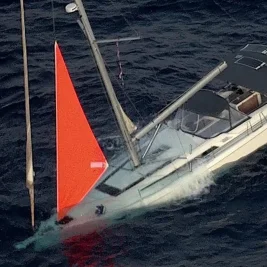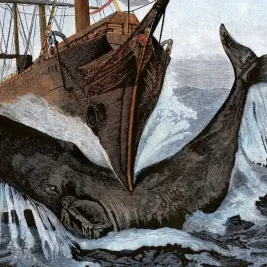
A sperm whale collided with a 52-foot yacht named Tai Tam in the South Pacific, sinking the vessel and forcing four sailors into a life raft.
The crew was rescued 18 hours later by a container ship, according to the Rescue Coordination Centre.
The incident occurred on a Saturday afternoon about 250 nautical miles north of Norfolk Island.
The impact caused severe structural damage, prompting the crew to activate an emergency beacon and abandon ship in two-meter seas.
Jemma Cooper, an Australian sailor, described the sudden collision. "There was sort of a loud thud.
The whole boat was pushed sideways," she said.
Her husband, Jeremy Cooper, recounted the immediate aftermath below deck as water began flooding the vessel. "It was pretty immediately evident it was very serious," he said.
The force of the collision wrecked the steering mechanism on the starboard side and left multiple gashes across the hull.
"All the steering gear was smashed on the starboard side, and there was a significant amount of water coming in," Jeremy Cooper said.
Crew members used expansion foam to slow the inflow while trying to keep the engine operational.
Terry Hetherington, a New Zealand crew member, said, "We declared a full mayday."
A French crew member, Martin Jaffre, dove beneath the boat to inspect the cracked fiberglass hull in an attempt to limit the damage.
"We could no longer steer the boat, and a boat with no steering quickly becomes a problem," Jaffre said.
The crew abandoned ship under a full moon, transferring to a life raft and cutting their tether before the yacht sank.
They were located after a Royal New Zealand Air Force P-8A Poseidon patrol plane established radio contact, guiding the 12,500 dwt Malta-flagged container ship MV Sofrana Surville to their location at 6 a.
m. Sunday.
Jeremy Cooper expressed relief at the outcome.
"It was wonderful, wonderful, and just a terrible, terrible ending — but luckily no loss of life," he said.
Mike Clulow, Rescue Coordination Centre Operations Manager, praised the sailors' preparation and quick actions. "This was a well-coordinated and executed rescue," Clulow said.
Maritime authorities highlighted the critical role of emergency signaling equipment in open-ocean survival.
"The crew of the yacht did all the right things, and it was unfortunate to have struck a whale in open water.
They were well prepared and the early activation of their EPIRB was key to helping get them to safety.
It is an excellent reminder that being prepared when going to sea can save your life," Clulow said.
The container ship transported the four rescued sailors toward Noumea, New Caledonia, before continuing its planned voyage to Brisbane, Australia.