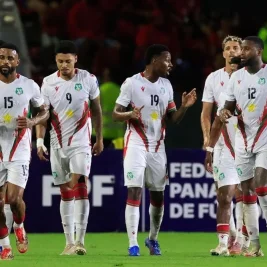
Suriname coach Henk Fraser has called for meaningful action against racism in international soccer while defending his players after their 1-0 defeat to Guatemala in the Concacaf Nations League.
In an interview with SUN published October 13, 2026, Fraser discussed the impact of a red card, allegations of discriminatory chanting, and competing accounts of confrontations between players and supporters.
The controversy has expanded beyond the match, with Guatemalan media figures accusing Suriname players of provoking home supporters.
Their claims contrast with concerns raised about racist abuse directed at Suriname players during the game.
Fraser Defends Team After Late Loss
Fraser said Suriname had planned to remain patient and look for opportunities late in the match.
The dismissal of a player forced the team to devote more attention to defending, disrupting that strategy.
"We really wanted to win, but we also said: be patient.
Our game would really take shape in the final stages, perhaps in the last half hour or the last 15 minutes.
If the score was level, time would be on our side," said Fraser, Suriname's head coach.
Guatemala scored deep into stoppage time.
Fraser said his players had exhausted their efforts to secure a result and noted that goalkeeper Etienne Vaessen nearly equalized with a header.
"I cannot blame the players, because we really did everything we could," Fraser said.
The coach also acknowledged concerns about his substitutions.
He said his changes had worked well in the opening match but had been less successful in the following two games, adding that he accepted responsibility for his decisions and the support provided to his players.
Racism Allegations and Media Dispute
Fraser said he initially did not hear the alleged racist chants because he was concentrating on the game.
He later learned about the incident and recalled advice from his father about remaining composed when facing discrimination.
"My father always taught me to be resilient against these kinds of things. He always told me to remain unfazed in such situations," Fraser said.
Before the match, Fraser had warned his players against reacting to provocations.
He acknowledged that the pressure of competition could affect their responses but maintained that players should not allow spectators to distract them.
According to Fraser, the American referee and several Guatemalan players apologized and distanced themselves from the racist remarks.
Suriname considered leaving the field, but Fraser believed the timing was inappropriate after his team had already received a red card.
He argued that the team faced consequences both on the field and potentially through disciplinary proceedings after the match.
"We are essentially being punished twice," Fraser said.
Fraser also cautioned against blaming Guatemala's entire population for the conduct in question.
"I do not think we should make the mistake of immediately writing off all of Guatemala, because that would not be realistic," he said.
Meanwhile, accounts published by Guatemalan media have shifted attention toward alleged misconduct by Suriname players.
Dany Futbol2 republished a photograph taken in 2025 during an earlier meeting between the countries, showing a Surinamese sports journalist alongside Guatemalan sports journalists, but presented it in a different context.
The accompanying text claimed that Surinamese visitors had been treated well and that the journalists had even received beer, while accusing players of arriving to fight or provoke others.
Guatemalan sports journalist Ninfita Garcia also disputed accounts of racist chanting and alleged that Suriname players repeatedly provoked spectators during the match.
"Honestly, I did not hear chants like that, but I did see Suriname players repeatedly provoking Guatemalan fans.
Even the substitute goalkeeper shouted 'Stupid Guatemalans' in front of me and two female photographers when I first walked past to see what they were doing near the goal that Etienne Vaessen defended in the second half," Garcia said.
Garcia further accused Vaessen and other Suriname players of provoking supporters before and after the game.
She described the alleged conduct as unacceptable, while acknowledging that it did not justify racist abuse.
"What followed was Suriname constantly provoking throughout the entire 90 minutes.
The match had not even started, and during the warm-up, goalkeeper Vaessen was already insulting fans in the general north stand.
Of course, that is no excuse, but what can you expect when they stir up anger after the match?
Or when almost everyone makes obscene gestures and shouts while leaving the field?
It is truly unfortunate that a team of 'professional' players, who could have shown on the field through soccer that they wanted to qualify and play well, instead chose to tarnish the game with violence, bad intentions, and even malice," Garcia said.
Fraser also addressed the future of Surinamese soccer, urging supporters to remain behind the national team and emphasizing cooperation between players and fans.
"Keep supporting us, because I think we need each other," Fraser said.
He said he hoped to continue as national coach for as long as possible and saw opportunities to exchange knowledge and experience with local coaches.
Fraser also stressed that the country's development strategy should create more opportunities for young players based in Suriname, alongside those who return from European clubs.
"The government, the federation, and everyone who cares deeply about Suriname or Natio must recognize that we need to provide for the children.
We must give them a platform," Fraser said.
Fraser said cooperation between the government, the soccer federation, and other stakeholders would be necessary to expand opportunities for young talent.