The municipality of Stichtse Vecht held its first local Keti Koti remembrance ceremony in Breukelen on June 30, 2026, to commemorate the historical abolition of trans-Atlantic slavery.
The event marks the first time the municipality has officially joined regional observations alongside the cities of Utrecht and Amersfoort.
Community members gathered at Park Boom en Bosch for a solemn evening program featuring music, spoken word performances, speeches, and a wreath-laying ceremony.
Committee June 30/July 1 Stichtse Vecht chairperson Naomi Veerman initiated the local event after discovering deep historical ties between the region and colonial plantation systems.
"What I mainly took away from conversations with residents is the realization that this commemoration should have taken place much earlier," Veerman said.
Veerman, who moved to Loenen aan de Vecht six years ago, noted that the wealth behind many historic estates along the Vecht river originates from colonial slavery.
Her personal genealogical research into Surinamese ancestors from the Kroonenburg plantation revealed direct connections to influential families from the Utrecht region.
"Many people know the beautiful country houses along the Vecht. But behind part of that wealth lies a history connected to plantations and slavery," Veerman said.
The local organization aims to foster mutual understanding and address societal divisions surrounding colonial history by encouraging open dialogue.
To promote this educational outreach, the foundation previously hosted a dedicated discussion evening regarding history, identity, and regional heritage in Loenen aan de Vecht earlier this month.
"There is sometimes division around this subject. Often that comes from people not knowing exactly how that history fits together.
That's why we think it's important to start the conversation," Veerman said.
The regional history also carries significant personal meaning for younger residents processing their cultural identities within the province.
Seventeen-year-old local resident Devine shared his experience growing up visible as a minority in Werkhoven before relocating to the city of Utrecht.
"In Utrecht I can be more myself," Devine said.
"I used to be seen more as that one dark boy. I sometimes felt like I didn't really belong," he added.
The formal program actively incorporated the next generation into the commemorative activities to preserve the cultural legacy of emancipation.
A youth dance group from Loenen aan de Vecht performed during the proceedings, which were co-opened by a child chairperson named Xavier.
"We consciously give space to the next generation to commemorate together and pass on the meaning of freedom," Veerman said.
Parallel remembrance events occurred throughout the province, including an evening ceremony at Griftpark in Utrecht and a reflective procession starting from the Hof in Amersfoort.
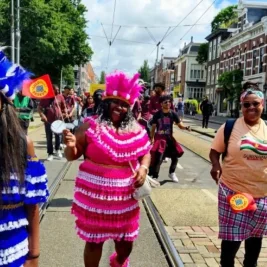
The commemorative activities transition into festive celebrations on July 1, 2026, with a joint Keti Koti Festival featuring music, food, and cultural gatherings at Griftpark.
The term Keti Koti signifies broken chains, marking the official legal abolition of slavery within Suriname and the former Netherlands Antilles in 1863.
Traditional observances dedicate the evening of June 30 to solemn reflection before transitioning to celebratory community events the following day.
The organizers emphasized that engaging younger populations ensures the foundational concepts of freedom carry forward to subsequent generations.
The initial Breukelen ceremony concluded its targeted two-hour schedule ahead of the broader provincial celebrations.
"It's connecting with yourself, but also with other people.
We look back at the past, but looking forward we try to treat each other positively," Devine said.
The scheduled festival activities remain open to the public across all participating municipalities to encourage shared reflection and community connection.