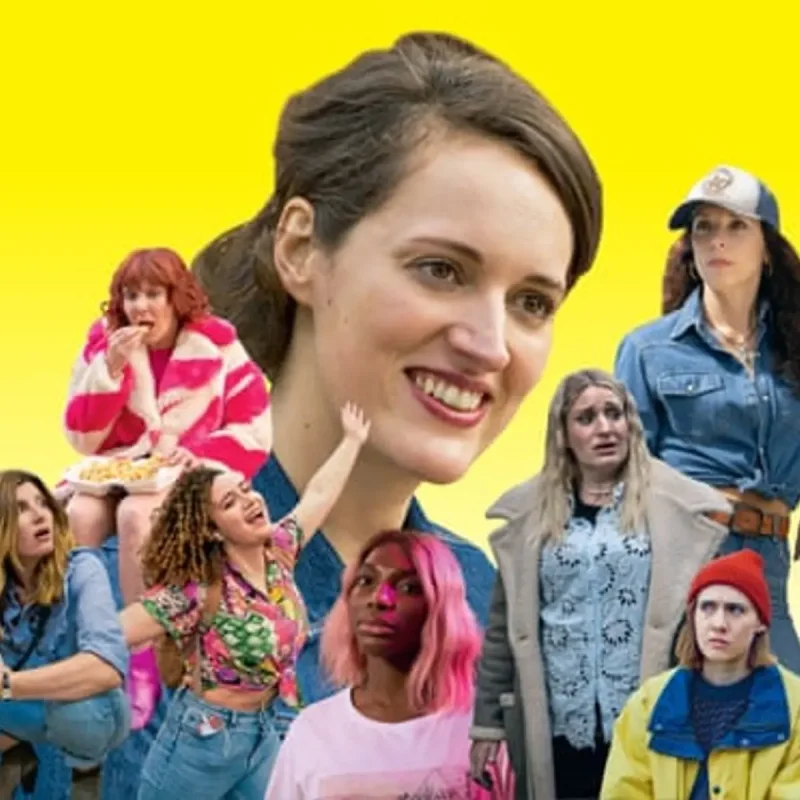
Ten years ago, Phoebe Waller-Bridge locked eyes with the camera and asked her audience: "Do I have a massive arsehole?"
That line, from a monologue about a booty call gone wrong, announced her as a new star of British television.
The half-hour comedy series Fleabag broke the fourth wall and became a cultural phenomenon.
Its second season was even bigger, spawning thinkpieces about the "hot priest" played by Andrew Scott and a sold-out Topshop jumpsuit.
Fleabag secured Waller-Bridge an exclusive deal with Amazon worth a reported $20 million a year. But how did it change TV?
The Rise of Female-Authored Comedy
In the mid-2010s, pop feminism was everywhere, but not on British TV.
A report by the Writers' Guild of Great Britain found that from 2001 to 2016, only 14% of primetime TV was written by women, and just 11% in sitcoms.
"We knew the gender balance was horrific," said Chris Sussman, former BBC comedy commissioner.
Things were already shifting. Lena Dunham's Girls premiered in 2012, creating an appetite for bawdy, awkward, vulnerable comedy.
Fleabag was part of a wave that included Catastrophe, Back to Life, and This Way Up. But Fleabag cut through in a way many contemporaries didn't.
"Fleabag was smoothly incorporated into that massive post-Girls cycle of unruly middle-class white women comedy," said Faye Woods, associate professor at the University of Reading.
Shows like Alma's Not Normal and Chewing Gum, while acclaimed, didn't travel as widely.
Fleabag gave confidence to female comedy writers, Sussman noted.
It opened doors for shows like Michaela Coel's I May Destroy You, which premiered in 2020 and balanced emotional gut punches with humor.
Co-produced by HBO, it was visually ambitious, with cinematography more common in feature films.
The Changing Landscape
The standard British half-hour comedy found a new form, bolstered by American money. "We tried to make Fleabag look more like a drama," said producer Harry Williams.
International streamers like Netflix, HBO, and Disney+ now partner with British broadcasters to fund women-led comedies such as We Are Lady Parts and Such Brave Girls.
But the "messy millennial" trope that Fleabag made famous has evolved. Rose Matafeo, creator of Starstruck, recalled comparisons to Fleabag as "a compliment and a little lazy."
Today, shows like The Change and Am I Being Unreasonable? feature older or more diverse female characters.
Fleabag began as a one-woman play at the Edinburgh festival fringe. Its success is hard to replicate, especially as public service broadcasters spend less on nurturing talent.
"There's some risk-averseness around original ideas," said producer Lydia Hampson.
"If something can come up under the radar again, like Fleabag did, that can release those risk-averse purse strings."
Waller-Bridge's later projects have been low-key: she created Killing Eve, co-wrote No Time to Die, and co-starred in Indiana Jones.
But her impact on British TV is undeniable.
A decade on, Fleabag's legacy is a landscape where more female voices are heard, even if the path is still challenging.