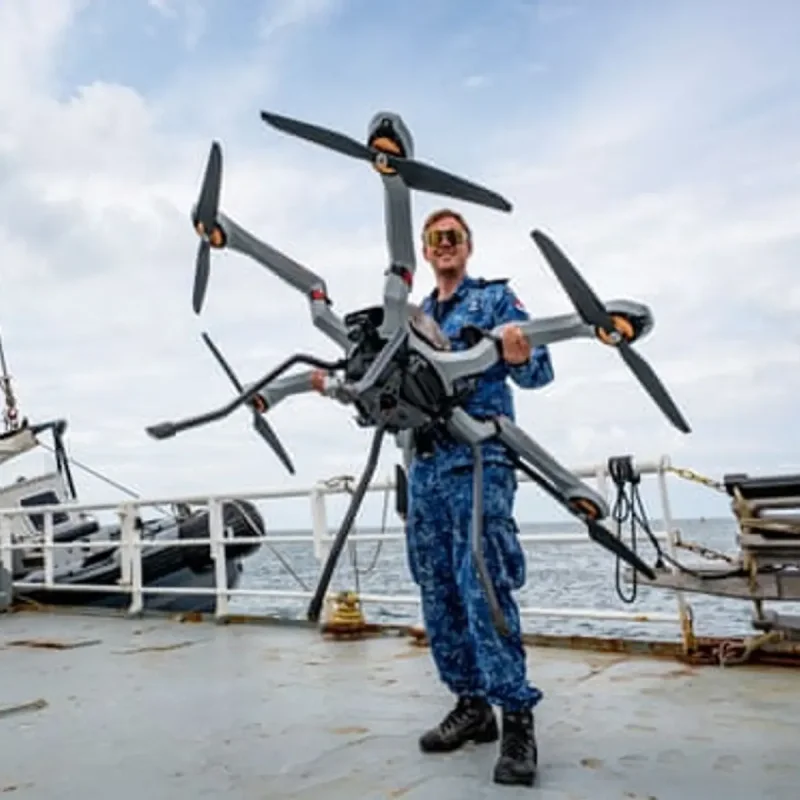
The Royal Netherlands Navy is actively testing autonomous systems off the coast of Den Helder, aiming to transform its operational structure within the next decade.
As reported by The Guardian, the five-week testing mission aims to push the operational limits of uncrewed maritime and aerial technologies.
The initiative is spearheaded by Capt Sjoerd Feenstra, who leads the expertise center for unmanned systems.
"For the last year and a half we’ve been working to change our organisation," he says.
"In about 10 years there will be crewed platforms surrounded by a ring of uncrewed systems operating as autonomously as possible."
Uncrewed aerial, surface, and underwater vehicles are increasingly integrated into global armed forces, heavily influenced by recent international conflicts.
The Dutch military has pledged to utilize uncrewed systems for over half of its operations within five years, while the UK plans a £5bn expenditure on similar technologies.
The testing operations utilize the GeoSea vessel as a primary base to deploy Noa drones, Defender vessels, and a Lobster Robotics undersea mine mapper.
This "system of systems" approach allows researchers to swap different technology models seamlessly as advances occur.
Feenstra emphasizes that safety remains the primary driver behind this technological transition.
"The goal is to do as many things as possible with unmanned systems to keep people out of danger zones," says Feenstra.
"The work has got a lot more difficult, especially with the amount of information, speed and capacity demanded.
And some jobs are unbelievably boring."
Despite the high level of automation, human oversight remains a fundamental component of the operational protocol.
Ferdinand Peters, the software integration lead, points out that artificial intelligence systems can still hallucinate or produce false results.
"You need to let the system work for you, but not think for you," he says.
"We need to think carefully about where we use it and where we do not."
Feenstra confirms that weapon deployment decisions will not be delegated to autonomous algorithms.
"A person is always part of the decision-making chain," says Feenstra.
The ethical debate surrounding military automation is not entirely new to the Netherlands, which has utilized the autonomous Goalkeeper air defense system for over forty years.
"What we know from the past is that even when people make the plan or collect the information, something can go wrong," says Feenstra.
"The question is where the culpability will lie if you automate everything."
Naval analysts view the Dutch efforts as a vital model for maritime security collaboration in the North and Baltic seas.
Naval analyst Lee Willett notes that the Netherlands is successfully advancing its capabilities despite possessing a relatively small navy.
"The Dutch punch above their weight," Willett says.
"They are also advancing what they have because they recognise that they are a relatively small navy in an incredibly important part of the world."
Sidharth Kaushal, a senior research fellow at the Royal United Services Institute, suggests that these systems also offer practical benefits for personnel retention.
"Uncrewed systems don’t completely remove the requirement for manpower – you tend to need more engineers – but they provide a different balance in terms of family life," he says.
"This is the direction of travel."