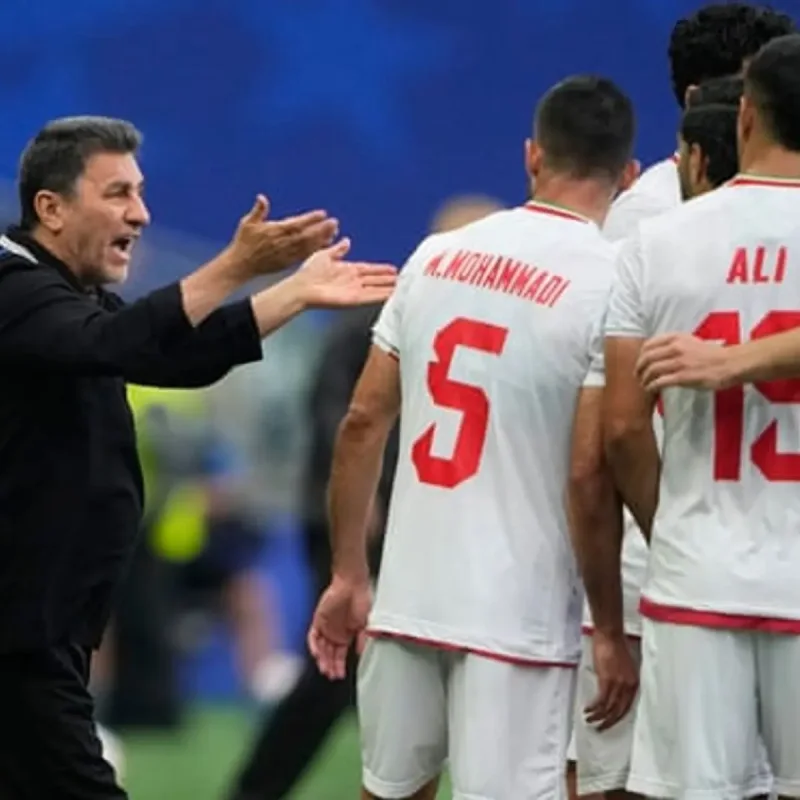
Iran head coach Amir Ghalenoei has urged FIFA President Gianni Infantino to confront United States officials over what he described as highly unfair treatment toward his team during the World Cup.
The frustrations peaked following a dramatic 1-1 group stage draw against Egypt in Seattle, which left Iran's qualification for the last 32 hanging in the balance.
Ghalenoei stated that despite Infantino's personal efforts to address local difficulties, the host country failed to provide adequate conditions for the traveling squad.
"I know Mr Infantino has tried his best to minimise the problems as much as possible but it was the host that wasn’t very good to us," Ghalenoei said.
The head coach emphasized that soccer's governing body must implement strict measures to protect international teams from similar operational disadvantages in future tournaments.
"I urge Fifa to not let the hosts treat teams and players the same way in the future.
I hope Mr Infantino will actually stand up to such behaviour," Ghalenoei added.
Visa Denials and Travel Disruptions
Team logistics worsened after US authorities denied 11 senior Iranian officials entry visas, leaving the squad without critical support staff throughout the group stages.
"Since the beginning, it’s a disaster World Cup.
I mean, Fifa, they have to solve every problem here but unfortunately this they couldn’t solve since the beginning," said captain Mehdi Taremi.
"Mr Infantino came to our changing room [after the] first game and he said: ‘It’s just the beginning.’
But [the] group stage finishes tomorrow and we don’t have our logistic people here, they don’t have a visa.
How [is that] possible?" Taremi added.
The veteran forward noted that the administrative hurdles created a distinct impression that governing entities preferred Iran's early exit from the competition.
"We have to fight against everything here.
I don’t know what people want or know, but as we see it by our perspective, yeah, they’d like that, I think," Taremi said.
The Iranian delegation was forced to commute back to their base in Tijuana, Mexico, after being denied permission to extend their stay in Seattle past matchday.
"To my players and the team, I want to say to them I’m proud of them, what these young people, these players have done, it should be written in history because the host country treated us very unfairly," Ghalenoei said.
Ghalenoei stated that restricted preparation timelines severely impacted the physical conditioning and mental state of his athletes.
"Had the host country allowed us to arrive two weeks earlier, we would have been more prepared. They were reasonable, rational demands.
We would have been able to recover and be in better shape physically and mentally; however, they deprived us of that justice," Ghalenoei said.
The frequent post-match travel arrangements directly interrupted the scientific recovery cycles required between elite sporting fixtures.
"When you play in a match, physically, scientifically, our bodies are at a low and when you suddenly go on a flight, that actually postpones your recovery and this is the third time they are doing this to us," Ghalenoei explained.
Despite competing amidst geopolitical tension and logistical constraints, the coaching staff maintained that the team achieved its core objective of making citizens proud.
"Their behaviour towards us has been really terrible and we hope the world will be aware of that.
They didn’t let us come two weeks earlier and two days earlier before every game. This has really hurt us," Ghalenoei said.
"And we had a war as well.
Despite all of these problems, we’ve been able to perform well and the world is proud of Iranians and our team.
I think that’s our greatest achievement despite all the obstacles and the hurdles they put in our way," he added.