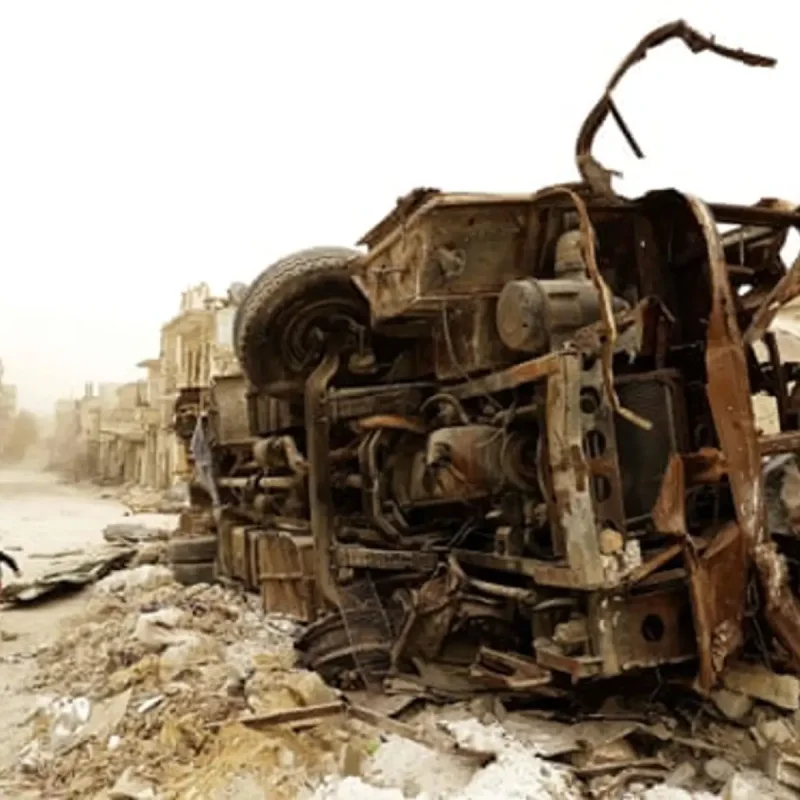
The air is thick with smoke and dust, the ground littered with burning vehicles.
Children scream as activist and videographer Abd Alkader Habak rushes to help after a bombing in Aleppo in 2017.
A voice note pops up on his phone: "My bird, are you OK?" says BBC journalist Janay Boulos.
"Get away from there, run."
For over a year, Habak and Boulos had been documenting atrocities by Syrian dictator Bashar al-Assad. Their connection deepened despite the distance.
This exchange marked the shift from colleagues to something more. "I don't want footage," Boulos says, fear in her voice.
"I don't want anything, just please take care."
A Love Story Against War
"Birds of War," released this week in the UK, tells their remarkable story. It uses 13 years of archive footage, voice notes, selfies, video calls, and texts.
The film shows how Lebanese journalist Boulos and Syrian activist Habak found each other amid revolution, war, and hostile borders.
"Originally I wanted to make a documentary about Lebanon and the war," says Boulos, the director. "But we should tell the story how we saw it."
Smartphones and the internet have made first-person war narratives a staple.
Yet "Birds of War" is not just about war; it portrays what it means to be Syrian or Lebanese at this precarious time.
It explores belonging—to each other, to a cause, to a nation—and the hopes and fears that accompany these bonds.
Watching their love blossom is deeply moving.
The film won the special jury award for journalistic impact at Sundance, plus prizes at Thessaloniki, Seattle, and Visions du Réel.
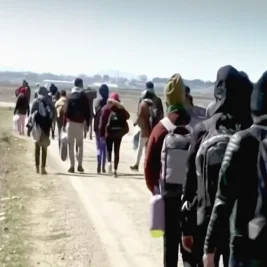
After the convoy bombing, Habak escaped Syria with smugglers, crossing into Turkey.
Boulos flew to visit him, and within months they decided to marry—something she kept from her disapproving parents until the film premiered.
"It was unbelievable," says Habak.
"That this person would come from London to see me, a man from a war zone with nothing to offer."
He left Syria with only his camera, hard drives, and clothes. He now lives with Boulos in London.
Meeting Habak in Turkey was a "no-brainer," Boulos says. "It was harmless chatting online—but it shifted to something real.
I really cared about him and his safety." She spent nights when he had no internet wondering where he was.
"I realized I really cared for this man when we met in Turkey."
The film captures the disconcerting element of modern conflict journalism. In their first exchange, Habak asked Boulos: "Who are you?"
She had only his word that he was an activist. Trust grew over weeks and months.
"She talks to me like she sees me. Not as news, not as a story," says Habak.
Another time, Boulos left a voice note: "You are more than a story to me." They used pet names—bird, my bird—creatures that can leave frontlines behind.
After Habak joined her in London, Boulos quit the BBC.
They set up Habak Films, an independent production company focusing on stories from Lebanon, Syria, and the region.
"It is a struggle when people back home are being killed daily," says Boulos.
"I have the privilege of London, so let's be this company that bridges local voices to Western audiences."
The film is careful not to show too much violence. The filmmakers chose not to feature graphic content or amplify explosions.
Psychotherapist Rebecca Day helped with the editorial process. Habak labeled his footage: green for safe use, orange for distressing, red for material not needed.
"Making this film has been healing," he says.
Footage of doctors after bombings is interspersed with a man tending his roof garden or friends joking.
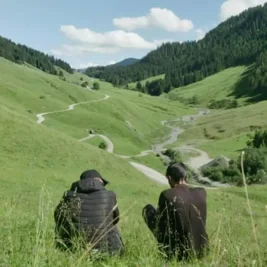
The bleakness of Syria contrasts with the sparkling Mediterranean when the couple meets in Turkey and goes paragliding—like birds.
"We talk about responsibilities film-makers have towards sources," says Day. "But it's also important to consider the film-maker's perspective.
It can be a huge burden, but they don't have to carry it alone."
The film ends after Habak returns home for the first time in years, following the Syrian opposition driving Assad from power in late 2024.
Yet the future for Syria and Lebanon remains uncertain. "How long can we keep doing this?"
asks Boulos. "Just until the wars finish," Habak replies.