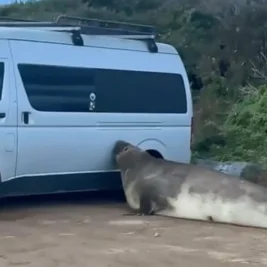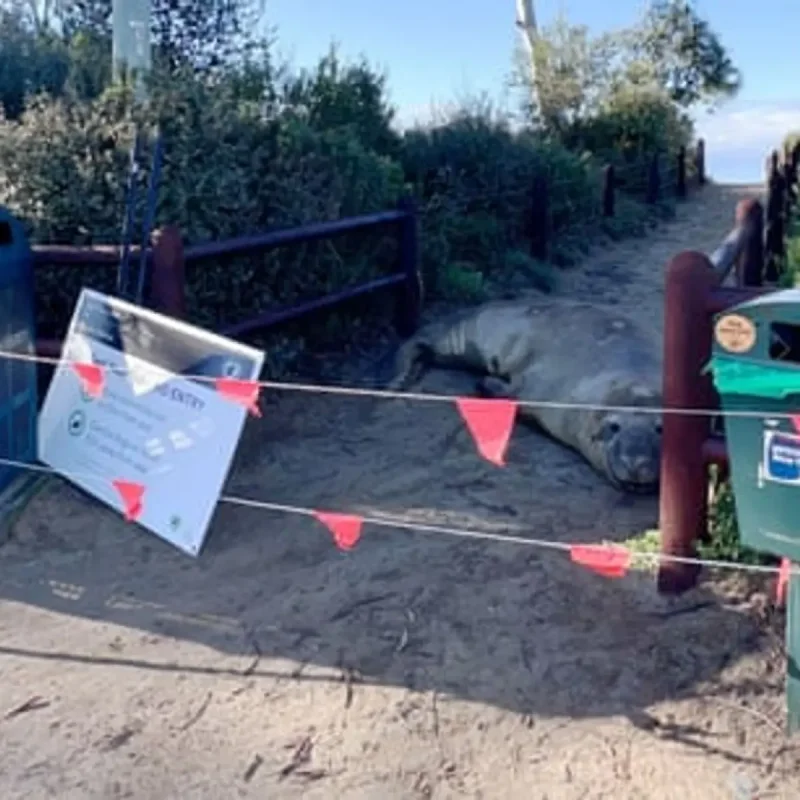
Tasmanian wildlife officials warned the public on Thursday to maintain a safe distance from a 1,000-kilogram southern elephant seal named Neil to prevent dangerous safety concerns during his annual coastal visit.
The five-year-old marine predator has drawn massive crowds and generated millions of social media views by wandering into streets, crushing barriers, and sleeping on roads in southern Tasmania.
Officials reported risky public behaviors, including people bringing infants close to the animal and attempting to take selfies within a few meters.
Officials Warn of Potential Euthanasia
Dr Kris Carlyon, the section head for wildlife health at Tasmania’s department of natural resources, expressed concern over the community's intense interaction with the animal.
"We have seen examples around the world where large, potentially dangerous animals have had to be euthanised if there is risky behaviour by the public, resulting in an unmanageable safety concern," said Dr Carlyon.
Carlyon compared the seal to other dangerous wild predators to highlight the necessity of keeping a safe distance.
"He can look cute, cuddly [and] placid, but he’s a large marine predator – and we certainly wouldn’t be approaching things like polar bears [and] bison in other parts of the world," said Dr Carlyon.
Carlyon noted that while the mammal's popularity increases conservation awareness, it simultaneously encourages dangerous human activities near the shore.
"Neil’s fame is a bit of a double-edged sword," said Dr Carlyon.
"Right now the attention Neil gets helps with awareness of our threatened species, helps with his protection in some ways.
But it also encourages perhaps risky human behaviour, people trying to get selfies with Neil, people trying get that little bit closer for that good photo."
He emphasized that onlookers have repeatedly ignored guidelines by prioritizing social media pictures over physical safety.
"Carrying their small babies up close to him and simply trying to get that shot for Instagram," said Dr Carlyon.
Carlyon reiterated that the animal is not inherently aggressive but will react to protect his immediate surroundings.
"Neil’s not inherently aggressive in the sense that some other animals might be," said Dr Carlyon.
He concluded with instructions on the required buffer zones for residents and their domestic pets.
"He’ll certainly defend his space, and if he feels threatened he may lash out. So really it’s about that proximity and staying away," said Dr Carlyon.
Biologists and Experts Echo Warnings
Wildlife biologist Sam Thamman from the Marine Conservation Program confirmed that thousands of spectators have gathered at Neil's coastal resting location.
"Certainly, over the last week, there have been hundreds of people in attendance and possibly thousands visiting over the course of a day," said Thamman.
Thamman noted that the presence of crowds has led to undesirable interactions that officials are working to halt.
"So there's a lot of attention.
And sometimes there's some unwarranted attention towards Neil and some behaviours that we try to discourage," said Thamman.
He described these specific behaviors by visitors as highly inappropriate given the seal's immense weight.
"This is really poor behaviour," said Thamman.
Thamman explained that the seal's natural instinct to play-fight could cause severe harm if directed at humans in populated zones.
"It's very dangerous to both the members of the public and it places the long survival of Neil as an elephant seal visiting our shores in great jeopardy as well," said Thamman.
He pointed out that while global authorities have culled wild animals under similar circumstances, Tasmania intends to use a different strategy with community cooperation.
"There's Freya, the walrus, and many other circumstances in the northern hemisphere where such large, powerful animals have not been tolerated by society and they have been euthanased," said Thamman.
"Now, I'll make it very clear that that is not our management approach, but we need the help of society.
We need the help of members of the public to appreciate Neil, but not feel the desire to be in his face, not feel the desire to need to have a selfie with him, to appreciate him for what he is and where he is and know that he exists without the desire to be there in front of him."
Dr Clive McMahon, an elephant seal expert, explained that the animal frequently returns to the region because of his birth history.
"Neil was born in Tasmania, near Hobart, and he thinks that’s where home is because he doesn’t know where Macquarie Island is," said Dr McMahon.
"And he doesn’t have a map."
Dr Jane Younger from the University of Tasmania warned that the marine mammal's size poses an immediate physical threat.
"He’s already at a size now where he’s dangerous," said Dr Younger. "Even if he’s not in an aggressive mood, he could easily kill a person.
They have a big mouth, big teeth, you could get very seriously injured."
Local resident Dale Creamer, who documents the seal on social media, spoke about the mammal's massive popularity among residents.
"He's always been a bit of an icon," said Creamer. "He's up there with Queen Mary and cherries and apples and stuff like that."
Creamer stated that online audiences view the seal's behavior as highly relatable to human life.
"I think people can relate to him," said Creamer. "A lot of people have said he's like the animal version of [themselves]."
Tasmanian Premier Jeremy Rockliff addressed the widespread interest while reinforcing the government's official safety protocols.
"He has a lot of social media activity when it comes to Neil the seal," said Rockliff.
"It's certainly sparked the attention and imagination of many people both in Tasmania and abroad.
[But] we need to be very mindful of Neil the seal and keep a very close watch with respect to the proximity of Neil.
And we need to be very mindful of leaving Neil alone to go about his daily routine."
The department faced local backlash last week after wildlife handlers used wooden poles and barge boards to guide Neil away from a road, causing him to lash out.
Social media manager Jason Howlett stated that the community strongly disapproved of the handling method during the road clearance operation.
"The general feeling of the public is outrage, many people have made complaints," said Howlett. "I would have used the traffic cone to lure him without hitting him."
Howlett added that Neil remains a beloved icon whose presence represents the close bond between local towns and native wildlife.
"Neil the seal has become a deeply cherished figure in southern Tasmania because his regular coastal visits embody the unique, sometimes chaotic, and close-knit relationship between Tasmanian communities and their local wildlife," said Howlett.
A spokesperson for the department defended the actions, stating that handlers used safe, approved tactics to prevent the seal from being struck by vehicles.