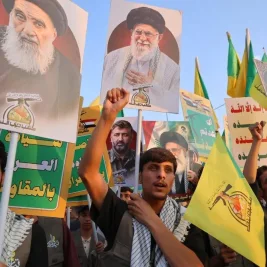
Vast numbers of Iranians poured onto the central thoroughfare of Tehran on the fourth day of mourning for the assassinated former supreme leader, Ali Khamenei.
Participants claimed their defiance through months of on-off war had only made them stronger, while many called for revenge, as reported by The Guardian.
For those in the procession on Monday, it served as both a display of patriotism and mourning.
The demonstration intended to show that Iran, as an ancient civilization, had uniquely taken on the world's greatest superpower and survived.
"We the people are Iran's true missiles," one banner read.
Vengeful chants against US President Donald Trump echoed along Azadi Street towards Revolution Square.
Observers noted a sense of quiet release among some participants who shared their survival, remaining proud of Iran's identity if not their government.
"Welcome to our Iran" was the most common greeting to the stranger in their midst.
Drums and chants filled the air while massive flags were waved from lorries during the heavily choreographed event.
The crowd included families with children in buggies, elderly people in wheelchairs, men in luxury T-shirts, and women in sequined chadors, all sprayed lightly with water to cool down from the 36C heat.
The atmosphere stood in sharp contrast to the sadness and religiosity of the prayers at the Grand Mosalla mosque at the start of the six-day funeral.
"Of course, Iran has won the war, take a look at the population in the streets.
If Trump dies today, will people attend his funeral," asked Fatima Zadeh, who was part of the procession.
"I want the war to restart, we want to destroy the oppressors and we are after revenge.
These people are here not to mourn and shed tears, they came here to become united and gain strength," she said.
Ali Sayadian, a cleric from Yasuj, also showed little sign of forgiveness after traveling 1,000km to Tehran.
He stated he felt indebted to Khamenei's leadership for making Iran powerful.
"We want revenge," he said.
"Someone has come here and killed our leader in his house with his family, our great man. It is our right to want to exact revenge," he added.
Sayadian claimed the massive turnout sent a message to the world and those who doubted internal support for the Islamic Republic.
"These people you see on the street?
You cannot say they are all poor, you cannot say they are all rich, you cannot say they are from one specific geographical location, they have come from all over Iran.
This is the voice of the Iranian nation," he said.
Experts noted that those traveling an average distance of 1,000 miles to attend represented a self-selecting sample.
Citizens who chose not to attend may hold different views on the choices the supreme leader required Iran to make in search of independence.
"Do you know about the shah and the crown prince? There is still a revolution happening.
We will not lose. It is not over," whispered one young woman wearing a chador before vanishing into the crowd.
Conversely, other attendees expressed deep remorse that they had not done more to protect the supreme leader, whom they regarded as a father of the nation.
"Our leaders called on us to keep our head up. We are ashamed because we did not do enough when he was alive.
He was a leader that wanted to make Iran strong," said Maryam Ghiyasi, a doctor.
Her husband, Hamid Razavi, an engineer, praised Iran's leadership for being the first in 200 years to sign a peace treaty that did not see Iran giving up foreign land.
"I am here for so many reasons – to make some people hopeful and to make some people hopeless," said Ali Hovayzavi, a software engineer for accountancy firms.
Hovayzavi, who narrowly avoided bombs in Tehran, expressed no fear.
"I was not frightened. Everyone somewhere will die and no one except God specifies when and where and how you die.
Even if there are many bombs surrounding me, and God does not want me to die, I will not die," he said.
Some individuals in the procession accosted reporters to state that Iran's leadership now needed to race to build a nuclear weapon.
"Would Japan have been attacked at Hiroshima if it had nuclear weapons?" asked Reza Aziz.
"Would Russia be safe after the Ukraine invasion?
Why is it OK for Israel to have nuclear weapons and not to sign the Nuclear Non Proliferation Treaty?"
Aziz added.
Standing with a "kill Trump" poster, Mohammad Mousabvi, a 50-year-old gymnastics coach, viewed the situation as a clash of civilizations.
"Yes I came to preserve the memory of our imam, but I also came to confront Trump.
This road is the pathway of the Islamic civilisation and with the help of God it will prevail over the civilisation of neoliberalism," Mousabvi said.
"We have taught and continued to teach the westerners that western civilisation is nothing but a dead end.
The revenge of our leader is through decimating Israel and America for ever.
Our civilisation is based on the prophet Mohammed, Moses, Jesus, but the western civilisation is made of the people of Epstein Island," he added.
Moftabva Karbvasi, a professor at the medical school in Isfahan, delivered a short dissertation outside Tehran University's gates regarding America's alleged role in building Islamic State to discredit Islam.
"But the world is becoming more familiar with our religion day by day, and we can use this moment when the world looks again at Iran, because for the first time America knows it dare not attack us again," Karbvasi said.