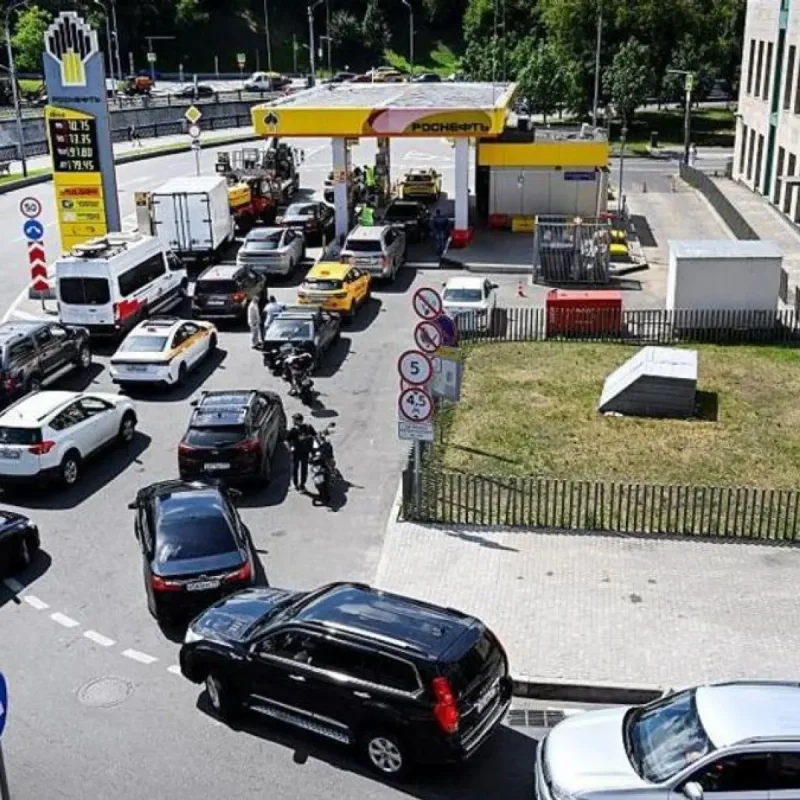
A severe nationwide fuel crisis has gripped Russia as persistent Ukrainian drone and missile strikes target domestic oil infrastructure, forcing gas stations across almost all 83 regions to implement rationing and purchase limits.
The long-range aerial campaign has damaged roughly one-third of the country's refining capacity, causing Russian gasoline production to plummet 25% year-on-year and forcing Moscow to explore fuel imports from Belarus, Kazakhstan, and India.
Frustration is growing among motorists who face waits of up to 18 hours, prompting authorities in some regions to declare a state of heightened alert and deploy Cossack patrols to maintain order.
"Not happy," said Yekaterina, a driver in Moscow.
She noted there was "panic because everybody thinks there will be no oil" but added "we just need to reorganise the oil distribution."
"Very bad," said Elmar, another driver who complained about rising prices. "You are wasting hours to fill up," he said.
"At the moment I am planning a trip to Dagestan but I don't know if I should drive there or not because there are so many problems with petrol."
When asked who was to blame for the crisis, he smiled knowingly.
"In our country, you can't say what is to blame and who is to blame," he said.
Another queuing driver expressed surprise at facing fuel shortages in a major oil-producing nation. "I have no desire to get used to queues," said Valery.
"I hope the situation will change soon and won't be continued."
The impact of the ongoing conflict is becoming increasingly difficult for the Kremlin to shield from the domestic public.
"We hope that all sides will start moving towards each other and discuss conditions for a peace deal," said Andrei, who was queuing with his wife.
"But now unfortunately we don't see it from our European partners. So perhaps the situation will only get worse."
Despite the current difficulties, he remained unfazed by the economic pressure. "We survived the 90s.
We remember times that were much more difficult. It doesn't scare us."
Russian President Vladimir Putin addressed the growing domestic crisis publicly on state television, acknowledging the disruption.
"Obviously creating problems," he said, but sought to reassure the public by insisting "it's not critical."
He also noted that the attacks were designed to create internal discord: "create uncertainty for us, or even better to lead to a schism in Russian society."
He stated that the country's most urgent task was "to rapidly and significantly increase production of the air defense systems," signaling heightened vulnerability.
Independent polling shows public satisfaction is declining alongside economic confidence, though analysts doubt it will lead to political upheaval.
"The costs of the conflict are rising," said Christopher Weafer, head of regional consultancy Macro Advisory.
"While the full impact from the fuel crisis will not be seen in the statistics until July, the likelihood of lasting crisis has significantly dimmed the growth prospects for the remaining part of the year."
International experts suggest the Kremlin's response to the mounting pressure will likely remain unyielding.
"The more pressure he feels, the more likely he would act aggressively and repressively," said Nina Khrushcheva, professor of international affairs at The New School in New York.
"I think it is serious, but the Western expectation that Russians are going to just take down the regime is very far-fetched."
She observed that the public mood was characterized by a combination of anger, desperation, and "a lot of resignation about what's going on," according to a BBC report.
Political observers point out that the lack of public recourse prevents these frustrations from manifesting as organized dissent.
"Mass fatigue with the war is turning into mass irritation," said Andrei Kolesnikov, a Moscow-based political analyst.
"There is certainly shock, but the lack of any real means of influencing the situation – and the risks associated with trying to do so – make protests unlikely."
The logistical strain is also impacting commercial sectors, causing significant delays for shipping and transport companies.
"I could never have imagined we would be rationing fuel," said Anastasiya, an employee at a logistics company in Irkutsk.
She explained that several company trucks had been stranded near Chita for five days without fuel.
"It's like the stories I heard about the Soviet Union, when people had to queue for food," Anastasiya added.
Elite figures within the country have also hinted at the widespread desire for a resolution to the ongoing hostilities.
"I don't believe there is anyone in this country whose primary concern is anything other than an end to military hostilities as soon as possible," said German Gref, the head of Sberbank.
Industry specialists highlight that the current shortage is driven by the severe intensity and frequency of recent Ukrainian operations.
"The key difference is the scale and persistence of the attacks," said Sumit Ritolia, lead analyst for refining supply and modeling at Kpler.
He estimated that domestic gasoline production is now operating at approximately 20% below standard domestic demand.
"In this race between the repairers and the attackers the balance is shifting," said Sergey Vakulenko, senior fellow at the Carnegie Russia Eurasia Center.
"The Russian oil industry's resilience is being stretched dangerously thin."
The government continues to implement emergency measures, including relaxing environmental fuel standards to allow the sale of lower-grade gasoline.