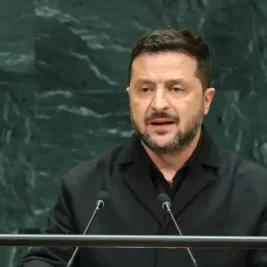
Ukrainian President Volodymyr Zelenskyy defended his decision to dismiss Defence Minister Mykhailo Fedorov during a press conference in Kyiv on Thursday, confirming a complete breakdown in relations between the defense ministry and the country's top military commanders.
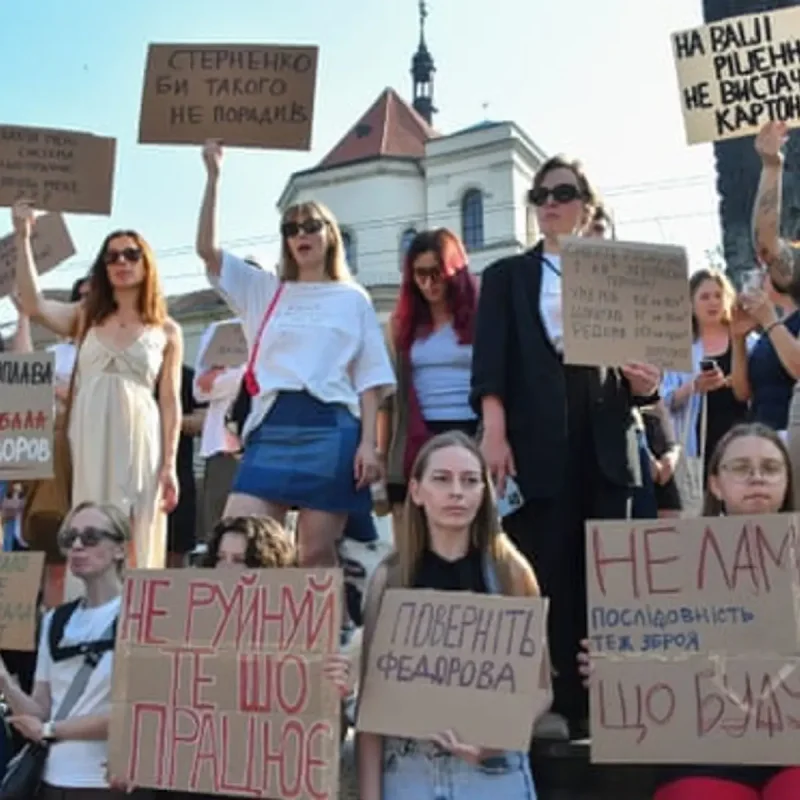
The removal of the popular Fedorov has sparked widespread public backlash, with over 1,000 protesters gathering outside the presidential office in Kyiv on Thursday to demand his reinstatement and the removal of the military's commander-in-chief.
Speaking alongside visiting British Prime Minister Keir Starmer, Zelenskyy acknowledged that personal friction between Fedorov and Col. Gen.
Oleksandr Syrskyi had paralyzed communication, forcing him to choose between civilian leadership and the active military high command.
"I would very much like to see unity. The sides have not found it.
And the problem lies not only with the sides, but with me as well," said Zelenskyy.
Zelenskyy explained that despite his hopes for cooperation, the deep divisions left him with no choice but to support one side to preserve operational stability.
"But things are as they are. And in such a situation, you have a choice: either one side or the other," said Zelenskyy.
New Acting Minister Appointed
To fill the vacancy, Zelenskyy appointed Yevhenii Khmara, the acting head of Ukraine's security service, as acting defense minister and formally requested parliamentary confirmation for his permanent appointment.
The domestic political shakeup coincided with the final official visit of British Prime Minister Keir Starmer to Kyiv before his scheduled departure from Downing Street, during which the leaders discussed military cooperation and bilateral ties.
During their joint appearance, Starmer reaffirmed the long-term commitment of the United Kingdom to supporting Ukraine against the ongoing Russian invasion.
"The support of the United Kingdom for this course will never change," said Starmer.
Starmer emphasized that British public and political solidarity remains deeply embedded within the nation's institutions and communities.
"It is in our bones.
The flags are flying in churches and town halls across the country, as they have throughout the duration of this conflict.
Your fight is our fight," said Starmer.
Meanwhile, the dismissed defense minister held his own press conference to outline the deep-seated institutional conflicts that led to his removal on Wednesday.
Fedorov accused the military general staff of actively resisting critical modernizations and digital reforms in favor of outdated operational structures.
"It's impossible to develop the system on this basis," said Fedorov.
Fedorov asserted that military decisions regarding resource allocation and brigade support were heavily influenced by personal loyalties rather than data-driven evaluations.
"This sort of culture needs to be eradicated, because otherwise we won't be able to defeat an enemy whose system is plagued by the very same issues," said Fedorov.
He emphasized that adopting modern, transparent systems remains the only viable path for Ukraine to successfully counter Russian forces.
"We have no other choice if we want to defeat Russia asymmetrically, with minimal losses," said Fedorov.
Fedorov added that he had formally declined an offer from Zelenskyy to remain in the administration as a government adviser, while parliament prepared to vote on a broader cabinet reshuffle, including a replacement for resigned Prime Minister Yulia Svyrydenko.
Civil society leaders and local demonstrators expressed concern that Fedorov's removal was politically motivated due to his growing popularity, comparing his dismissal to the prior removal of Gen.
Valerii Zaluzhnyi.
"Syrskyi is an old-fashioned general. Some of the people around him are allegedly corrupt and have their own drone projects.
The problem is that Zelenskyy opposes anybody who shows political ambition," said protester Andrii Dligach.
Dligach expressed frustration over what he characterized as a highly centralized and archaic decision-making process surrounding the presidency.
"Only a few people can influence the president's thinking. Most are against Fedorov.
They prefer an old-fashioned management style, similar to the one in Russia, with a tsar," said Dligach.
The Ukrainian parliament is expected to vote on the nomination of Yevhenii Khmara and other key cabinet positions in the coming days.