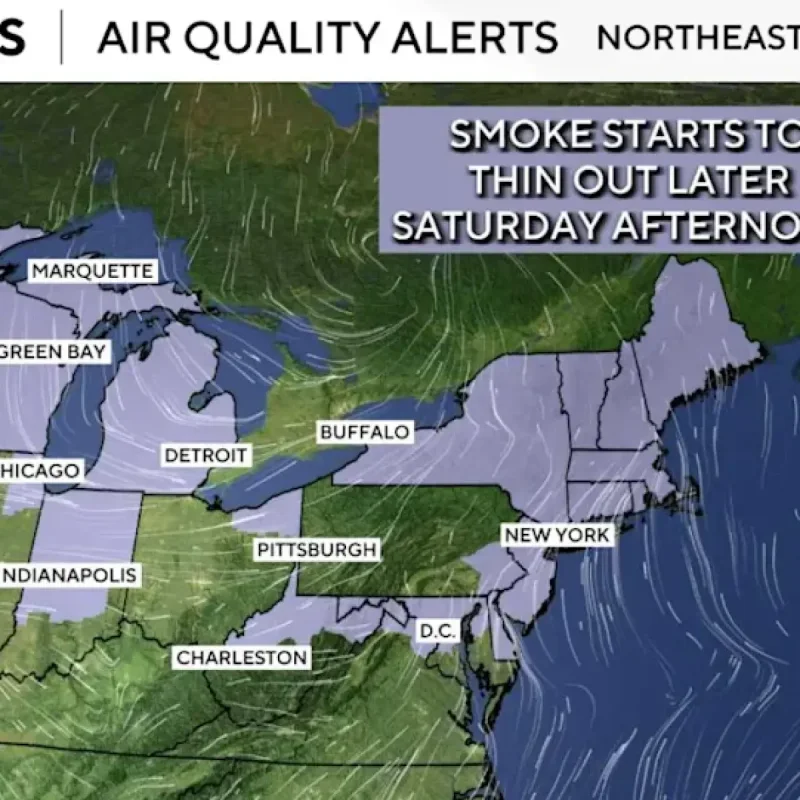
Thick smoke from ongoing wildfires in Canada and northern Minnesota has degraded air quality across the U. S.
Midwest and Northeast this week, exposing millions to dangerous pollution levels.
Chicago and Minneapolis were ranked among the most polluted major cities globally on Sunday morning, according to Yahoo News.
While a cold front and storms cleared the air in the Northeast on Saturday, hazardous smoke persisted in parts of the Great Lakes region.
Multiple local governments issued health warnings due to high levels of fine particulate matter, which pose severe risks to children, older adults, and those with respiratory or cardiovascular diseases.
Minnesota officials extended an air quality alert through the weekend, noting that pollution in the northeastern corner of the state reached unsafe levels for all residents.
Similar alerts were active in Wisconsin and Michigan earlier in the week.
The air pollution also impacted major events.
In New Jersey, officials monitored air quality ahead of the World Cup final between Spain and Argentina on Sunday.
“There's been discussion about it, and we have somebody with the National Weather Service that sits in FIFA headquarters there, so we're monitoring closely,” said Andrew Giuliani, White House World Cup task force executive director.
In Massachusetts, the heavy plume changed the sky color over New England from milky white to a brown-yellow hue, reported CBS News Boston.
“It almost felt like you were at a campsite with an active fire going,” said James Venezia, a resident of West Roxbury.
Meteorologists advised residents in impacted regions to stay indoors to protect themselves from the combined effects of smoke and high temperatures.
“Those two things coinciding with each other is not good from a health perspective,” said Tyler Hasenstein, a meteorologist with the National Weather Service in Chanhassen, Minnesota.
Medical professionals warned that long-term exposure to fine particle pollution is a primary cause of premature death and can cause immediate symptoms like coughing, dizziness, and fatigue.
“If we keep being exposed to this level of air pollution over time, that increases our risks down the road for developing chronic health conditions,” said Dr. Alexander Azan, an assistant professor of population health and medicine at NYU Langone Health.
Azan noted that a study published earlier this year linked chronic wildfire air pollution to tens of thousands of annual deaths in the United States.
“Whether you're somebody who's working outdoors [or] you have an errand that you just can't not do today or tomorrow, the best way to keep yourself safe is buying an N95 or KN95-grade mask,” Azan said.
Climate experts attributed the severity of the blazes to extreme drought conditions and rising temperatures fueled by the burning of fossil fuels.
The Canadian National Railway temporarily suspended operations near Armstrong, Ontario, after a freight train was trapped by a wall of burning trees earlier in the week.
“This could potentially overtake us here, this has gotten a little scary,” said a crew member in a video captured during the incident.
The railway company confirmed that all crew members survived safely before the lines were closed.
On Friday, President Donald Trump threatened to impose new tariffs on Canada, criticizing the neighboring nation for its handling of the out-of-control forest fires.
Canadian Minister of Emergency Management Eleanor Olszewski stated that Canada is working with urgency alongside provincial and territorial partners, adding that the country has dedicated billions of dollars to forest fire prevention in recent years.