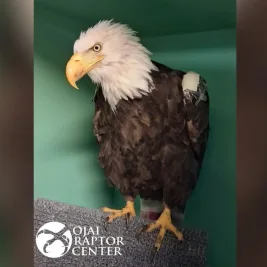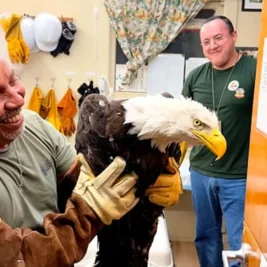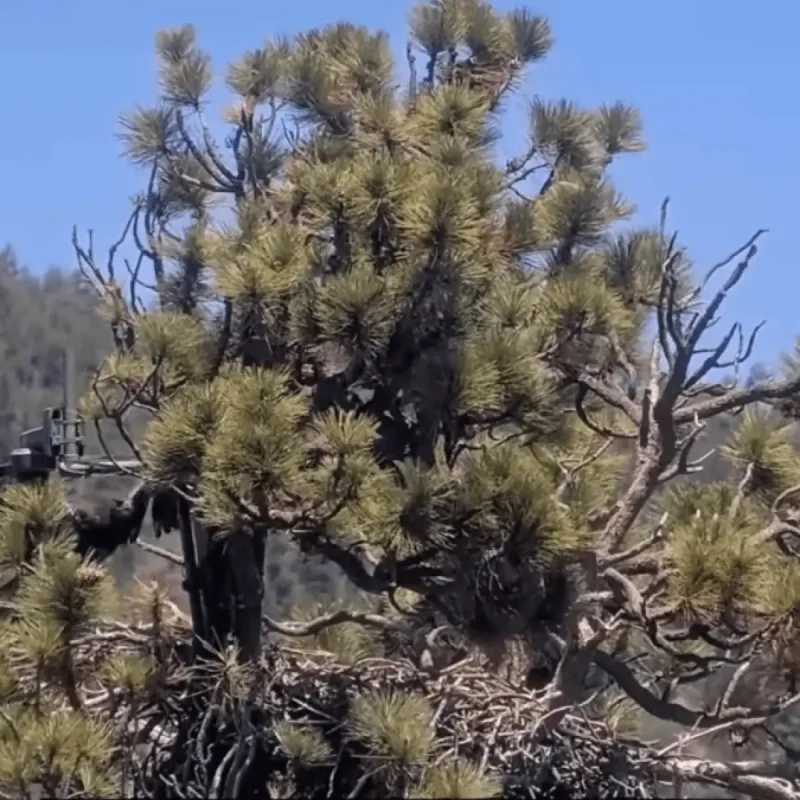
Jackie, the well-known Big Bear bald eagle, has undergone a blood transfusion and CT scan at the Ojai Raptor Center as medical teams work to determine the cause of her severe anemia.
Veterinary specialists confirmed that testing ruled out lead toxicosis, cancer, and foreign objects such as metallic fishing hooks.
Blood for the critical transfusion was provided by Spirit, a resident bald eagle from the California Living Museum in Bakersfield.
While Jackie is eating well, perching, and showing improved kidney inflammation, wildlife officials emphasize that her condition remains critical.
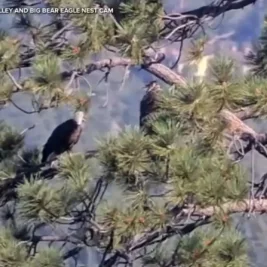
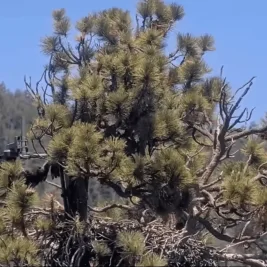
Friends of Big Bear Valley reported that her mate, Shadow, continues to protect their nest and care for young eagles Sandy and Luna.
"Her condition remains critical at this time, and this is not a straightforward case, so we are consulting with several specialists," said Eliza Cameron of the Ojai Raptor Center.
"A treatment plan is being developed to ensure we're covering all bases while we work to determine the cause of anemia," Cameron added.
The incident occurred after Jackie was attacked by subadult eagles. Falconer Adam Baz noted that territorial conflicts are common among wild raptors.
"A lot of times these birds fight to establish dominance or territory or sometimes take over a territory or a mate," said Baz.
"I think Jackie and Shadow are important in it of themselves, but also, they're kind of ambassadors for all eagles, and in many ways, all wild animals," Baz said.
Researchers state that while Shadow is expected to maintain his current territory through the fall, displacement or mate replacement remains a reality in wild eagle populations.
"When that happens, they typically replace that partner. How quickly it happens tends to depend on the population density.
As soon as a space opens up, somebody's going to come in and grab that space because they don't have many opportunities to get those spaces," said Dr. Todd Katzner, a research wildlife biologist with the U.
S. Geological Survey.
"She could go off and find a new territory and find a new mate and start all over again.
These birds are really resilient," Katzner said.
"She was taken in for a CT scan; there are no obvious signs of cancer or any metals in her body," said the organization Friends of Big Bear Valley.
"While we are encouraged by the dedication and collaboration surrounding this case, it is still too early to predict the outcome," said the Ojai Raptor Center in an official update.
"We know many of you are hoping for more answers, and so are we. Wildlife medicine often requires patience, and some answers simply take time," the center added.
Veterinary teams expect to release another medical update regarding Jackie's status on Monday.