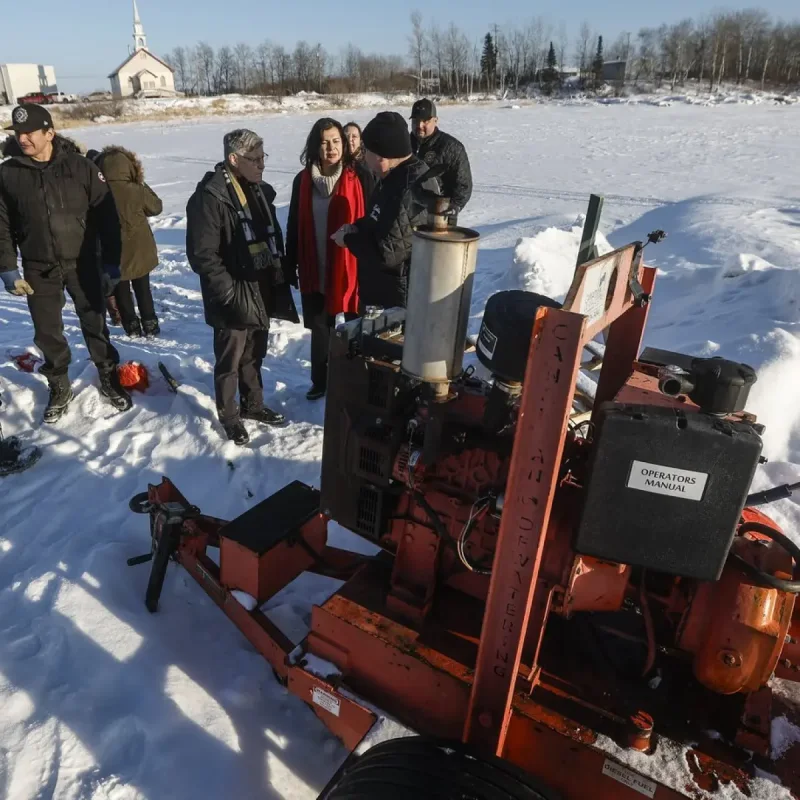
Pimicikamak Cree Nation has filed a proposed class-action lawsuit against Manitoba Hydro, the province of Manitoba, and the federal government over a catastrophic winter power outage that began on December 28, 2025.
The outage lasted approximately 110 hours, until January 2, 2026, forcing more than 4,000 of the northern community's 8,000 residents to evacuate as temperatures plunged.
Sub-zero conditions caused severe infrastructure damage, including frozen water systems, sewer backups, burst pipes, and widespread mold contamination.
The lawsuit states that 180 homes were left uninhabitable, 35 were ruined beyond repair, and the local water treatment plant was rendered inoperable.
More than six months after power was restored, roughly 650 displaced community members remain in hotels across Thompson, Brandon, and Winnipeg, awaiting home repairs or replacements.
Allegations of Negligence and Ignored Warnings
The lawsuit accuses the utility and government defendants of negligence and breach of fiduciary duty, claiming they ignored repeated warnings between 2018 and 2025 about the vulnerability of the sole power line serving the remote reserve from the Jenpeg generating station.
Pimicikamak leaders had repeatedly requested system redundancies, including backup generators and a secondary transmission line along accessible highways, to prevent winter supply failures.
The statement of claim also alleges that human errors by Manitoba Hydro delayed service restoration, such as dispatching repair crews to incorrect map locations and improperly re-energizing electrical grid segments during the crisis.
Chief David Monias said during a news conference that the emergency severely impacted the community long after electricity returned.
“The harm continued long after the lights came back on,” he said, detailing the physical and emotional toll on displaced families.
Monias noted that residents fled quickly under perilous conditions without knowing when they could return.
“Families left quickly, often with only essential belongings and no clear idea of when they could return,” he said.
He also described the physical devastation inside empty structures. “Some homes needed major repairs, some needed replacements.
Some were damaged so badly that demolition was required,” Monias said.
Monias criticized the province and Ottawa for failing to provide adequate disaster relief and accountability. “They're washing their hands, saying they're not responsible,” he said regarding government responses.
He stressed that both levels of government and the Crown corporation placed the First Nation in grave danger.
“It is both governments and Manitoba Hydro who put the citizens of the Cross Lake Band of Indians in the precarious position to be left without power in the dead of winter,” Monias said.
Monias asserted that officials were fully aware of the risks posed by single-line dependency in harsh winter climates.
“They knew, or ought to have known, that it was just a matter of time before a system failure would endanger the lives of citizens in our community,” he said.
Historical Outages and Response Failures
Pimicikamak Councilor Shirley Robinson highlighted historical outage records and geographical vulnerabilities.
She said the community was left depending on one old and vulnerable power line, even though the danger was known and backup power was repeatedly requested.
Robinson noted that Manitoba Hydro acknowledged nine separate power outages in 2018 alone, including five within a single month.
She also contested earlier claims by Manitoba Hydro attributing the conductor failure to shotgun pellet damage, pointing out that equipment analysis indicated internal electrical failure instead.
Councilor David Muswaggon criticized Manitoba Hydro's emergency management, noting that operational missteps exacerbated the crisis.
“In our lawsuit, we allege that Hydro first found the [line] break, but then pointed crews to the wrong location on a map,” Muswaggon said in a statement read at the press conference.
He stressed that poor logistical coordination prolonged the community's exposure to freezing temperatures.
“Crews were sent to the wrong location, backup power was late, and the restoration itself was mishandled,” Muswaggon said.
He concluded that official negligence transformed a technical defect into a human emergency. “This was not only a broken line.
The lack of planning and mistakes during the response made a serious emergency even worse,” Muswaggon said.
Legal counsel representing the First Nation emphasized that the failure was the product of long-standing systemic neglect.
“The warning signs were there for many years,” said Jeremy McKay, a lawyer representing the First Nation.
Lawyer Brian Meronek stated during the briefing that while the statement of claim does not list a specific financial figure, monetary damages sought will reach multiple millions of dollars.
The lawsuit requests a mandatory injunction forcing Manitoba Hydro to construct and fund a secondary power line, while compelling Ottawa to fund a new water treatment facility for the First Nation.
Manitoba Hydro spokesperson Peter Chura stated that the Crown corporation plans to defend itself vigorously in court, maintaining that power loss is an inherent operational risk.
Spokespersons for the Manitoba provincial government and the federal Justice Department declined to comment on the specific allegations, citing ongoing court proceedings.