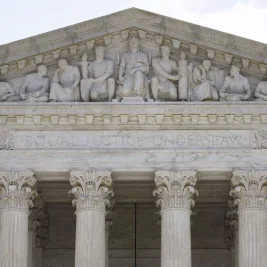
The US Supreme Court upheld state restrictions on transgender students' sports participation on Tuesday, delivering a major victory to conservative women activists who rallied outside the courthouse.
The decision directly impacts state laws across the country regarding the participation of transgender athletes in female sports categories.
It aligns with broader Republican legislative efforts targeting transgender youth rights.
Activists celebrated the legal outcome on the steps of the courthouse, displaying signs advocating for biological definitions of sex in sports.
The demonstration highlighted a decade of conservative legal mobilization.
"The court agrees with us that a man cannot be a woman," said Penny Young Nance, CEO of Concerned Women for America.
Nance emphasized the national reach of the ruling and its implications for future advocacy frameworks regarding female student-athletes.
"The decision will affect the law across the country," she said. "We will have a better opportunity to protect young women."
Sociologists Kelsy Burke and Katie Gaddini noted that Generation Z conservative women are increasingly shaping the core operations of the political right.
This contrasts with common media focus on young men.
These young women effectively countered legal challenges to state bans, such as Idaho's 2020 law. They framed themselves as defenders of historical civil rights legislation.
"This rule is not only unfair but ridiculous because men like to play sports far more than women do," stated Phyllis Schlafly, a 1970s antifeminist activist who originally opposed Title IX.
Modern conservative female organizers have shifted away from older rhetoric, adopting contemporary empowerment vocabulary to appeal to broader audiences while receiving training from well-funded advocacy networks.
"If identifying as feminist is you believe that men and women are different but still should be equal in law, to that I say of course," said Caitlyn, an activist on her South Carolina college campus.
Many younger activists within the movement initially focused on anti-abortion campaigns before redirecting their organizational efforts toward transgender sports restrictions following judicial changes in 2022.
"This is a direct threat for women in sports," said Olivia, a 24-year-old rightwing lobby organization worker in California.
Olivia argued that permitting transgender women to compete on female teams reversed historical progress made under federal civil rights laws.
"It is taking a step back in history by allowing men into our sports," she added.