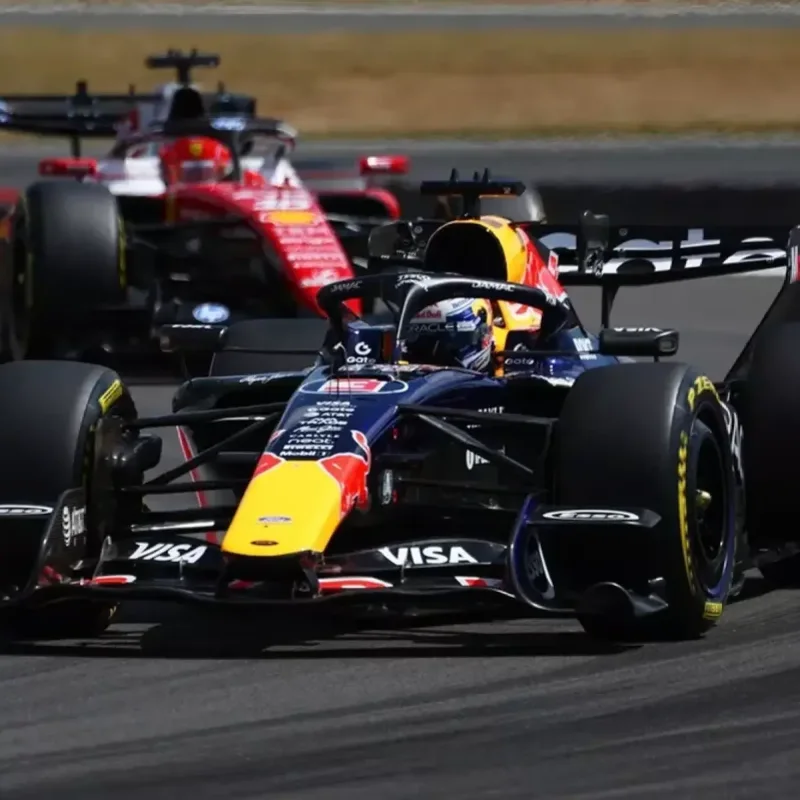
The FIA has launched an inquiry into the rotating rear wings used by Red Bull Racing and Ferrari following Max Verstappen's high-speed crash at the British Grand Prix on July 5, 2026, as reported by motorsport.
com.
Verstappen spun into the gravel trap at Stowe corner four laps before the end of the race due to a mechanical failure where his rear wing failed to reattach properly at the end of a Straight Mode zone.
The incident marked the second consecutive rear wing failure for the four-time World Champion, following a major crash during Q3 qualifying at the Austrian Grand Prix a week prior.
The governing body contacted both teams to ensure full compliance with safety requirements, including the mandatory maximum transition closing time of 400 milliseconds, though the regulation does not guarantee immediate airflow reattachment.
Red Bull Team Principal Acknowledges Driver Frustration
Red Bull Team Principal Laurent Mekies acknowledged Verstappen's frustration regarding the recurring aerodynamic issues on the RB22 car.
“Look, he's right not to be happy,” said Mekies.
Mekies noted that while the team understood the component failure at the Red Bull Ring, a separate issue caused the accident at Silverstone.
“It is very unpleasant for drivers to be let down by the car in high-speed corners in two consecutive races, let it be for two different reasons,” said Mekies.
“And it is, in a much lower scale, also extremely unpleasant for us as a group to send our drivers to the gravel trap.”
The team principal emphasized that the squad would thoroughly evaluate the aerodynamic assembly before the upcoming race at Spa-Francorchamps.
“So he's right to be unhappy,” said Mekies.
“I have no doubt that, as a team, we will put in place what is necessary for that not to happen again, even if we failed to do that today.”
The team chose to maintain Verstappen's seventh-place grid spot rather than changing the car setup and starting from the pit lane.
“And we take that as seriously as one can do, and therefore the minimum that Max can feel today is being unhappy,” said Mekies.
Verstappen expressed his immediate concerns over team radio and reiterated the danger of the aerodynamic malfunction after retiring from third place.
“When the rear wing doesn’t close fully, you lose a lot of downforce and you spin off the track,” said Verstappen.
The technical malfunction has triggered widespread paddock speculation regarding Verstappen's contract exit clauses and future team placement.
“So, yeah,” said Verstappen. “One time, okay, but two times… This is becoming dangerous for myself.
And obviously, I don’t want that.”
Former Haas Boss Doubts Verstappen Exit
Former Haas team principal Guenther Steiner doubted that Verstappen would switch teams, citing current driver contracts at Mercedes, McLaren, and Ferrari.
“I think his bigger problem at this moment lies with Red Bull, because of what happened in the last two races,” said Steiner.
Steiner stated that the driver might regret not negotiating an alternative move earlier in the 2025 season.
“Of course he doesn't like the regulations, we don't have to repeat that again,” said Steiner. “He is not happy with the engine rules and things like that.”
He suggested that Formula 1 officials could have adjusted technical parameters at Silverstone to diminish the visible power fluctuations.
“They could have been a bit more drastic at Silverstone by lowering the power a bit further,” said Steiner.
Steiner concluded that top-tier alternative seats remain unavailable unless Verstappen accepts a lower salary.
“Then you would have had that yo-yo effect less,” said Steiner. “It was visible, but not very bad.
Was it beautiful? Not really.
But was it bad? Not really either.”
He questioned why competitive teams would disrupt their current stable lineups or incur excessive financial costs.
“Where is he going?” asked Steiner.
“If he doesn't like Red Bull anymore, then I don't think there are many places.
There are places where he can go, but they don't have the money to pay him and not the car that he wants.”
Steiner emphasized that Mercedes already possesses a strong prospective lineup with George Russell and Kimi Antonelli.
“Why would Mercedes take him?” asked Steiner.
He noted that introducing a high-profile driver could destabilize the team dynamics and championship leader Antonelli.
“Mercedes has the next superstar and a very good driver in George,” said Steiner. “Why would you spend more money to bring Max in?”
Steiner reiterated that alternative options at McLaren and Ferrari are completely blocked for the upcoming season.
“The only way Max would come, is if George leaves,” said Steiner. “But Max costs much more than George and could perhaps unbalance Kimi.
Why would you do that? Toto is in my opinion too smart to do that.
It costs much more. And no matter how much money they have, they also like to keep that for themselves.”
He concluded that Verstappen missed his optimal window to depart Milton Keynes during recent market movements.
“McLaren is in my opinion pretty good with Lando and Oscar,” said Steiner.
According to Steiner, Verstappen must now focus on internal team motivation rather than seeking an exit.
“And we all know how Ferrari stands, at least for next year,” said Steiner.
Steiner affirmed that the driver retains significant goodwill within the garage despite his aggressive radio communications.
“Even then I don't just think there is someone who takes him, because they all have running contracts,” said Steiner.
“They must then first get rid of one of their current drivers.”
He stated that a wage reduction is the only hypothetical path to an external seat.
“If Max really wants to do that, then it is worth the try,” said Steiner. “He would have a chance, I'm not saying he wouldn't have a chance.
But otherwise I think it will be difficult.”
Steiner remains convinced that the reigning champion will ultimately stay at his current team.
“Absolutely, I'm sure he regrets that,” said Steiner.
He referenced the period when Mercedes was actively finalizing its long-term driver arrangements.
“At that time, when Mercedes was negotiating with George, Max could probably have been the alternative,” said Steiner.
Steiner stated that waiting for the upcoming regulatory cycle left the driver with limited immediate flexibility.
“I think Max was not sure what would happen in the future,” said Steiner. “Then it slipped away.
The chance was there then and there. He was convinced to stay where he sat and waited for the new regulations.
Now it seems too late. Not a little bit too late, but just too late.”
He emphasized that the underlying performance of the Red Bull car remains competitive when the wing functions properly.
“He stays,” said Steiner. “That is my opinion.
He stays.”
Steiner noted that the team members understand the driver's emotional outbursts during high-pressure race weekends.
“What he must do, is try to motivate his people so that they give him the car he needs,” said Steiner.
“The car hadn't been bad if it hadn't gone wrong with the rear wing. Performance-wise it was good.
He wanted a new engine, but the car seemed on its way to a podium.”
The engineering analysis by technical expert Gary Anderson in The Race indicated that the fundamental issue stems from the transient aerodynamic window rather than the mechanical flip-over concept itself.
“At Red Bull everyone knows Max,” said Steiner. “They know he has those outbursts and then comes back wanting to win races.
He has won a lot for them. The people close to him know why he is like that.
He is disappointed because he isn't winning.”
Ferrari and Red Bull remain the only teams to field the rotating design since its Miami introduction, while McLaren has delayed its scheduled on-track debut until the Belgian Grand Prix.