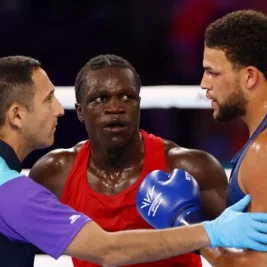
Sky Sports has released a new documentary titled The Final Round, which explores the mental health struggles, financial turmoil, and identity crises that professional boxers encounter after retiring from the sport.
The film features extensive interviews with former world champions, trainers, and promoters, weaving together themes of sacrifice, addiction, and ego.
Promoter Steve Wood highlights the stark financial reality, noting that ninety percent of the fighters he manages do not earn enough money to pay tax.
Former world champion Ricky Hatton reflected on the internal battles boxers face when considering retirement.
"Many boxers tell themselves, 'I've got one more good fight in me,'" Hatton said. "Nine times out of 10, you haven't.
That was the case with me."
Former world champion Johnny Nelson emphasized that a fighter's psychological drive persists long after physical abilities decline.
"Ego never leaves a fighter, and that's the problem," Nelson said.
Heavyweight veteran Dave Allen addressed the profound loss of personal identity that accompanies stepping away from competition.
"Apart from 'Dad', I'm just a boxer. I'm not even David, the normal human being," Allen said.
Former world champion Josh Warrington described the unique sensory high of fight days.
"I wake up on fight day and it's like everything's brighter, everything smells better, I'm more alert... that's an unreal feeling," Warrington said.
He underscored the difficulty of adjusting to life after boxing.
"Once that stops, you'll never feel it again," Warrington said.
Nelson elaborated on the severe post-career financial strain faced by former household names.
"The amount of household names I could tell you that are absolutely on their ass, they've got nothing, and that financial pressure on top of the other effects of boxing has accumulated over the years.
How can your mental health be stable? How can it be?"
Nelson said.
He described the isolation inherent in a fighter's daily existence during and after their career.
"That animalistic instinct we have, there's nothing you can adapt it to in everyday life - not an office or anything like that, because it's barbaric," Nelson said.
He detailed the personal disconnection fighters feel from those closest to them.
"It's a very lonely existence. Your wife, brother, mother, sister don't get it.
The aches and pains are lonely, the thought processes are lonely," Nelson said.
Nelson explained the progression from passion to financial necessity that dominates a boxer's career choices.
"You do it first for the love of it, then money comes into it, then ups and downs, so we still do it - but resentfully.
You've not got time to have a full-time job, so [you may think]: 'People see me on a dizzy high, and then I've got to go and work on a building site.
God, I've got to deal with the shame of that,'" Nelson said.
He concluded by noting the painful shift in public perception after retirement.
"You're resentful of how human nature can change: when you retire, people no longer look up to you as an amazing fighter.
'He's overweight, he's not who he was.'
They talk to you like they talk to anybody, whereas when you're a fighter, they talk to you with respect," Nelson said.
Reflecting on his early perception of his career prospects, Nelson shared his educational background.
"I thought boxing was the only option I had," Nelson said.
He acknowledged his early academic struggles while reflecting on his journey to becoming a respected sports pundit.
"I left school with the reading and writing ability of a 10-year-old. I wasn't thick - I just wasn't academically astute - but I thought I was.
I'd got nothing on paper to say, 'Johnny is really good with people,' so that wisdom doesn't get you a job," Nelson said.
To address structural financial issues, Nelson is currently working with parliamentarians, financial institutions, and boxing authorities to establish a mandatory pension scheme paying two thousand pounds annually to active fighters.