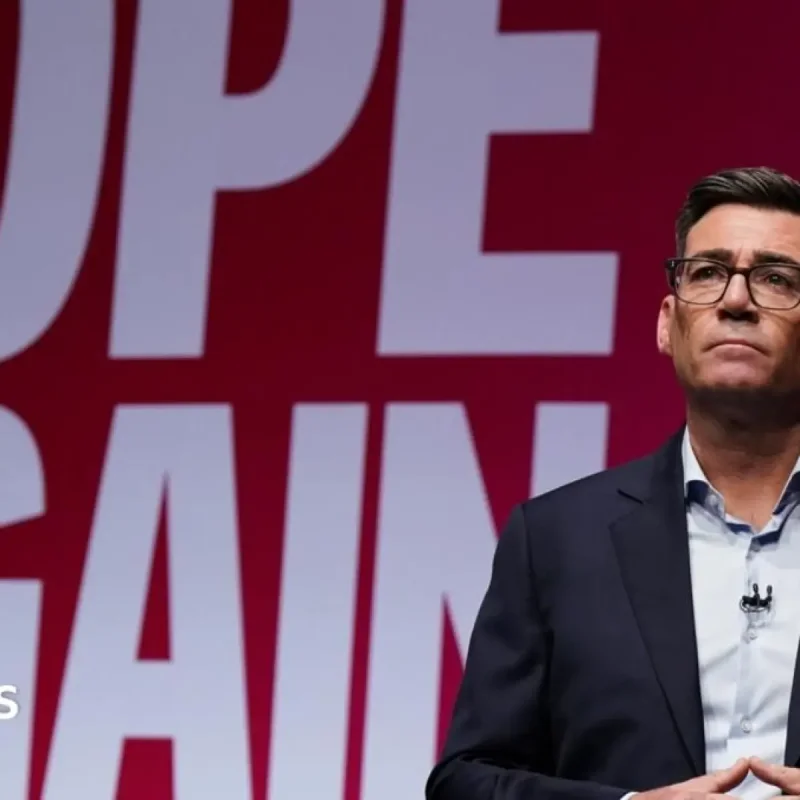
Prime Minister Andy Burnham has set out plans to change the pension triple lock from April 2030 in order to finance a new National Care Service.
He announced the proposal at the Labour Party conference in Liverpool on Tuesday, September 29, 2026.
Under the plan, the existing triple lock would stay in place for the rest of the current parliament.
After that, the state pension would rise by at least inflation or 2.5 percent each year.
Officials estimate the adjustment would save 15 billion pounds per year by the late 2030s.
Savings could reach up to 50 billion pounds annually by 2050, covering care costs without borrowing.
Burnham Pledges Record Pension and Tax Relief
Addressing delegates, Burnham said he would protect current retirement benefits while building long-term funding for social care.
"We promised in our manifesto to keep the triple lock unchanged throughout this parliament. I will honour that promise, and I'll do more.
That promise will take the state pension to a record high," he said.
He added that low-income retirees would avoid income tax obligations for the remainder of his term.
"This change will generate significant savings, which we will use to build up our national care service," Burnham said.
Reflecting on past political failures on adult care, he apologised directly to care sector personnel.
He vowed to reform the sector using guidance from Louise Casey's social care review.
"So this is the deal: a state pension that rises every year, no care charges, and a high-quality national care service to give peace of mind in later life," he said.
"Conference, I am going to go out and argue for that-a good deal for our pensioners and for older people in the 21st century."
"What an indictment of my generation of politicians, myself included, too cowardly to fix something as basic as the care we give to each other," Burnham said.
"You are not invisible to me. I see you.
I thank you, and I am sorry that my profession has let down yours for so long."
IFS and Union Pushback on Funding Gaps
Financial experts and union representatives raised concerns about the economic and political implications of the restructuring.
The Institute for Fiscal Studies cautioned that moving away from the triple lock would generate insufficient funds in the early 2030s.
That would leave the government reliant on spending cuts or broad tax increases, the IFS said.
IFS Deputy Director Jonathan Cribb noted that income tax or National Insurance hikes would hit younger Londoners disproportionately.
He cited the capital's younger demographic profile and a lower old-age dependency ratio of 162 pensioners per 1,000 working-age individuals, compared to 353 per 1,000 in the South West.
"If they scrap or move away from the Triple Lock, that's not enough to fund big entitlement to social care in the next few years, in the early 2030s," Cribb said.
"Therefore, they would need other spending cuts, or tax rises."
"If they do tax rises, that's likely to affect Londoners more than the rest of the country," he said.
"If they do broad tax rises through income tax or National Insurance, or an equivalent to National Insurance, some kind of social care levy, that is likely to affect younger and middle-aged people more because they work more and they earn more."
Unite general secretary Sharon Graham voiced sharp opposition to modifying the pension guarantees.
"Going to a group of people who are getting around £12,500 a year, in order to pay for it, to take their security from them, is wrong.
I think it's morally wrong," she said.
"We need to look at other ways.
And I can't understand why we keep going to the well of the poorest in society as a Labour government… if that were to be the case, why are we doing that instead of taxing the rich in our society?"
Beyond social care funding, Burnham signalled plans to advance electoral reform by evaluating proportional representation options for Westminster elections.
Democratic reform groups welcomed the potential shift away from the first-past-the-post voting model.
"Every vote should count, and in our fragmented political landscape, proportional representation is the tool we need to become a fully functioning liberal democracy – with just the UK and Belarus currently clinging to first past the post among European countries," said Cary Mitchell, Executive Director of Strategy at Best for Britain.
"Labour has long championed equality, and now finally backs democratic equality too.
It was a Labour government that introduced PR for voting in the devolved nations and it's right that they introduce it for Westminster elections too.
Equal votes for the whole of the UK can't come soon enough."